Where do you start in dealing with a narcissistic person?
Start by understanding what is happening to you, before thinking about changing the other person: which behavior hurts you, when it recurs, and what you need in order to feel safe and respected.
The skills are the same whether the person has been diagnosed with narcissistic personality disorder or simply has narcissistic traits. That is why we do not advise trying to diagnose a partner or relative, or confronting them with the word “narcissist,” because it usually fuels the conflict and changes nothing.
How do you set healthy boundaries with a narcissistic person?
A healthy boundary is what you will do, not what you ask the other person to do. Instead of “Don't shout at me,” the boundary is: “If voices get raised, I will end the conversation and continue it later.” The strength of a boundary lies in carrying it out calmly every time, not in explaining it at length.
- Identify one clear behavior that hurts you, such as being insulted in front of the children or mocked about your work.
- Phrase the boundary in a short sentence that starts with “I” or “I will.”
- Tell them at a calm moment, not in the middle of a disagreement.
- Follow through calmly every time the behavior recurs, without threats or extra punishment.
- Expect the boundary to be tested at first with anger, blame or appeals for pity, and hold to it.
It may feel hard at first, especially if you are used to appeasing to avoid anger, and you may feel guilty. This feeling is natural and does not mean you are in the wrong.
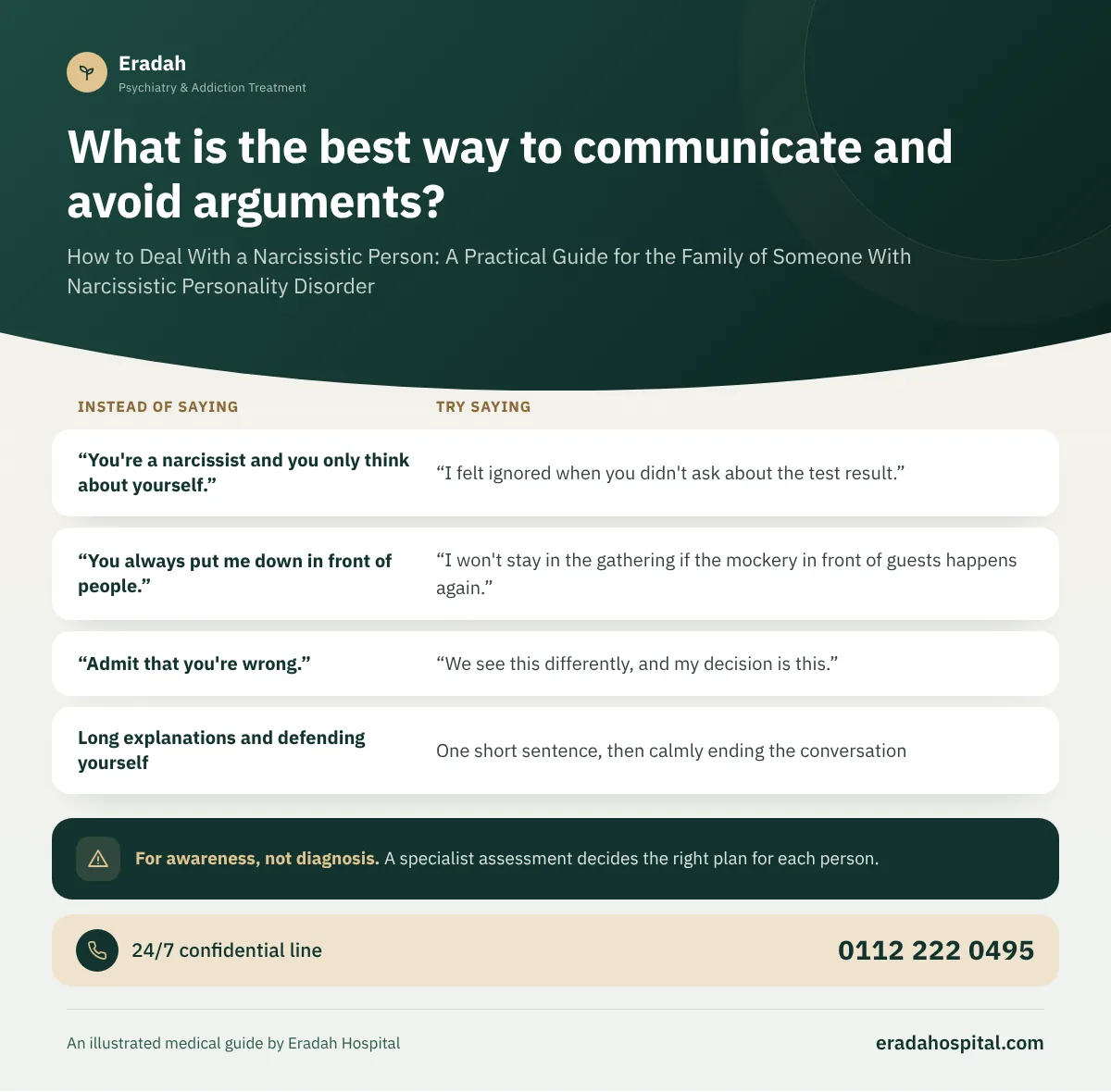
What is the best way to communicate and avoid arguments?
| Instead of saying | Try saying |
|---|---|
| “You're a narcissist and you only think about yourself.” | “I felt ignored when you didn't ask about the test result.” |
| “You always put me down in front of people.” | “I won't stay in the gathering if the mockery in front of guests happens again.” |
| “Admit that you're wrong.” | “We see this differently, and my decision is this.” |
| Long explanations and defending yourself | One short sentence, then calmly ending the conversation |
- Don't enter battles to prove a point: trying to make them admit a mistake drains you and usually does not work.
- Talk about facts, not traits: what happened and when, not a judgment on their personality.
- Use sincere appreciation when it is deserved: acknowledging real effort eases defensiveness, without flattery.
- Choose the timing: avoid important conversations during anger or under the influence of alcohol or drugs.
- Write down important incidents: it protects you from doubting your memory when events are retold differently.
How do you deal with a narcissistic husband or wife?
In marriage, daily life, children and money are intertwined, so dealing with it is more complicated. It helps to have your own space, relationships and friends, and not to rely on your partner alone for your sense of worth. If your partner is willing, couples therapy with an experienced therapist may help, provided there is no violence or threat.
Ask yourself honestly: are there moments of genuine apology and change, or is the pattern getting worse? The answer helps with your decision, without forcing you into a hasty one.
How do you deal with a narcissistic father, mother or brother?
The relationship with parents carries feelings of duty and filial devotion, which makes setting boundaries come with guilt. But devotion does not mean accepting constant insults. You can maintain respect, visits and care, while talking less about topics that spark conflict, limiting the length of visits, and not sharing details that could later be used against you.
How do you deal with a narcissistic manager or colleague?
- Keep important communication in writing and as specific as possible.
- Quietly document your achievements and contributions so they are not credited to someone else.
- Offer feedback as suggestions that serve the goal of the work, not as personal criticism.
- Do not share more of your personal life than necessary.
- If it reaches abuse or harassment, use the official channels at your workplace.
How do you protect children?
Children are the most affected, and what protects them most is a warm, stable relationship with another parent or relative who sees their feelings and believes them:
- Do not make the child a messenger or a party to disputes between adults.
- Validate their feelings when they say they are sad or afraid, and do not ask them to ignore them.
- Praise their effort, not only their achievement, and tell them your love for them is unconditional.
- Do not speak ill of the other parent in front of them, and explain in simple language that the problem is not their fault.
- If the child shows persistent anxiety, sadness or behavior problems, consult a child psychologist.
When is stepping away or asking for help necessary?
Not every relationship with someone who has narcissistic traits has to end, but there are signs that make safety the absolute priority:
In Egypt, you can contact the Child Helpline on 16000 for child protection matters, and the National Council for Women's complaints line on 15115. Consult a lawyer before decisions about separation and custody. This is general awareness information and not legal advice.
Even without violence, if you feel the relationship is draining your mental health and there is no willingness to change despite attempts and treatment, you have the right to reduce contact or step away. This is a difficult decision that deserves calm thought with a professional.
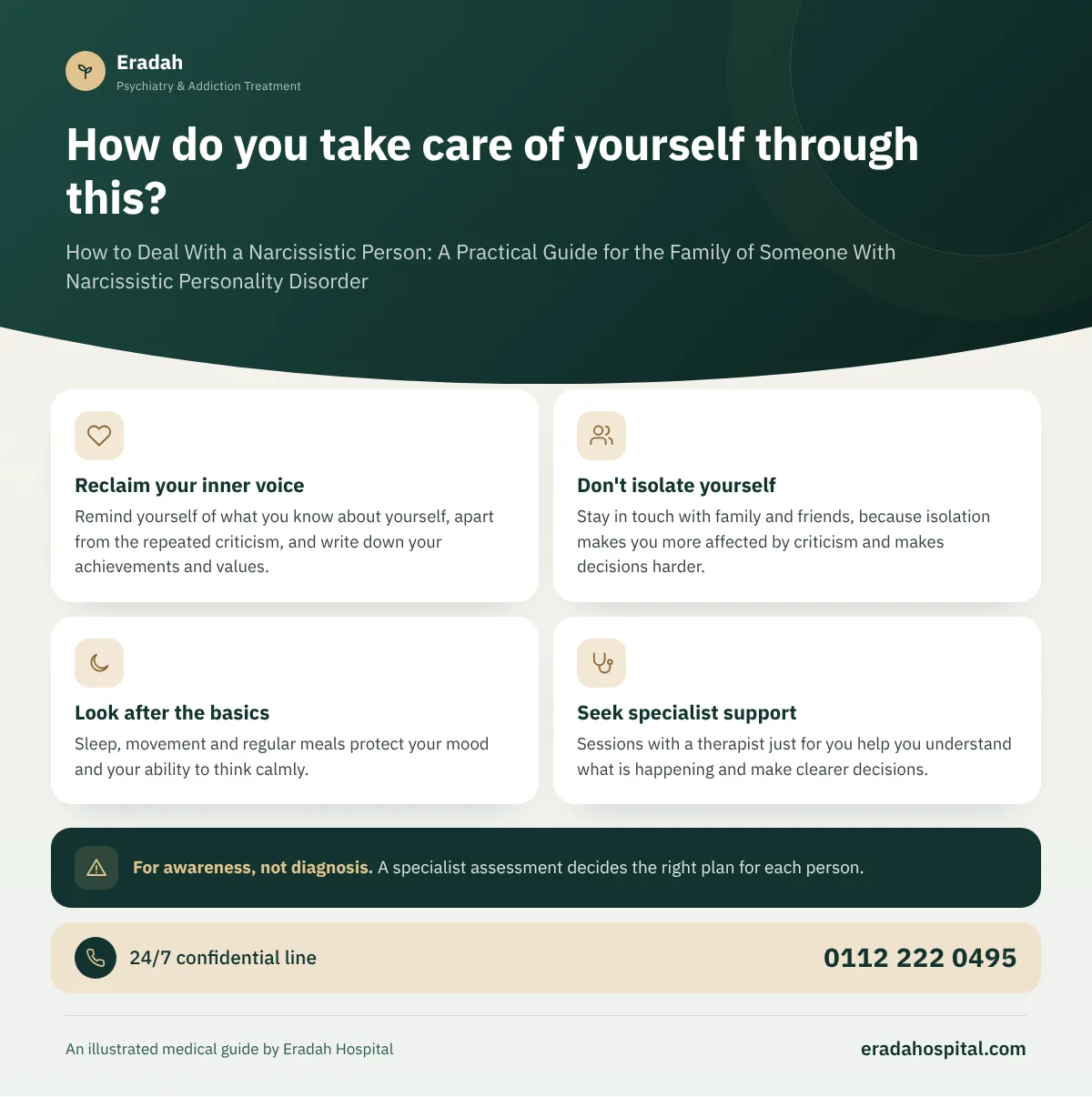
How do you take care of yourself through this?
Remind yourself of what you know about yourself, apart from the repeated criticism, and write down your achievements and values.
Stay in touch with family and friends, because isolation makes you more affected by criticism and makes decisions harder.
Sleep, movement and regular meals protect your mood and your ability to think calmly.
Sessions with a therapist just for you help you understand what is happening and make clearer decisions.
If you notice in yourself symptoms of anxiety, depression or persistent insomnia, or you have started relying on sedatives or alcohol to bear the pressure, this is a sign to seek help for yourself right away. You can also learn about the options for treating the other person on the narcissistic personality disorder treatment page.