What Is Self-Harm?
"I didn't want to die, I wanted the pain inside me to go quiet for a little while." Many people who have been through self-harm say something like this. Understanding this truth is the first step in helping yourself or someone you love, free of shock, anger and blame.
The UK's National Health Service (NHS) defines self-harm as deliberately damaging or injuring your body. The guidelines of the UK's National Institute for Health and Care Excellence (NICE) define it as any intentional self-poisoning or self-injury, regardless of the purpose. It is a behavior often linked to severe emotional distress or to conditions such as depression, borderline personality disorder and post-traumatic stress disorder (PTSD), and it is not a separate illness.
Why Does a Person Self-Harm?
In an analysis of more than 170 datasets covering about 600,000 adolescents from 41 countries, published in the Journal of the American Academy of Child and Adolescent Psychiatry in 2018, the most common reason was relief from painful thoughts or feelings. The NHS adds other reasons:
- Expressing emotional pain the person has no words for.
- Trying to feel in control when life seems out of control.
- Punishing oneself because of guilt or self-hatred.
- Easing emotional distress that seems unbearable.
- Asking for help that the person doesn't know how to ask for in words.
- Responding to intrusive, distressing thoughts.
These feelings often build up from accumulated pressures such as bullying, family conflict, problems at work, school or with money, loss, trauma and low self-esteem. Doctors warn that the relief self-harm gives is short-lived, followed by guilt and shame that add to the distress, so the cycle repeats.
Who Is Most Likely to Self-Harm?
According to a systematic review published in Suicide and Life-Threatening Behavior in 2014, the rate of self-harm without suicidal intent was about 17.2% among adolescents, 13.4% among young adults and 5.5% among adults in non-clinical samples. For many it begins in the teenage years, but it happens at every age and in both men and women. The risk rises with depression, anxiety, and the use of alcohol and drugs, which increase impulsivity and weaken control.
Signs Families May Notice
- Repeated injuries or bruises without a convincing explanation.
- Wearing clothes that cover the whole body even in extreme heat.
- Severe isolation and avoiding talking to others.
- Signs of depression: sadness, crying and loss of interest in everything.
- Talk of being worthless or a burden.
- Talk of ending things or of not wanting to go on.
Is Self-Harm a Suicide Attempt?
Not always. The NHS notes that many people who hurt themselves do not want to end their lives, and describe self-harm as a way to survive intense pain. But it also stresses that there is a clear link between self-harm and suicidal thoughts. A 2018 review found that adolescents who self-harm are several times more likely to attempt suicide, especially when self-harm is repeated. That is why every instance of self-harm is taken seriously, and the person is gently asked about suicidal thoughts; asking does not plant the idea, it opens the door to help.
What to Do When You Feel the Urge to Harm Yourself
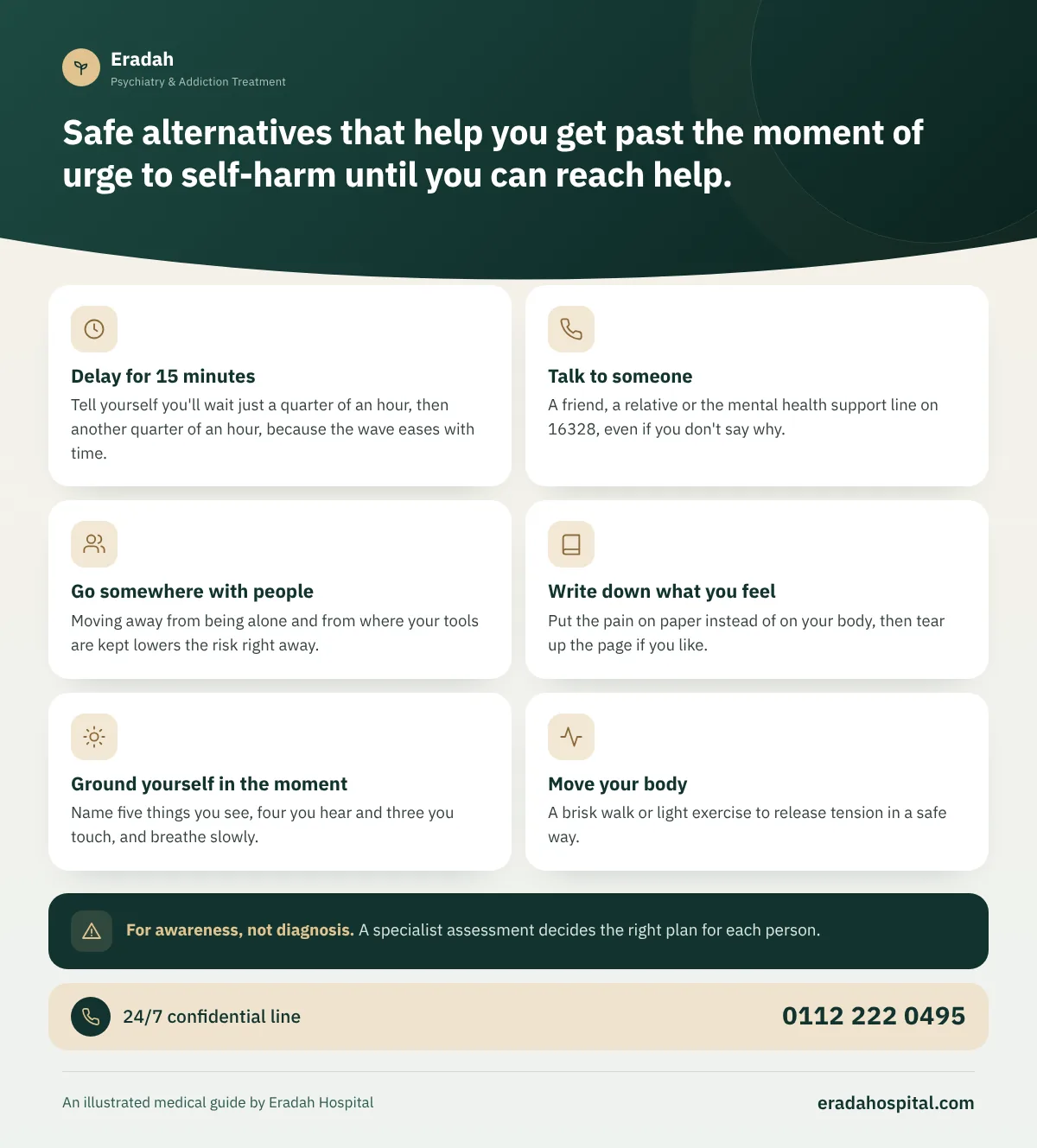
These alternatives don't treat the cause, but they help you ride out the wave until you reach help. Try what suits you:
Tell yourself you'll wait just a quarter of an hour, then another quarter of an hour, because the wave eases with time.
A friend, a relative or the mental health support line on 16328, even if you don't say why.
Moving away from being alone and from where your tools are kept lowers the risk right away.
Put the pain on paper instead of on your body, then tear up the page if you like.
Name five things you see, four you hear and three you touch, and breathe slowly.
A brisk walk or light exercise to release tension in a safe way.
It also helps to write a safety plan in advance with your therapist: your warning signs, what calms you, the names of people to call, emergency numbers, and how to make your environment safer.
How Do You Help Someone Who Is Self-Harming?
- Speak calmly and without shock or anger, and choose a private place.
- Ask about their feelings and what they are going through, not about the details of the self-harm.
- Don't label them as attention-seeking, and don't threaten them or force them to promise to stop.
- Ask how they would like you to support them, and keep them a partner in decisions.
- Encourage them to see a psychiatrist, and offer to go with them.
- Get medical help immediately if there is an injury or danger.
- Look after yourself too, and find support for yourself through the family program.
Treatment for Self-Harm
Treatment begins with a comprehensive psychological assessment that understands the reasons for the self-harm and any accompanying conditions, without judgment. According to the NHS, treatment often includes cognitive behavioral therapy and dialectical behavior therapy, which teaches skills for tolerating distress and regulating emotions. A 2021 Cochrane review found that individual cognitive behavioral therapy may reduce how often adults self-harm. The doctor may prescribe medication for accompanying depression or anxiety; never start or stop any medication without a doctor. If substance use is part of the picture, treating both together as a dual diagnosis is more effective. In high-risk cases, a temporary stay in a psychiatric hospital may be the safest option.
Urge to self-harm or an injury right now? Get help immediately
- An injury that needs medical treatment or won't stop bleeding, or deliberately taking an amount of any medication or substance
- Talking about death or about not wanting to go on
- Self-harm becoming more frequent or more severe than usual
- Severe hopelessness and complete withdrawal from people
- Self-harm after drinking or using drugs, or when no one is nearby
Stay with the person and don't leave them alone. Speak calmly, without shock, blame or threats, and ask them openly and gently whether they have thoughts of ending their life; asking does not plant the idea, it opens the door to help. For any injury, substance taken or urgent danger, call an ambulance on 123 or go to the nearest emergency room, or call the mental health support line on 16328 around the clock, and move away from their reach any medications and objects they could use to hurt themselves.
Ambulance 123 Mental health support line 16328