“They are going to electrocute him? Has he gone that mad?” This is how many families react when a doctor suggests ECT, because of an old movie image of a restrained patient convulsing while awake. The reality today is completely different, and understanding it can save a patient’s life.
What is ECT?
The US National Institute of Mental Health defines electroconvulsive therapy as a non-surgical procedure that treats severe mental disorders by using an electrical current to trigger seizure-like activity in the brain. It is the oldest brain stimulation treatment used for depression. MedlinePlus notes that doctors believe this activity helps the brain “reset” its circuits, and that the amount of electricity used has dropped considerably since the treatment first appeared in the 1930s.
When does a doctor turn to ECT?
It is not usually the first choice. It is considered when the condition has not improved with psychotherapy and medication, or when time is critical. According to NIMH and MedlinePlus, the main situations are:
- Severe treatment-resistant depression that has not responded to medication.
- High suicide risk that cannot wait weeks for medication to work.
- Catatonia, when the patient is unable to move or respond.
- Refusal to eat and drink to the point of malnutrition.
- Psychotic depression, accompanied by delusions or hallucinations.
- Severe depression during pregnancy or when medications cannot be tolerated.
- Less commonly: manic episodes in bipolar disorder and some cases of schizophrenia.
How does a session go, step by step?
The patient fasts before the session because it is done under general anesthesia. The anesthesiologist then gives a short-acting anesthetic and a muscle relaxant through a vein, while monitoring breathing, heart rate and blood pressure. Electrodes are placed on the scalp and a current triggers seizure-like brain activity lasting less than a minute, while the muscle relaxant keeps the hands and feet almost still. The patient wakes after 5 to 10 minutes and may feel groggy at first, then usually returns to normal activity after about an hour according to NIMH, with no memory of the session itself.
According to NIMH, sessions are usually given three times a week until symptoms improve, often within 6 to 12 sessions. After that, the patient needs medication or widely spaced “maintenance” sessions to prevent symptoms from returning.
Side effects of ECT
- Temporary confusion after waking, which usually clears quickly.
- Headache, muscle aches and nausea.
- Temporary changes in blood pressure or heart rate during the session.
- Memory disturbance, especially for events around the time of treatment, which usually improves within days to weeks after the course ends.
NIMH notes that the risk of memory problems is lower when the electrodes are placed on one side of the head and when very brief pulses are used, so discuss both points with your doctor. MedlinePlus states that permanent memory loss beyond the treatment period is uncommon and much less frequent than it used to be.
Common myths about ECT
| The myth | The truth | |
|---|---|---|
| Pain | The patient is in pain and convulsing while awake | It is done under general anesthesia with a muscle relaxant |
| Purpose | A punishment, or a way to calm a “difficult” patient | A medical treatment for specific conditions, given with informed consent |
| The brain | It burns and destroys the brain | A controlled current triggers a brief burst of activity, and memory often improves after treatment |
| Danger | Deadly | Treatment-related death occurs in about 2 per 100,000 sessions |
| Personality | It changes the patient’s personality | It does not change personality; its goal is to bring the patient back to how they were before the illness |
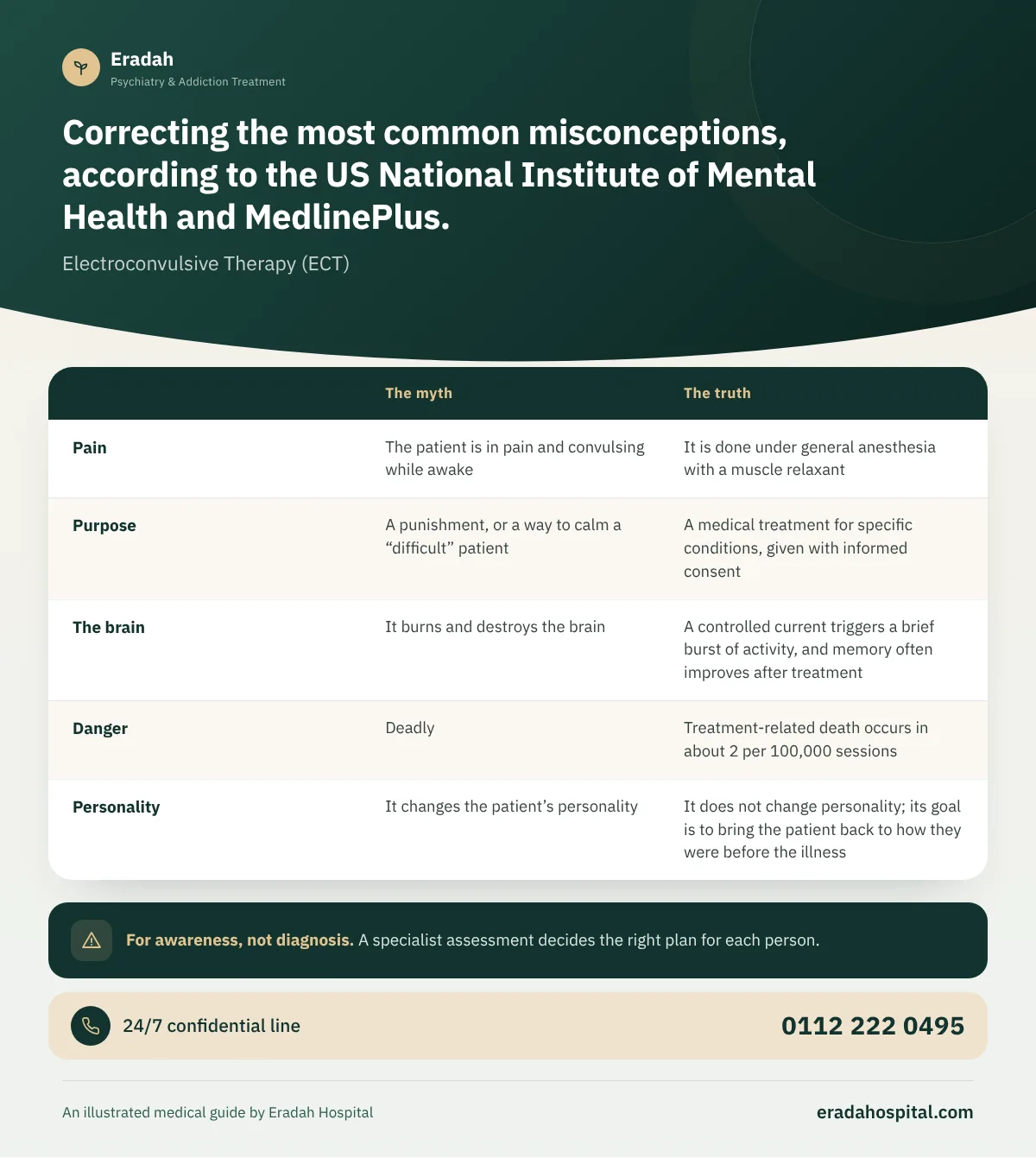
The safety figure comes from a systematic review published in 2017 that covered more than 766,000 sessions in 32 countries. It estimated treatment-related deaths at about 2.1 per 100,000 sessions, which is lower than the death rate the same study reported for general anesthesia in surgery.
ECT and addiction
ECT is not used to treat addiction itself, and it does not remove the urge to use substances. However, a patient with dual diagnosis who has severe depression or psychosis alongside addiction may need it, and it then becomes part of a plan that includes detox, rehabilitation and follow-up.
When should you discuss this option with a doctor?
If your relative refuses to eat, does not move or speak, expresses a wish to die, or has not improved despite more than one medication, this needs an urgent assessment. ECT is not performed at Eradah, but the psychiatrist at the Eradah psychiatric hospital assesses the case and discusses the available options with the family as part of depression treatment. If the doctor decides that ECT is the most suitable option, it is arranged at a hospital equipped for it, while psychiatric follow-up continues.