What are the goals of bipolar disorder treatment?
Treatment is not just about stopping an episode. It has three successive goals: bringing the current episode under control, whether mania or depression; then consolidating stability; then long-term prevention of future episodes, while restoring normal life at work and in the family.
The plan is built in partnership between the doctor, the patient and his family, and takes into account the type of disorder, the pattern of episodes, other conditions, any wish to become pregnant, substance use, and the patient’s previous experiences with medication.
What medications are used to treat bipolar disorder?
Several groups of medication are used, and the doctor chooses among them according to the case. We list names for information only, not for self-treatment:
| Group | Examples | Their role |
|---|---|---|
| Mood stabilizers | Lithium, valproic acid (valproate), lamotrigine, carbamazepine | Prevent episodes; some also treat mania, and lamotrigine is more useful for preventing depression |
| Newer antipsychotics | Quetiapine, olanzapine, risperidone, aripiprazole and others | Quick control of mania and psychosis; some also help in bipolar depression and in prevention |
| Antidepressants | At the doctor’s discretion | Not used alone; may sometimes be added alongside an antimanic medication, with close monitoring |
| Short-term supporting medications | Some sedatives, at the doctor’s discretion | Calm agitation and severe insomnia for a short time only, with caution against dependence on them |
Why does lithium need regular blood tests?
The UK’s NICE guidelines recommend lithium as a first choice for long-term treatment in many patients, because it is one of the most effective medications for preventing episodes, and research links it to a lower risk of suicide. But the gap between the helpful and the harmful blood level is narrow, so it needs close monitoring:
- Regular measurement of the lithium level in the blood, more often at the start of treatment.
- Periodic monitoring of kidney and thyroid function.
- Telling any doctor or pharmacist that you take lithium before any new medication, because some anti-inflammatory painkillers and blood pressure medications change its level.
- Drinking enough fluids, and being careful in extreme heat or with vomiting and diarrhea, because dehydration raises its level.
What about side effects?
Every medication has possible side effects, which vary from person to person, and many ease with time or can be handled by an adjustment the doctor decides. They include weight gain and drowsiness with some antipsychotics, and thirst and mild tremor with lithium. For this reason the doctor regularly monitors weight, blood sugar, blood fats and the kidneys.
It is important to tell your doctor about any troublesome effect rather than stopping the medication, as a suitable alternative usually exists. Medical guidelines avoid prescribing valproate to women of childbearing age because of the risk to the fetus, except in very special circumstances decided by the doctor, so a pregnancy should be planned in advance with the psychiatrist.
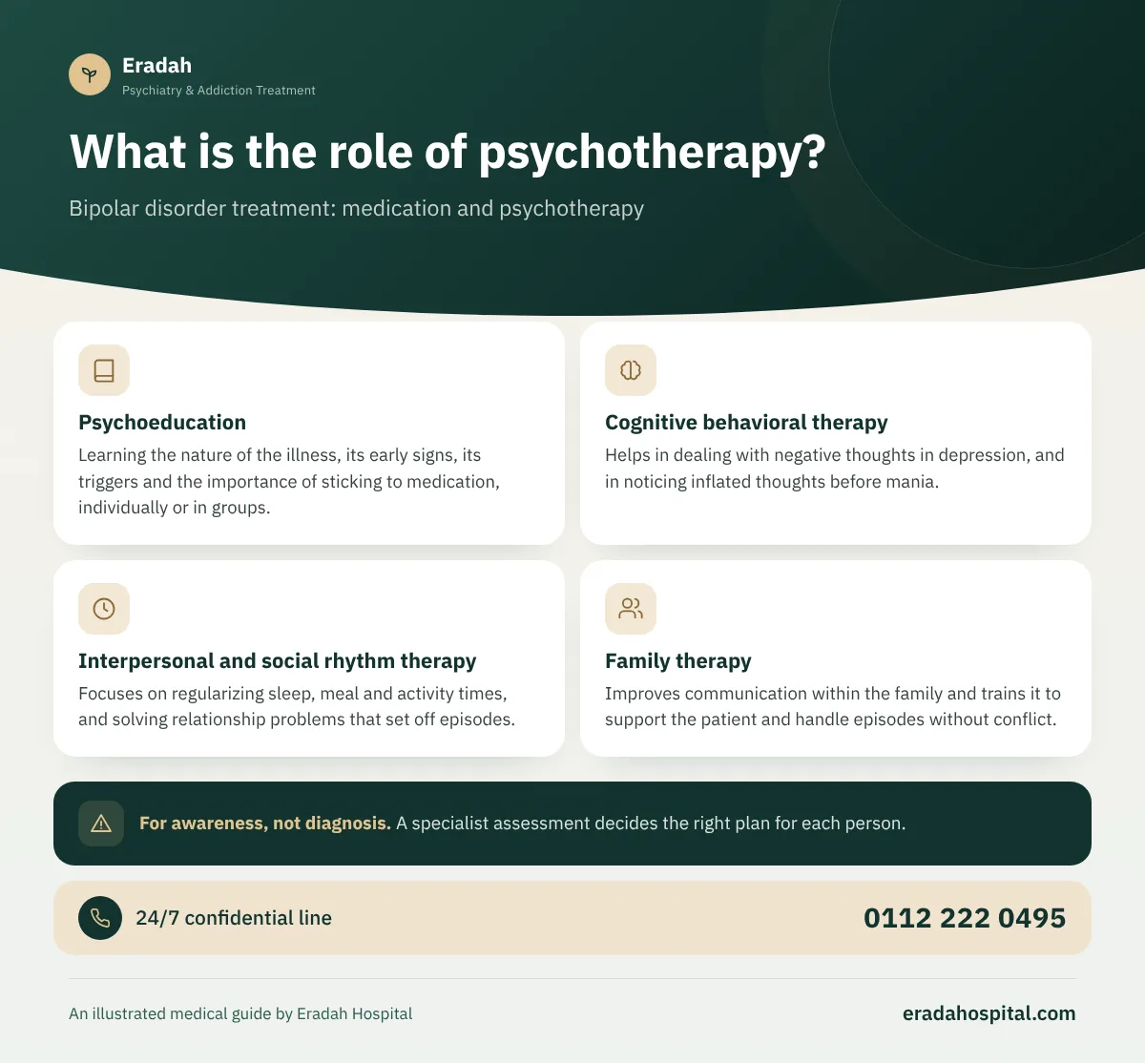
What is the role of psychotherapy?
Psychotherapy does not replace medication in this disorder, but it complements it, reduces relapses and improves daily life. Among its most important types:
Learning the nature of the illness, its early signs, its triggers and the importance of sticking to medication, individually or in groups.
Helps in dealing with negative thoughts in depression, and in noticing inflated thoughts before mania.
Focuses on regularizing sleep, meal and activity times, and solving relationship problems that set off episodes.
Improves communication within the family and trains it to support the patient and handle episodes without conflict.
Why is regular sleep part of treatment?
Lack of sleep is one of the strongest triggers of mania, and disruption of the daily routine shakes mood stability. Doctors therefore advise fixed times for sleeping and waking, even on days off, avoiding repeated late nights and night shifts where possible, limiting caffeine in the evening, regular physical activity, and complete avoidance of alcohol and drugs.
Are there other options for difficult cases?
In severe cases, cases that do not respond to medication, or when there is serious danger to life, the doctor may turn to electroconvulsive therapy under full anesthesia. It is a safe and effective treatment when carried out in a specialized setting, far from the frightening picture films give of it. Options such as transcranial magnetic stimulation are also studied for some cases of depression.
When does a patient need hospital admission?
| Inpatient treatment (hospital admission) | Outpatient treatment (clinic) |
|---|---|
| Severe mania with danger to himself or others | Mild to moderate episodes with good family support |
| Serious suicidal thoughts | The stability and preventive follow-up stage |
| Severe psychosis, or refusing food and drink | The patient’s ability to stick to medication and appointments |
| An episode combined with an addiction that needs detox | No active substance use, or it is under control |
How long does treatment last?
Treating an acute episode usually takes weeks until it settles, but preventive treatment often continues for long periods, and may last years or a lifetime in people who have had repeated episodes. It is similar to treating chronic illnesses such as diabetes: continuing is what preserves stability, and it does not signal failure.
How do we prevent relapse?
- Sticking to medication and appointments even in periods of improvement.
- Writing an early-warning plan: what are the signs, whom do we call, and what do we do?
- Regular sleep and daily routine.
- Staying away from alcohol and drugs completely.
- Dealing with stress early and asking for support when needed.
- Seeing the doctor as soon as any change appears, rather than waiting for a full episode.
The family’s role here is central: calm observation, reminding without pushing, accompanying the patient to follow-up, and agreeing in advance on what to do when an episode begins.
Choosing a Hospital for Bipolar Disorder Treatment
In bipolar disorder the patient needs two things in one place: a team able to contain an acute manic episode or a depression with suicidal thoughts, and a patient clinic that follows him for years after things settle. A place that masters only the first sends the patient home stable and then leaves him to the next episode, and a place that masters only the second stands helpless when an episode flares.
- A psychiatrist who tells bipolar disorder apart from ordinary depression and borderline personality disorder before any prescription, because a mistake can flip mood into mania.
- A clear system of blood tests with medications such as lithium, and knowing who reviews the results and when.
- Attention to sleep and daily routine as part of treatment, not as a side tip.
- Training the family in the early signs of the next episode.
- The ability to treat substance use if present, since drugs and alcohol are among the strongest drivers of episodes.
At Eradah, Dr. Mahmoud El-Sawy provides the medical supervision, and a doctor and nursing staff are on site around the clock, so an acute episode can be admitted to the psychiatric hospital and then moved to outpatient follow-up for prevention. The medication plan is set and reviewed by the doctor, and any accompanying substance use is treated within the same plan. To read more about how the two conditions intertwine, see bipolar disorder and addiction.
If the episode is dangerous right now, call the ambulance on 123. For non-emergencies, talk to our team on 01122220495 by phone or WhatsApp, day and night. The first consultation is free and confidential, residential treatment is for men, and you can arrange a visit from the consultation booking page.
Bipolar disorder treatment at Eradah
At Eradah we begin with a comprehensive psychiatric assessment that identifies the type of disorder and any accompanying condition, especially substance use, and then set a plan that combines medication, laboratory follow-up, psychotherapy and family education. We provide inpatient care for acute episodes and outpatient follow-up for prevention, with particular experience in treating bipolar disorder alongside addiction, all in complete confidentiality.