What Is Schizophrenia?
Schizophrenia is a long-term mental disorder that belongs to the psychotic disorders, meaning conditions in which a person loses some of the ability to tell what is going on in their mind from what is happening in reality. It affects thinking, perception, emotions and behavior together.
The word "schizophrenia" comes from Greek and literally means "split mind". What is meant is a separation of thinking from feelings and from reality, not a person splitting into two personalities. This is why doctors today prefer the term "schizophrenia" and reject the phrase "split personality", because it confuses it with a completely different disorder.
Schizophrenia usually does not appear suddenly. It is typically preceded by a gradual change in school, work or relationships, and then comes the first psychotic episode, which catches the family's attention. After that the course differs from person to person: some become fully stable, some have episodes spaced far apart, and a few continue to have symptoms to some degree.
How Many People Have Schizophrenia?
The World Health Organization estimates that about 1 in 300 people worldwide lives with schizophrenia, and that the rate is slightly higher among adults. It usually begins in the late teens and twenties, and tends to appear earlier in men than in women.
Source: World Health Organization, schizophrenia fact sheet. We do not have documented Egyptian figures, so we rely on global estimates.
The most painful figure is the treatment gap, not the prevalence rate: more than two-thirds of people with psychosis worldwide do not reach specialist care. In our communities, stigma and fear of what people will say widen this gap, and many families wait years before the first visit to a psychiatrist.
What Does Schizophrenia Feel Like from the Inside?
Many patients describe the start of the illness as the world having "changed" without knowing how: ordinary things suddenly seem to have special meaning, people's glances seem aimed at them, and thoughts crowd together or stop. Because these experiences feel completely real from the inside, the person often does not see them as an illness.
The voice a person with schizophrenia hears is not an imagination they choose; it reaches them as clearly as a human voice in the room. That is why it does not help to tell them "you're imagining it". It helps to say, "I believe you hear it, and I'm here with you to understand what's happening."
Alongside these experiences, many people suffer from a less visible but exhausting side: reduced enthusiasm, difficulty starting tasks, flattened expression of emotions, and poor concentration and memory. Families may think this is laziness or stubbornness, but it is really part of the illness.
What Happens in the Brain in Schizophrenia?
There is no single cause of schizophrenia, but research points to a disruption in how brain regions communicate with each other, especially in the dopamine and glutamate systems. Increased dopamine activity in some pathways is linked to hallucinations and delusions, while reduced activity in other pathways is linked to low motivation and poor concentration.
Imaging studies show subtle differences, on average, in the size and activity of some brain regions in people with the condition, but these are not enough to diagnose an individual by scan. Many researchers believe schizophrenia is tied to the course of brain development from before birth through adolescence, when the thinking networks of the frontal lobe are completed. The details of the genetic and environmental factors are on the page causes of schizophrenia.
Common Myths About Schizophrenia and the Facts
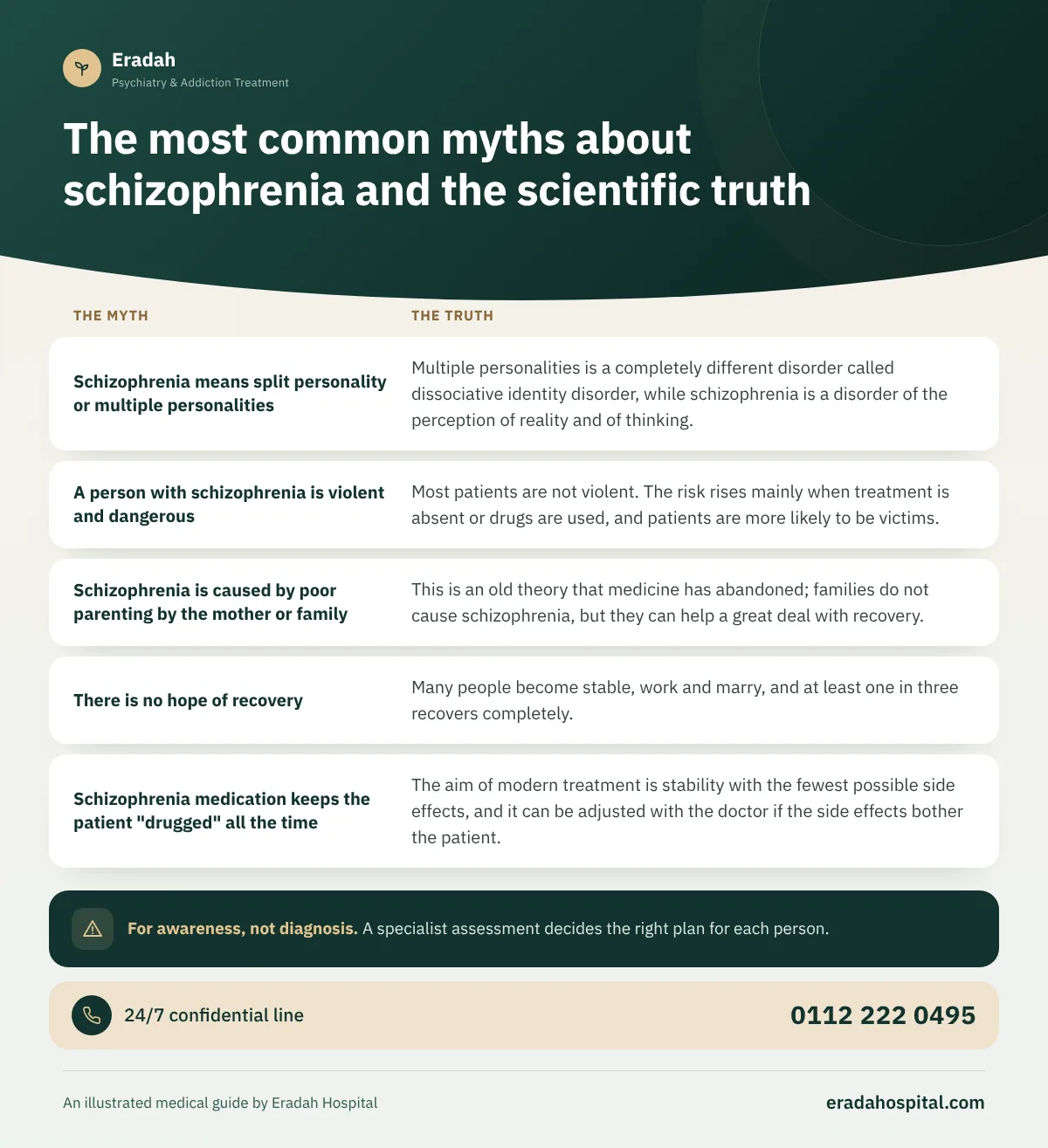
| The myth | The truth |
|---|---|
| Schizophrenia means split personality or multiple personalities | Multiple personalities is a completely different disorder called dissociative identity disorder, while schizophrenia is a disorder of the perception of reality and of thinking. |
| A person with schizophrenia is violent and dangerous | Most patients are not violent. The risk rises mainly when treatment is absent or drugs are used, and patients are more likely to be victims. |
| Schizophrenia is caused by poor parenting by the mother or family | This is an old theory that medicine has abandoned; families do not cause schizophrenia, but they can help a great deal with recovery. |
| There is no hope of recovery | Many people become stable, work and marry, and at least one in three recovers completely. |
| Schizophrenia medication keeps the patient "drugged" all the time | The aim of modern treatment is stability with the fewest possible side effects, and it can be adjusted with the doctor if the side effects bother the patient. |
What Is the Difference Between Schizophrenia and Similar Conditions?
Hallucinations and delusions are not exclusive to schizophrenia, which is why diagnosis needs a psychiatrist who can tell apart conditions that look alike but are treated differently:
Psychotic symptoms may appear, but they are tied to clear episodes of mania or depression and usually disappear when those end. Learn more
Hallucinations and delusions that appear with the use of substances such as crystal meth (shabu) and Strox, or when stopping them, and that usually improve once the substance is stopped. Learn more
What people call "multiple personalities", a disorder usually linked to severe trauma and not a type of schizophrenia.
Some brain and hormonal diseases, infections and medications can cause psychotic symptoms, which is why the doctor orders tests before reaching a conclusion.
There are also disorders close to schizophrenia that differ from it in duration or in the presence of mood symptoms, such as schizoaffective disorder and delusional disorder, and we explain them on the page types of schizophrenia.
When should you see a psychiatrist?
Don't wait until you are sure for yourself that what is happening is "schizophrenia". Any lasting change in how reality is perceived or in behavior deserves a psychiatric assessment, and an assessment does not necessarily mean a diagnosis of a chronic illness:
- A clear, unexplained decline in school or work with growing withdrawal from friends and family.
- Talk about voices no one else hears, or about being watched, a conspiracy, or special messages in the TV or phone.
- Incoherent or hard-to-follow speech, or strange behavior that is out of character.
- Obvious neglect of personal hygiene, sleep and food.
- Hallucinations or suspicions after using hashish or stimulants, even if they go away after a few days.
The earlier the assessment, the better; research links a shorter duration of untreated psychosis to better long-term outcomes. If the person refuses to go, the family can start by visiting the doctor alone to learn how to persuade them and how to deal with them.
Can a Person Recover from Schizophrenia?
Yes. Recovery in psychiatry means that the person lives a meaningful life: studies or works, keeps up their relationships, and knows the early warning signs so they act before a relapse, even if not all symptoms always disappear. The World Health Organization notes that at least one in three patients can recover completely.
Among the strongest things that improve the chances are starting treatment early, continuing it without sudden stops, staying away from hashish, stimulants and alcohol, regular sleep, an understanding family, and a rehabilitation program that gradually returns the person to their role. The details of the options are on the page treatment of schizophrenia.
How Can an Egyptian Family Support a Person with Schizophrenia?
In our homes the family carries the greatest burden, and it often deals with the illness in silence for fear of scandal or of its effect on the siblings' marriages. But hiding it delays treatment, and informed support makes a real difference:
- Learn about the illness: understanding the symptoms reduces anger at behaviors the family mistakes for stubbornness or bad manners.
- Reduce criticism and shouting: an atmosphere charged with criticism and blame is linked to more relapses, while calm and encouragement protect the patient.
- Don't argue about delusions: don't agree with them and don't mock them, but talk about the feelings behind them, such as fear and anxiety.
- Help with routine: with appointments, treatment and sleep, without turning the home into constant surveillance.
- Look after yourselves: caring for a person with a mental illness is exhausting, and family support groups and counseling for you are not a luxury.
And remember that the patient is not the illness. They are your son or your brother going through a treatable illness, and they deserve respect, privacy and hope like any other patient.
Schizophrenia Guide: Everything You Need to Know
We have gathered everything about schizophrenia into 10 pages, each answering one question in detail. Choose what you are looking for:
Schizophrenia symptoms and signs
Positive symptoms such as hallucinations and delusions, negative symptoms such as flatness and withdrawal, cognitive symptoms, and the early signs that come before the first episode.
Causes of schizophrenia
How genetics, brain chemistry and brain development interact with stress, trauma and hashish use to raise the risk.
Harms and complications of schizophrenia
What untreated schizophrenia does to physical health, work, relationships and the family, why it shortens life, and how complications are avoided.
Types of schizophrenia
Why modern classifications abolished the old types such as paranoid, and what the related disorders are, such as schizoaffective and delusional disorder.
Schizophrenia treatment
Antipsychotics as tablets and long-acting injections, clozapine for resistant cases, psychological and social rehabilitation, and family education.
Schizophrenia and addiction
Why many patients turn to hashish, smoking and stimulants, how substances increase episodes, and the importance of integrated treatment.
Dealing with a Person with Schizophrenia: A Practical Guide for Families
How do you deal with a person with schizophrenia? Why not to argue with delusions, how to help them take medication without confrontation, early signs of relapse, a calm home atmosphere, and when hospital admission is needed.
Marriage and Schizophrenia: What Medicine Tells the Patient, Their Family and Their Partner
Marriage and schizophrenia from a medical view: does marriage treat schizophrenia? When is it appropriate, why honesty matters, the chance of children being affected in numbers, pregnancy and medication, and the partner's role in stability.
The Difference Between Schizophrenia and Split Personality: Why Do We Confuse Them?
The difference between schizophrenia and split personality: why do people call schizophrenia "split personality" when it is not? The origin of the name, and how it differs from dissociative identity disorder in symptoms, causes and treatment.
The Difference Between Schizophrenia and Bipolar Disorder: How Does the Doctor Tell Them Apart?
The difference between schizophrenia and bipolar disorder: an illness of perceiving reality or of mood? Why they are confused when psychosis appears, how the course of the illness settles the diagnosis, shared genes, and what this means for treatment.
Acute psychotic episode or suicidal thoughts? Get help now
- Hearing voices that command the person to harm themselves or others, or acting on them
- Severe agitation, threats, or behavior that puts them or those around them in danger
- Stopping eating, drinking or sleeping for days, or severe neglect that threatens their health
- Talking about wanting to die or end their life, or saying goodbye and giving away their belongings
- Stiffness, rigidity and no response to speech, or sudden confusion and severe disorientation with fever
Stay with the person and don't leave them alone, speak in a calm voice and short sentences, and don't argue with the voices or ideas or mock them. Move dangerous objects out of reach as far as possible without confronting them, and call an ambulance on 123 or go to the nearest emergency room. You can call the mental health support line on 16328 around the clock for advice.
Ambulance 123 Mental health support line 16328