What is bipolar disorder?
Bipolar disorder is a disorder in the regulation of mood, energy, and activity, in which the person goes through periods when mood and activity rise markedly and other periods when they drop into deep depression. It is called “bipolar” because mood moves between two opposite poles.
The difference between it and the everyday mood swings everyone goes through is that its episodes last days or weeks and are severe enough to change how the person thinks, sleeps, and behaves, and the people around them clearly notice. Between episodes, many people return to their usual state and carry on with their lives and work normally.
It was once called “manic-depressive psychosis” or “manic depression,” and its modern name has since settled in international medical classifications such as the DSM-5 and the ICD-11, within the group of mood disorders alongside depression.
What is the difference between mania, hypomania, and a depressive episode?
The disorder revolves around three main types of episodes, and knowing the difference between them is the key to understanding the illness:
| Episode | What happens | Approximate duration required for diagnosis | Effect on life |
|---|---|---|---|
| Mania | Markedly elevated or irritable mood, excess energy, little need for sleep, racing thoughts and reckless decisions; psychosis may accompany it. | At least one week, most of the day, or less if hospitalization is needed | Clearly disrupts work and relationships, and may require hospitalization |
| Hypomania | The same picture but less severe, and without psychosis. | At least four consecutive days | A change others notice without major disruption, and it may look like “productive energy” |
| Depressive episode | Sadness or emptiness and loss of pleasure, fatigue, disturbed sleep and appetite, guilt, and sometimes thoughts of death. | At least two weeks | Cripples the ability to work and study, and is often the longest-lasting |
| Mixed episode | Symptoms of mania and depression at the same time: energy and agitation together with despair and sadness. | Specified as a feature accompanying an episode | One of the hardest and highest-risk states, and needs urgent assessment |
The detailed signs guide explains what each episode looks like from the inside and how families notice it.
How common is bipolar disorder? And when does it begin?
The World Health Organization estimates that about 36 million people worldwide lived with bipolar disorder in 2023, including about 3.3 million adolescents. It affects men and women at similar rates, although women are more prone to depressive and mixed episodes.
It usually begins in late adolescence or early adulthood, and medical reviews note that most people with the disorder show its signs before the age of 25. But it can begin in childhood or in midlife, and the first clear episode is often a depressive one, so the correct diagnosis can be delayed for years.
Sources: the World Health Organization's fact sheet on mental disorders, and the StatPearls review on bipolar disorder.
What does bipolar disorder feel like from the inside?
Many patients describe the start of mania as the best they have ever felt: brilliant ideas, boundless confidence, and endless energy. But this feeling soon turns into distraction, irritability, and decisions the person later regrets. Depression, they say, is a heaviness like walking through water, where the simplest daily tasks become a battle.
And perhaps the hardest part of the illness is losing trust in your own feelings, more than the lows or highs themselves: is this real happiness, or the start of an episode?
This is why, with treatment, the patient learns to watch for their early signals, such as a sudden drop in sleep or speeding up of speech, and to deal with them before they turn into a full episode.
What happens in the brain?
There is no single known cause, but research points to differences in the functioning of brain circuits that regulate mood, reward, and sleep, and in the balance of neurotransmitters such as dopamine, norepinephrine, and serotonin, along with disruption of the body's biological clock. Genetics play a large role; it is one of the mental health conditions most strongly tied to family history.
That does not mean genes are a “final verdict”: severe stress, lack of sleep, and drug use can be the spark that ignites the first episode in a person who is predisposed. The details are on the causes page.
Does bipolar disorder have types?
Yes. The best known are type I, in which at least one full manic episode occurs; type II, which combines hypomanic episodes and depressive episodes without full mania; and cyclothymic disorder, in which milder mood swings repeat over a long period. Type II is not necessarily “milder,” as its depressive episodes can be long and painful.
Common myths about bipolar disorder and the truth
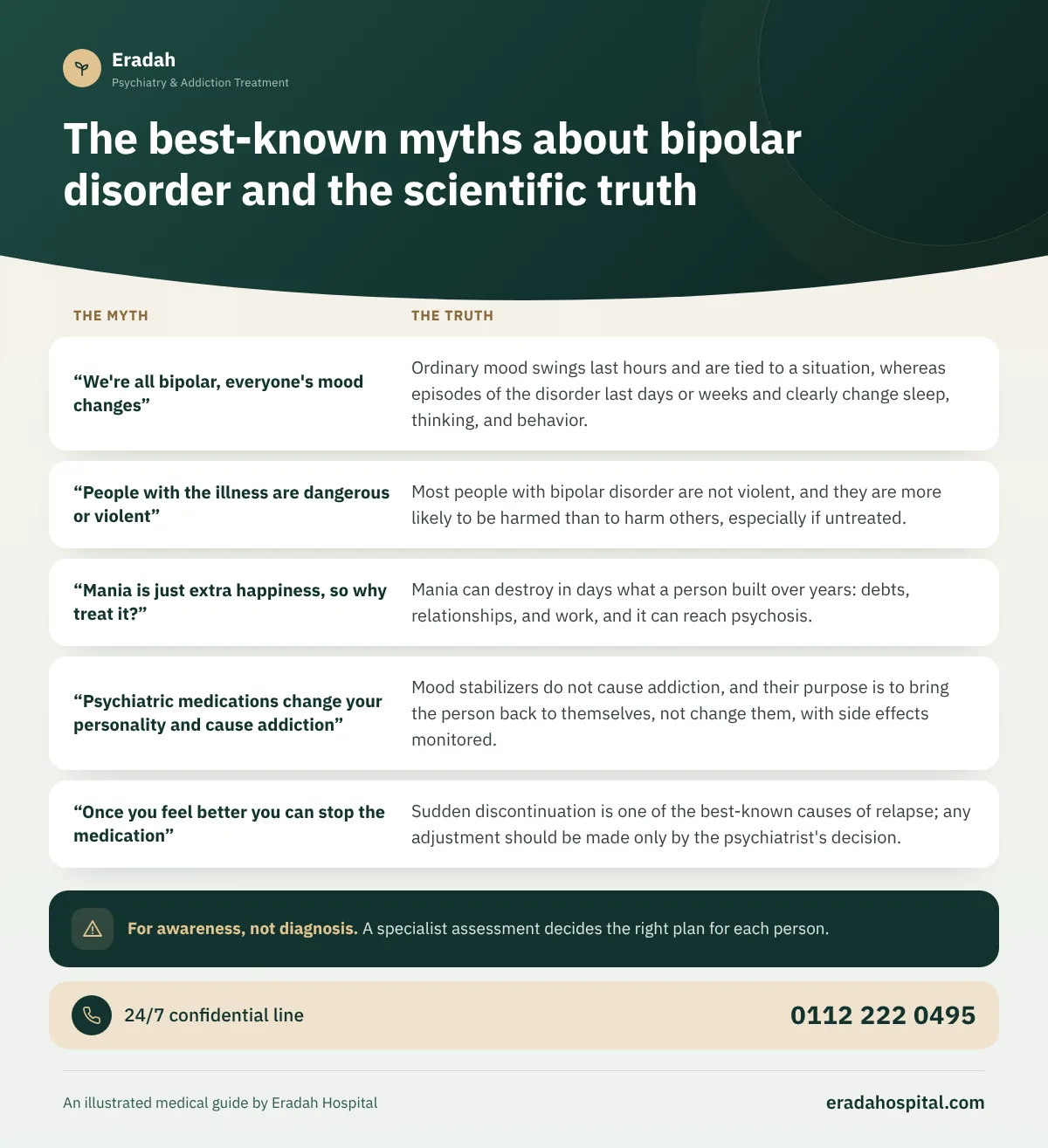
| The myth | The truth |
|---|---|
| “We're all bipolar, everyone's mood changes” | Ordinary mood swings last hours and are tied to a situation, whereas episodes of the disorder last days or weeks and clearly change sleep, thinking, and behavior. |
| “People with the illness are dangerous or violent” | Most people with bipolar disorder are not violent, and they are more likely to be harmed than to harm others, especially if untreated. |
| “Mania is just extra happiness, so why treat it?” | Mania can destroy in days what a person built over years: debts, relationships, and work, and it can reach psychosis. |
| “Psychiatric medications change your personality and cause addiction” | Mood stabilizers do not cause addiction, and their purpose is to bring the person back to themselves, not change them, with side effects monitored. |
| “Once you feel better you can stop the medication” | Sudden discontinuation is one of the best-known causes of relapse; any adjustment should be made only by the psychiatrist's decision. |
How does it differ from similar conditions?
Bipolar disorder resembles other conditions on the surface, and telling them apart is the psychiatrist's job, but these general differences help families understand:
In depression there are never manic or hypomanic episodes; the presence of even one changes the diagnosis and the treatment plan.
Emotions shift within hours and are tied to relationships, whereas bipolar episodes last days and weeks.
Its symptoms have been continuous since childhood, whereas manic activity comes in episodes with a beginning and an end.
Stimulants such as crystal meth (shabu) and cocaine can cause a state that looks exactly like mania, and telling them apart needs a careful assessment.
When should you see a psychiatrist?
- If there are repeated periods of greatly reduced sleep without tiredness, with racing speech and thoughts and unusual spending or behavior.
- If a person was treated for depression and then showed excessive energy or severe irritability after starting an antidepressant.
- If there is a family history of bipolar disorder along with repeated depressive episodes.
- If mood swings are linked to alcohol or drug use.
- Immediately if there are suicidal thoughts, hallucinations, or dangerous agitation.
Early assessment saves years of misdiagnosis and protects against painful decisions made during episodes. Learn the assessment steps on the page How the assessment is done and who does it.
Can a person with the disorder live a normal life?
Yes. Bipolar disorder is a chronic condition that needs long-term follow-up, but many people live stable lives with it, work, raise families, and achieve great successes. The deciding factors are sticking to treatment, keeping sleep regular, staying away from alcohol and drugs, and having a family that understands the illness and does not blame the person.
The family's role: how do you support someone you love?
- Learn about the illness so you can tell the difference between the person and the episode they are going through.
- Notice early signs such as reduced sleep or excess spending, and agree in advance, while they are stable, on what you will do when they appear.
- Help them keep regular sleep, medication, and follow-up, without suffocating monitoring.
- Do not argue with their ideas during acute mania; focus on their safety and on getting them to the doctor.
- Agree on temporary financial safeguards during episodes, such as holding on to bank cards.
- Take care of yourself and ask for family guidance; supporting a patient is a long journey.
Egypt's Mental Health Care Law (No. 71 of 2009) guarantees the patient's rights to treatment and confidentiality, and regulates the rare cases that require hospital admission without their consent when there is serious danger. This is a general awareness overview and not legal advice.
Bipolar Disorder Guide: Everything You Need to Know
We have gathered everything about bipolar disorder into 10 pages, each answering one question in detail. Choose what you are looking for:
Bipolar disorder symptoms and signs
What manic, hypomanic, and depressive episodes look like, how they appear in adolescents, women, and older adults, and the early signs families notice.
Causes of bipolar disorder
The role of heredity, brain chemistry, and the biological clock, and the difference between causes and triggers such as lack of sleep, stress, and drugs.
Harms and complications of bipolar disorder
What the illness does to work, money, relationships, and physical health without treatment, why the risk of suicide rises, and how it can be avoided.
Types of bipolar disorder
The difference between type I, type II, cyclothymic disorder, and other types, and what rapid cycling and a mixed episode mean.
Diagnosing bipolar disorder
The steps of psychological assessment and mood tracking, and telling it apart from depression, ADHD, borderline personality, and the effects of drugs.
Treating bipolar disorder
Mood stabilizers including lithium, antipsychotics, psychotherapy, education, and regular sleep, and why medication should not be stopped without the doctor.
Bipolar disorder and addiction
Why it so often occurs together with alcohol, stimulants, and hashish, how substances ignite episodes, and why it needs integrated dual treatment.
Dealing with a person with bipolar disorder: a practical guide for family and partners
Dealing with a person with bipolar disorder in practice: what to do during a manic episode, how to protect money and major decisions, watching for the risk of depression, and writing an early-warning plan without suffocating them with monitoring.
Bipolar disorder and marriage: how can couples protect the relationship from episodes?
Bipolar disorder and marriage: how mania and depression affect married life, trust, and money, the chance of children being affected, why pregnancy needs planning with the doctor, and how couples protect their stability.
The difference between bipolar disorder and borderline personality: how do you tell two kinds of mood instability apart?
The difference between bipolar disorder and borderline personality: instability lasting days or hours? Episodes without a cause or emotional reaction after rejection? How the doctor tells them apart, why they sometimes occur together, and how treatment differs.
Acute mania or suicidal thoughts? Get help now
- Talking about wanting to die or being a “burden” on others, or feeling complete despair
- Saying goodbye to family, giving away belongings, or sudden isolation
- No sleep for several days in a row with severe agitation or nonstop racing speech
- Hearing voices that command them to act, or fixed strange beliefs that they are being pursued or have a special mission
- Dangerous reckless behavior that puts them or others at risk of harm, or unusual aggression
Stay with the person and do not leave them alone, and listen calmly, without arguing or blaming. Call the ambulance on 123 or take them to the nearest emergency department, or call the mental health support line 16328, available around the clock, and keep anything they could hurt themselves with out of their reach.
Ambulance 123 Mental health support line 16328Supporting the patient in mania, depression, and stability, in brief
What the patient needs changes with the phase: in mania, calm and brief speech and less late-night activity and noise, without arguing about their big plans; in depression, presence, listening, and small daily tasks without blame; and in stability, agreement on early signs and a written plan for crises. A meta-analysis showed that excessive criticism and hostility at home predict relapse, so a calm atmosphere is part of treatment, not a courtesy.
We explain what to say and what to avoid in each phase, and how to handle refusal of treatment and reckless spending, in the guide Dealing with a person with bipolar disorder: a practical guide for family and partners.