What is psychotic depression?
"My father has become convinced that he committed a terrible sin and that God will punish all of us because of him, and whatever we tell him, he doesn't believe it." This sentence may sound like a description of deep sadness, but when it becomes an unshakable certainty, accompanied by voices or complete isolation, it may be a sign of psychotic depression, one of the most severe forms of depression and one of those most in need of rapid treatment.
In the American diagnostic manual DSM-5-TR, psychotic depression is not a separate illness but a specifier added to a diagnosis of major depression when psychotic features appear: delusions, meaning fixed beliefs that are not real, or hallucinations, meaning hearing or seeing things that are not there. The MSD Manual notes that these delusions often center on having committed unforgivable sins or crimes, having shameful or incurable illnesses, or being persecuted.
Symptoms of psychotic depression
- Deep sadness and loss of pleasure in everything for most of the day.
- Severe disturbance of sleep and eating, and marked weight loss.
- Marked slowing of movement and speech, or agitation and restlessness.
- Certainty of having committed a great sin or of being the cause of the family's misfortunes.
- Conviction of being bankrupt or seriously ill despite evidence to the contrary.
- Hearing voices that blame, belittle or accuse.
- Suspicion that others are plotting against or watching him.
- Complete isolation and, at times, refusing food.
- Suicidal thoughts, or talk about deserving punishment.
Examples of delusions in psychotic depression
| Type of delusion | What it looks like |
|---|---|
| Delusions of guilt | Certainty of having committed an unforgivable wrong and deserving punishment |
| Delusions of poverty | Conviction of being completely bankrupt even though money is available |
| Delusions of illness | Certainty of having a serious illness or that the body's organs are rotting |
| Nihilistic delusions | A feeling that he or the world no longer exists |
| Persecutory delusions | A belief that people are plotting to punish him |
These are called "mood-congruent" delusions because they reflect the feelings of depression: guilt, helplessness and despair. Occasionally, delusions unrelated to mood may appear, which leads the doctor to review the diagnosis carefully.
The difference between psychotic depression, schizophrenia and bipolar disorder
| Psychotic depression | Schizophrenia | Psychotic depression in bipolar disorder | |
|---|---|---|---|
| Timing of the psychosis | Only during a depressive episode | Continues even outside mood episodes | During a depressive or manic episode |
| Content of the thoughts | Usually guilt, punishment, illness and poverty | Varied, and may be bizarre | Depends on the type of episode |
| Previous history | Depressive episodes only | Gradual decline in functioning | Previous episodes of mania or excess activity |
| Main treatment | Antidepressant plus antipsychotic, or electroconvulsive therapy | Long-term antipsychotics | Mood stabilizer plus antipsychotic |
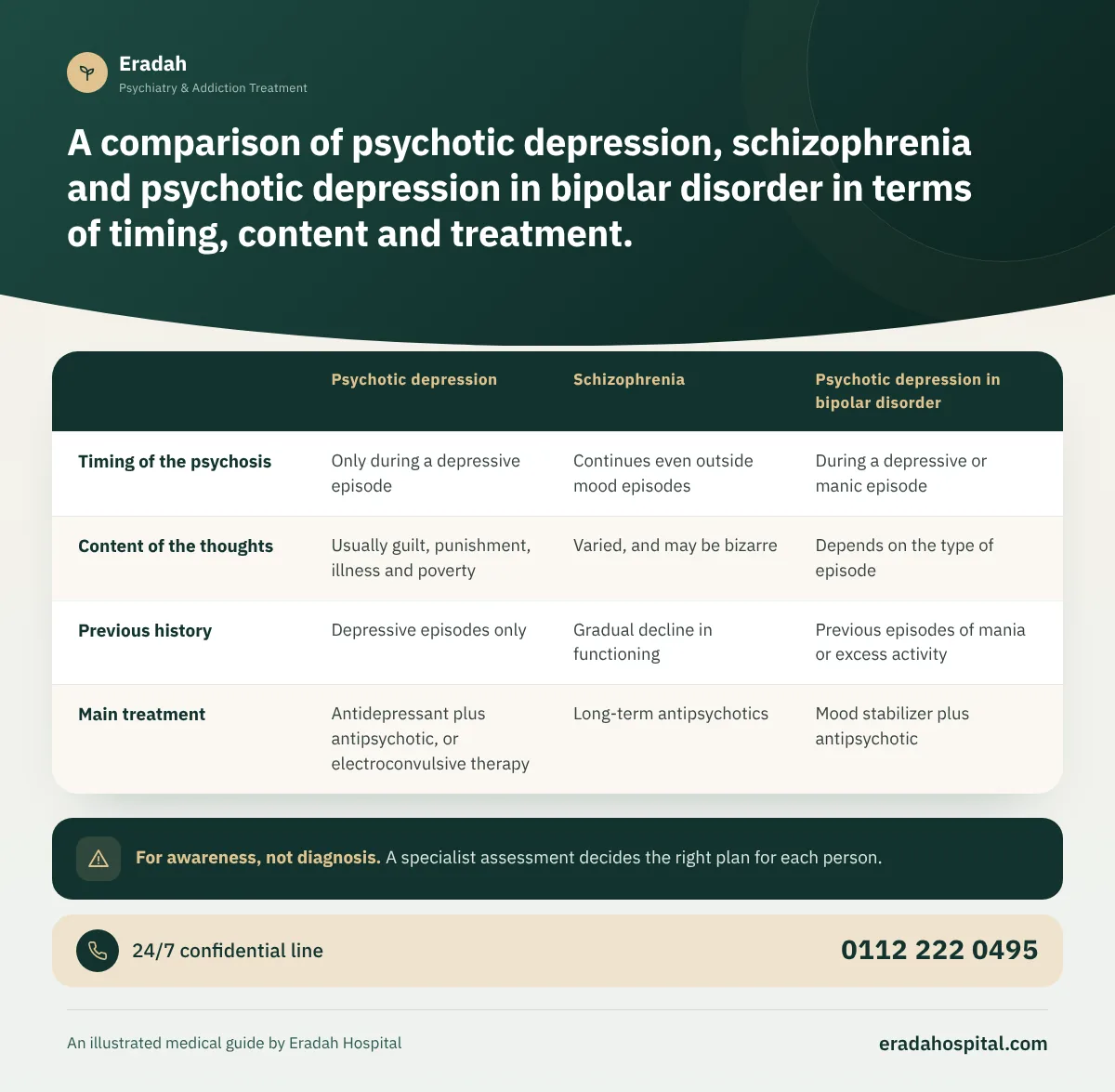
That is why the doctor always asks about past periods of excess energy and reduced sleep, because their presence points to bipolar disorder and a different treatment plan. The doctor also distinguishes the condition from schizophrenia and from drug-induced psychosis.
Who is most at risk of psychotic depression?
A systematic review published in Psychological Medicine in 2018, covering 99 studies, found that the lifetime prevalence ranges between 0.35% and 1%, that it is higher in older adults, and that a family history of psychosis and bipolar disorder raises the risk. Its outcomes were also worse than non-psychotic depression but better than schizophrenia. A review published in Schizophrenia Bulletin indicates that it is often undiagnosed, because patients may hide their thoughts or see them as facts not worth mentioning.
Treatment of psychotic depression
- Combining an antidepressant and an antipsychotic: according to the Schizophrenia Bulletin review, this combination is more effective than either one alone, and most treatment guidelines recommend it.
- Electroconvulsive therapy: the MSD Manual describes it as particularly effective in psychotic depression. It is used when the risk is high, the patient refuses food, or does not respond to medication, and it is done under full anesthesia.
- Psychotherapy: begins after the acute symptoms ease, to support the patient and family and prevent relapse.
- Hospital stay: in a psychiatric hospital when there is a risk of self-harm or inability to care for oneself, under daily supervision.
The doctor chooses the medications and doses and monitors side effects such as weight gain; do not start or stop any medication without a doctor. To learn more about antidepressants and when they start working, you can read our dedicated guide.
Duration of treatment and relapse prevention
In a clinical trial published in JAMA in 2019 of 126 patients who had recovered from psychotic depression, about 20% of those who stayed on the antipsychotic together with the antidepressant relapsed, compared with about 55% of those who stopped the antipsychotic and stayed on the antidepressant alone, with weight and waist-circumference gain in those who continued it. So the doctor decides how long to continue by carefully balancing relapse prevention against side effects.
How can the family help?
- Do not argue with the patient about the delusion; acknowledge his pain instead: "I can see you're suffering a lot."
- Do not leave him alone if he talks about punishment or death, and move medications and dangerous items out of reach.
- Watch his eating and drinking; refusing food is a danger sign.
- Help him see a doctor quickly, and go with him.
- Follow up on his taking the medication after he improves, since stopping early is one of the best-known causes of relapse.
Suicidal thoughts or danger to self? Get help now
- Talk about wanting to die, being a “burden” on others, or life having no meaning
- Severe despair and a feeling that there is no way out and no hope of getting better
- Suddenly saying goodbye to family and friends, giving away personal belongings or putting affairs in order
- Complete withdrawal from people, or a sudden unexplained calm after a period of intense distress
- Increased use of alcohol or drugs, or reckless behavior that puts their life at risk
Do not leave the person alone. Ask them calmly and directly about their thoughts and listen without judgment or blame; asking does not plant the idea, it opens the door to help. Call the ambulance on 123 or take them to the nearest emergency room, or call the mental health support line 16328 (24 hours), and keep medications and anything they could harm themselves with out of reach.
Ambulance 123 Mental health support line 16328