What is gambling and betting addiction?
Gambling addiction is a repeated pattern of betting money or items of value on an uncertain outcome, in which the person loses the ability to control when it starts, how long it lasts or how much they risk, and continues despite clear harm to their life and family.
Gambling takes many forms: card games and the casino, sports betting, online casinos and apps, and some games of chance. What they share is risking something of value in the hope of winning more, on an outcome determined mainly by luck.
What distinguishes this addiction is that it is “hidden”: no smell and no signs on the body, and a person may live for years hiding it from those closest to them until the debts are suddenly exposed. This is why many reach treatment after a major financial or family crisis, although early intervention is much easier.
When does betting turn from entertainment into addiction?
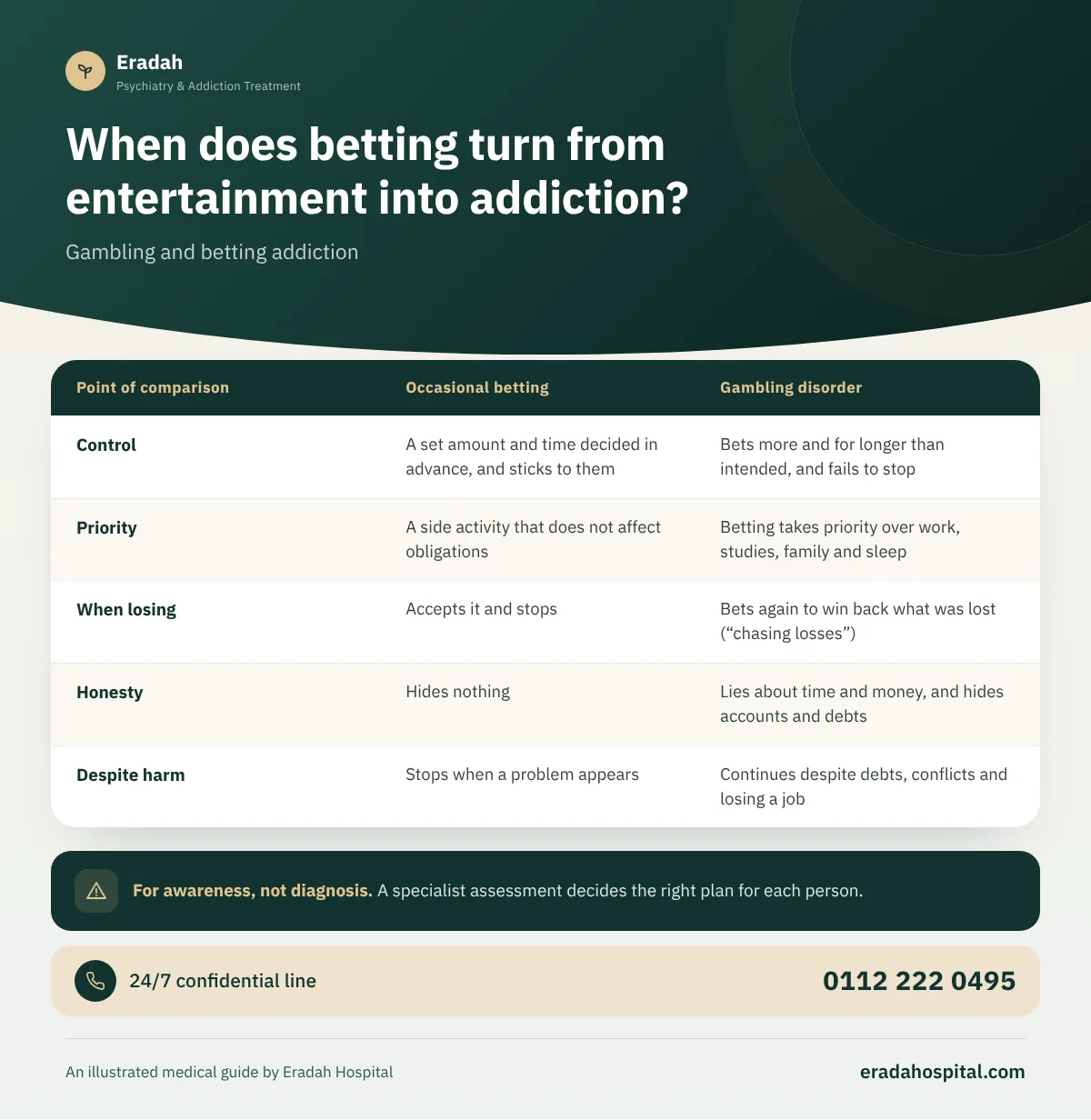
Not everyone who has placed a bet is addicted. The difference lies in control, priority and persistence despite harm, the three elements the World Health Organization uses to diagnose gambling disorder:
| Point of comparison | Occasional betting | Gambling disorder |
|---|---|---|
| Control | A set amount and time decided in advance, and sticks to them | Bets more and for longer than intended, and fails to stop |
| Priority | A side activity that does not affect obligations | Betting takes priority over work, studies, family and sleep |
| When losing | Accepts it and stops | Bets again to win back what was lost (“chasing losses”) |
| Honesty | Hides nothing | Lies about time and money, and hides accounts and debts |
| Despite harm | Stops when a problem appears | Continues despite debts, conflicts and losing a job |
The shift can be faster with online betting, because it is available on the phone all day, and the money is numbers on a screen rather than notes in the hand, which weakens the sense of its value.
Is gambling addiction a medically recognized illness?
Yes, and it is the first “behavioral addiction” to receive full recognition. In 2013 the American diagnostic manual DSM-5 moved gambling disorder to the chapter on substance-related and addictive disorders, next to alcohol and drug addiction, after it had been classified as an impulse control disorder.
The international classification ICD-11 lists it under code 6C50 among “disorders due to addictive behaviors,” and distinguishes between a pattern mainly of offline gambling and one mainly of online gambling. This recognition makes it a condition with diagnostic criteria and treatment, and takes it out of the category of “poor morals” or “greed.”
How common is gambling and betting addiction?
Sources: the gambling fact sheet issued by the World Health Organization (December 2024), and the Lancet Public Health Commission on gambling (2024). There are no unified official Egyptian figures on gambling disorder.
The Lancet Commission points out that online casino products and sports betting are linked to higher rates of problem gambling among their users, and that teenagers are more vulnerable than adults, which explains the growing concern over the spread of these apps among young people.
Why has online betting spread among young people?
The phone makes betting possible at any moment: at work, in bed, during the match, without anyone noticing.
Successive bets on small events within a single match, so the cycle of anticipation and reward repeats dozens of times.
Love of football and knowledge of the teams creates a false sense that winning is “skill” rather than luck.
Ads, pages and influencers show the winnings and not the losses, so “quick profit” seems easy.
E-wallets and accounts the family does not see, so the problem is discovered months late.
The page on the causes of gambling addiction explains how these products are designed to make stopping hard, and why smart and educated people fall into them just as others do.
What happens in the brain during betting?
Betting activates the same reward circuit in the brain that drugs activate, and dopamine plays a central role in it. Notably, dopamine does not rise only with winning, but with anticipation and uncertainty: the moment before the result appears is what the person with an addiction chases.
With repetition the person needs larger sums or riskier bets to feel the same excitement, just like tolerance in substance addiction, and feels irritable and anxious when trying to stop. This is why gambling is described as an “addiction without a substance.”
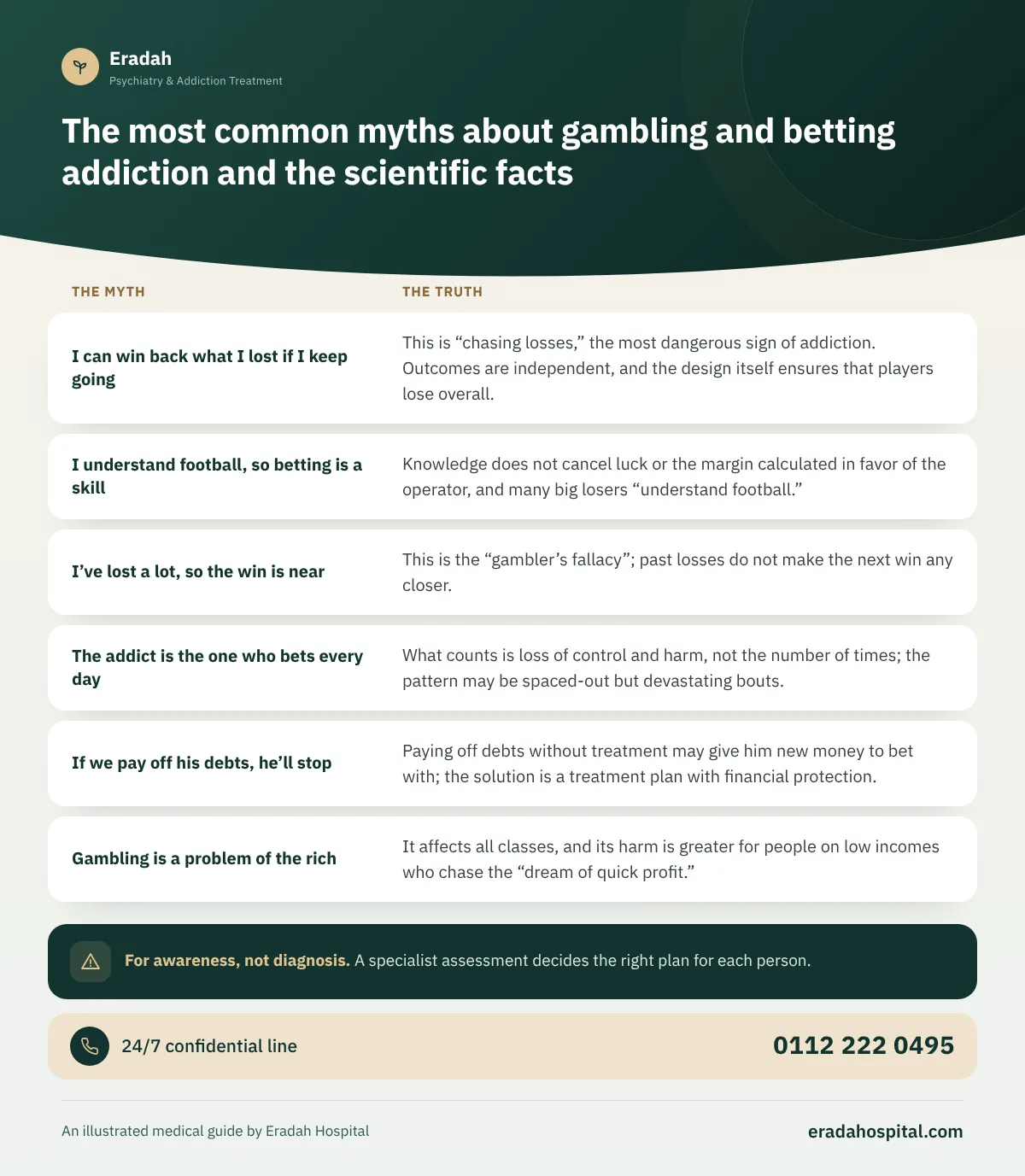
Common myths about gambling and betting, and the facts
| The myth | The truth |
|---|---|
| I can win back what I lost if I keep going | This is “chasing losses,” the most dangerous sign of addiction. Outcomes are independent, and the design itself ensures that players lose overall. |
| I understand football, so betting is a skill | Knowledge does not cancel luck or the margin calculated in favor of the operator, and many big losers “understand football.” |
| I’ve lost a lot, so the win is near | This is the “gambler’s fallacy”; past losses do not make the next win any closer. |
| The addict is the one who bets every day | What counts is loss of control and harm, not the number of times; the pattern may be spaced-out but devastating bouts. |
| If we pay off his debts, he’ll stop | Paying off debts without treatment may give him new money to bet with; the solution is a treatment plan with financial protection. |
| Gambling is a problem of the rich | It affects all classes, and its harm is greater for people on low incomes who chase the “dream of quick profit.” |
What is the legal status of gambling and betting in Egypt?
Gambling and betting are heavily restricted in Egypt, and the law punishes running gambling venues without a license. Many online betting platforms also operate from outside the country without a local license, exposing their users to legal and financial risks, and to the possible loss of their money or theft of their data with no protection.
From a medical perspective, we do not treat the patient as an accused person but as someone with a disorder that needs treatment, and what they share with their doctor remains confidential. This is a general awareness overview and not legal advice.
What is the family’s role in facing gambling addiction?
The family is often the first to pay the price and the last to know. Its role is decisive, provided it is balanced:
Separate joint accounts temporarily, do not lend him money, and protect the household savings and the children’s expenses.
Talk about the facts (missing sums, debts) without insults, and offer help instead of scandal.
Paying debts in secret or lying on his behalf prolongs the addiction.
Specialist treatment raises the chances of recovery, and the family can seek a consultation even if he refuses.
Anger, shame and anxiety are natural feelings for the family, and you have the right to independent psychological support.
Gambling and betting addiction guide: everything you need to know
We have gathered everything about gambling and betting addiction in 5 pages, each answering one question in detail. Choose what you are looking for:
Signs of gambling and betting addiction
The nine criteria for gambling disorder in simple language, signs of online betting in young people and teenagers, self-assessment questions, and how to open the conversation.
Causes of gambling and betting addiction
How betting design works on the brain, common thinking errors, and the role of depression, hyperactivity, financial pressure and football culture.
Harms of gambling and betting addiction
Debts and the collapse of family trust and its effect on children and work, depression and the risk of suicide, and legal risks.
Gambling and betting addiction treatment
Cognitive behavioral therapy, protecting money, blocking apps, support groups, family counseling and relapse prevention.
Dealing with a person addicted to gambling: a practical guide for wives and families
How do you deal with someone addicted to gambling and betting? My husband gambles, what do I do? Steps to protect money, talking without confrontation, why you should not pay his debts, and when the danger is urgent.
Despair over debts or thoughts of self-harm? Get help now
- Talk about death being the “only solution” to the debts, or that the family would be better off without him
- Severe despair after a big loss or the exposure of the debts to the family
- Saying goodbye to loved ones, writing a will, or suddenly putting affairs in order
- Complete withdrawal, or a sudden unexplained calm after a period of intense distress
- Outbursts of anger or threats of violence at home, or a major increase in use of alcohol or drugs
Do not leave the person alone, ask them calmly and openly about their thoughts, and listen without blame or talk of money at this moment; debts have solutions, and life matters more. Call the ambulance on 123 or take them to the nearest emergency room, or call the mental health support line 16328 (24 hours), and keep medications and anything they could harm themselves with out of their reach. If there is a risk of violence, move away with the children to a safe place.
Ambulance 123 Mental health support line 16328