Our admissions team is available now, 24/7
Self-test

Depression test PHQ-99 questions about the past two weeks, with an instant result and what it means

Reviewed by: Dr. Mahmoud El-Sawy Last updated: October 1, 2026 5 min read
Before you begin

This test is the PHQ-9, one of the most widely used depression screening tools in clinics around the world. Answer 9 questions based on how you have felt over the past two weeks, and you will see your score from 0 to 27 and what it means. The test is completely confidential and your answers are not saved, but it is a screening tool, not a diagnosis; a diagnosis requires a psychiatrist.

  • Your answers are not sent or saved anywhere.
  • Answer honestly about the past two weeks only, not your whole life.
  • If you have thoughts of harming yourself, contact 16328 or 123 immediately.

Sometimes it is hard to know: is what you feel passing sadness, or depression that needs treatment? This short test helps you put what you are going through into numbers, so you can decide on your next step clearly.

Start the depression test

Over the past two weeks, how often have you been bothered by the following problems? Choose one answer for each question.

1Little interest or pleasure in doing things
2Feeling sad, down, or hopeless
3Trouble falling asleep or staying asleep, or sleeping more than usual
4Feeling tired or having little energy
5Poor appetite or overeating
6Feeling bad about yourself, or that you are a failure or have let yourself or your family down
7Trouble concentrating on things such as reading or watching television
8Moving or speaking so slowly that other people notice, or the opposite: being restless and moving around more than usual
9Thoughts that you would be better off dead, or thoughts of hurting yourself in some way

How is the score calculated?

Each answer has a score: “Not at all” = 0, “Several days” = 1, “More than half the days” = 2, and “Nearly every day” = 3. The scores of the nine questions are added up to give a number from 0 to 27, which is read as follows:

How to read PHQ-9 scores
LevelSymptom levelSuggested step
0 – 4No significant symptomsNo treatment needed; retake the test if your condition changes
5 – 9MildSelf-monitoring and retaking the test after two weeks
10 – 14ModeratePsychological assessment, and often psychotherapy
15 – 19Moderate to severeSee a psychiatrist soon for a treatment plan
20 – 27SevereSee a psychiatrist as soon as possible

What to do after your result

0–4: Keep your balance

Your sleep, activity, and relationships are your first line of defense. Retake the test if your condition changes.

5–9: Watch and act

Regulate your sleep, move every day, stay in touch with people, and retake the test after two weeks.

10–14: Ask for an assessment

This score often benefits from psychotherapy, and an assessment will determine whether you need medication.

15–19: See a doctor soon

Symptoms are clearly affecting your life, and early treatment shortens recovery time.

20–27: Do not delay

Severe depression that needs a psychiatrist as soon as possible, with close follow-up.
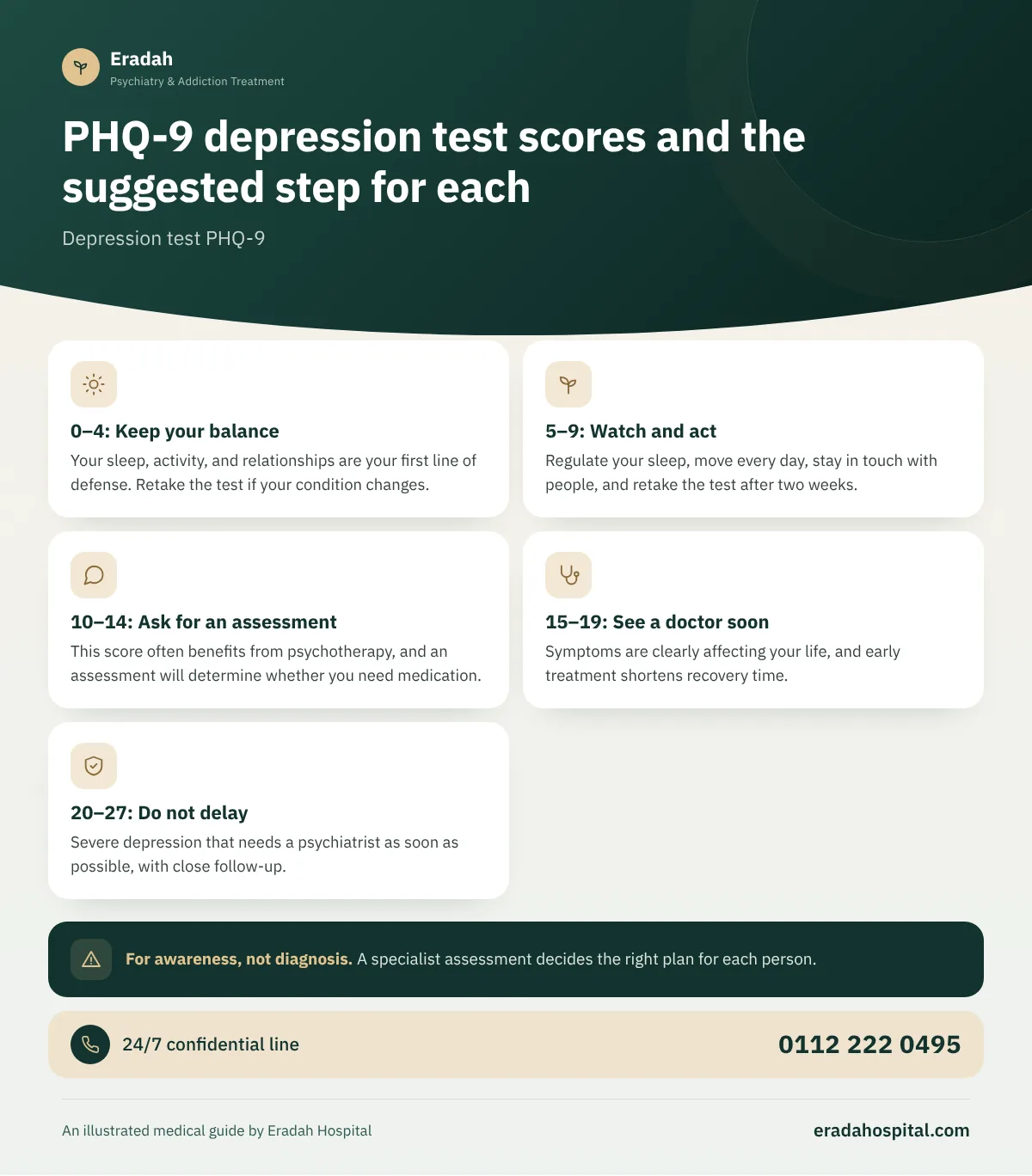
Infographic explaining PHQ-9 depression test results: 0–4: keep your balance, 5–9: watch and act, 10–14: ask for an assessment, 15–19: see a doctor soon, 20–27: do not delay
PHQ-9 depression test scores and the suggested step for each

What is the PHQ-9?

PHQ-9 stands for “Patient Health Questionnaire-9.” It was developed by American physicians and published in 2001, and its nine questions correspond to the nine diagnostic criteria for major depression in the diagnostic manual. In the original validation study, a score of 10 or higher identified about 88% of cases of major depression, with similar accuracy in ruling out people without it. This is why doctors use it for initial screening and for tracking improvement during treatment.

Limits of the test

  • It does not diagnose depression; a diagnosis requires an interview with a psychiatrist.
  • It cannot tell depression apart from bipolar disorder or from normal grief after a loss.
  • Some physical conditions, such as thyroid problems and anemia, cause similar symptoms.
  • Drugs, alcohol, and withdrawal from them can raise the score temporarily.
  • A low score does not rule out a problem if you are truly struggling.

Depression and addiction

If your score is high and you use alcohol, sedatives, hashish, or painkillers to cope with your feelings, the two problems feed each other. Treating them together works better than treating each one separately, and this is what the treatment program for depression with addiction offers.

Frequently asked questions

Frequently asked questions about the depression test

Didn’t find your answer?

Ask a specialist directly. The reply is confidential and carries no commitment.

Ask on WhatsApp
How do I know if I have depression?

A self-test gives an indication, but a diagnosis requires a psychiatrist who assesses your symptoms, how long they have lasted, and their impact, and who rules out other causes.

Is the PHQ-9 accurate?

It is one of the most accurate and widely used depression screening tools, and a score of 10 or higher picks up most cases of major depression, but it is not a diagnosis.

What does a score of 10 mean on the depression test?

A score of 10 to 14 indicates moderate symptoms, and a psychological assessment is recommended because this level often benefits from treatment.

How often should I retake the depression test?

About every two weeks if you are monitoring your condition, or as your doctor directs during treatment.

Is the test result saved?

No. The calculation happens on your device only, and the answers are not sent or saved anywhere.

Is the test suitable for children and teenagers?

A modified version exists for teenagers, but assessing children and teenagers requires a specialist, with the parents taking part.

What should I do if my result is severe?

Book an appointment with a psychiatrist as soon as possible, and if you have thoughts of harming yourself, contact 16328 or 123 immediately.

Need a suitable treatment plan?

Your information is confidential and is not shared with anyone

Call WhatsApp Consultation