What is the relationship between depression and addiction?
Depression and substance use disorders are among the conditions that most often occur together in psychiatry. The US National Institute on Drug Abuse (NIDA) notes that a large share of adults with a mental disorder also have a substance use disorder, and that when the two occur together, symptoms are often more severe, longer-lasting and harder to treat than either one alone.
The relationship works in three directions: depression may come before substance use and drive it, substance use may cause depression or reveal it, and the two may share common roots such as genetic predisposition, early trauma and chronic stress. Whatever the order, each condition feeds the other.
Why do people with depression turn to drugs?
It rarely starts with a wish to "have fun." More commonly, a person with depression looks for a quick way out of a pain no one understands, which doctors call self-medication:
Insomnia is one of the hardest symptoms of depression, so some turn to sedatives, alcohol or hashish to sleep.
Exhaustion and loss of energy push some toward tramadol or stimulants "so they can work."
A wish to switch off negative thoughts and painful memories, even for a few hours.
Feeling uninhibited with others, or easing the social anxiety that comes with it.
Some people see substance use as less "shameful" than visiting a psychiatrist, so they delay real treatment.
The problem is that this "relief" is temporary. With repetition the brain adapts, natural pleasure drops further, depression and anxiety get worse between uses, and the substance is needed in larger amounts for the same effect, until self-medication turns into addiction.
Which substances are commonly used with depression?
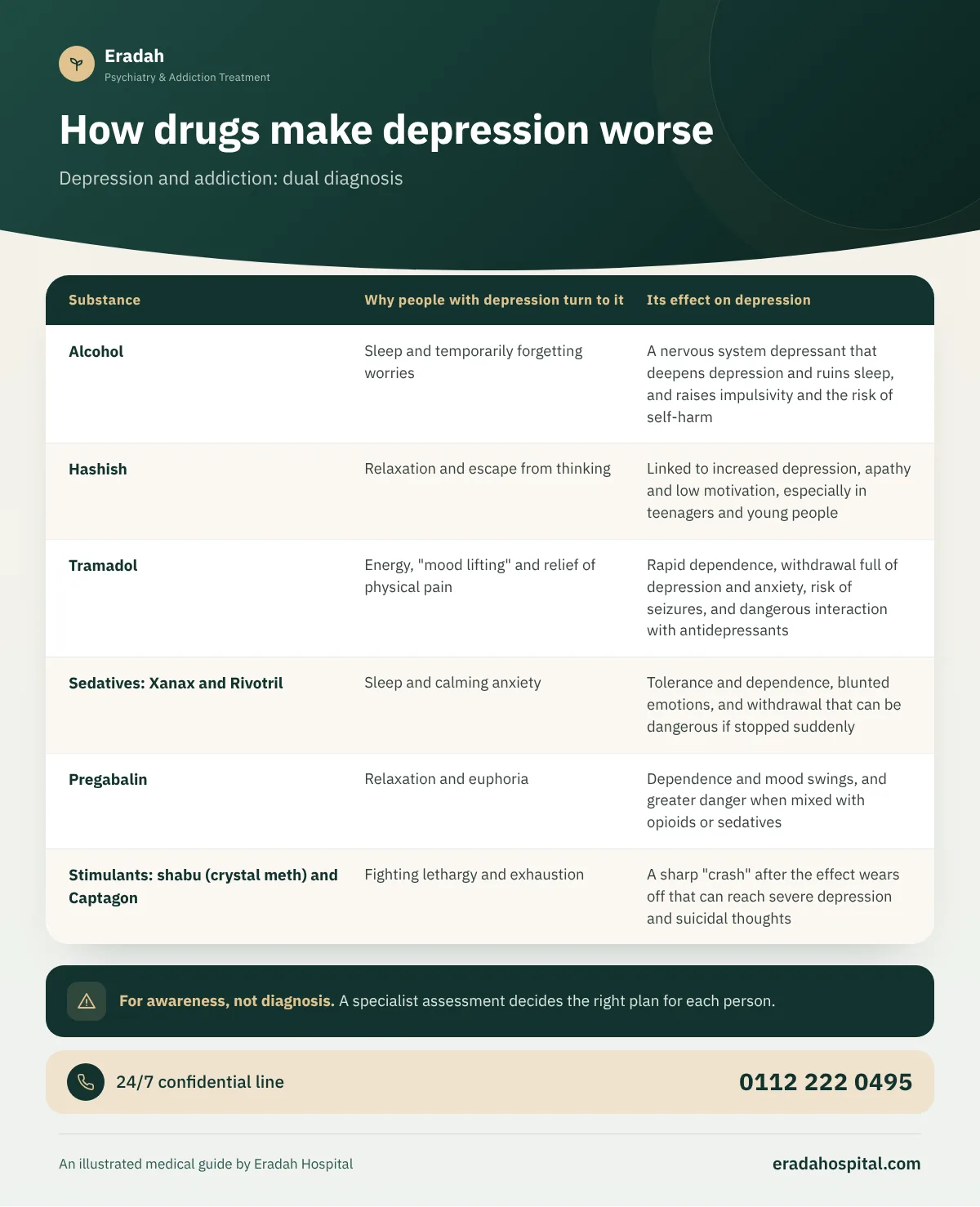
| Substance | Why people with depression turn to it | Its effect on depression |
|---|---|---|
| Alcohol | Sleep and temporarily forgetting worries | A nervous system depressant that deepens depression and ruins sleep, and raises impulsivity and the risk of self-harm |
| Hashish | Relaxation and escape from thinking | Linked to increased depression, apathy and low motivation, especially in teenagers and young people |
| Tramadol | Energy, "mood lifting" and relief of physical pain | Rapid dependence, withdrawal full of depression and anxiety, risk of seizures, and dangerous interaction with antidepressants |
| Sedatives: Xanax and Rivotril | Sleep and calming anxiety | Tolerance and dependence, blunted emotions, and withdrawal that can be dangerous if stopped suddenly |
| Pregabalin | Relaxation and euphoria | Dependence and mood swings, and greater danger when mixed with opioids or sedatives |
| Stimulants: shabu (crystal meth) and Captagon | Fighting lethargy and exhaustion | A sharp "crash" after the effect wears off that can reach severe depression and suicidal thoughts |
Many of these substances are medications with legitimate medical uses, such as tramadol, sedatives and pregabalin. Anyone taking them by prescription must not stop or change them without the treating doctor, especially sedatives, where sudden stopping can cause seizures.
How do drugs and alcohol make depression worse?
- They change reward chemistry: repeated use drains the brain's natural pleasure systems, so loss of pleasure, the core of depression, increases.
- They ruin sleep: even substances that "put you to sleep" damage sleep quality, so the person wakes more tired and discouraged.
- Withdrawal cycles: with each withdrawal, depressive symptoms and anxiety intensify, and the person goes back to using to get rid of them.
- They weaken treatment: they reduce the effectiveness of antidepressants and lower commitment to sessions and medication.
- They multiply losses: the financial, work and family problems caused by addiction deepen hopelessness and guilt.
- They raise the risk of self-harm: especially alcohol and sedatives, because they increase impulsivity and weaken judgment.
Is the depression caused by drugs, or is it a separate illness?
This is a fundamental question in dual diagnosis. Substance-induced depression appears during use or withdrawal and usually improves within weeks of stopping. Independent depression, on the other hand, may come before substance use, persist for a long time after stopping (about a month or more after withdrawal ends), or recur during periods of abstinence.
| Measure | Points toward substance-induced depression | Points toward independent depression |
|---|---|---|
| Timing | Began after use or during withdrawal | Clearly began some time before substance use |
| After stopping | Improves gradually over weeks | Continues for more than about a month after withdrawal ends |
| History | No depressive episodes during periods of abstinence | Earlier episodes or a family history of depression |
| Severity | In proportion to the type and amount of the substance | More severe than would be expected from the substance alone |
Telling them apart does not mean delaying help: severe symptoms or suicidal thoughts are treated immediately whatever their cause, and then reassessed after a period of abstinence.
Can tramadol or alcohol be combined with antidepressants?
That is why being honest with the psychiatrist is necessary medical information for choosing a safe medication, and the patient is not judged for it. Medical information is confidential.
Why must depression and addiction be treated together?
In the past, patients heard: "Treat the addiction first, then we'll look at the depression," or the reverse. But modern evidence, including what NIDA affirms, shows that integrated treatment, which treats both conditions together by one team, achieves better results. Treating addiction alone leaves the depression pushing toward relapse, and treating depression alone falters while substance use continues.
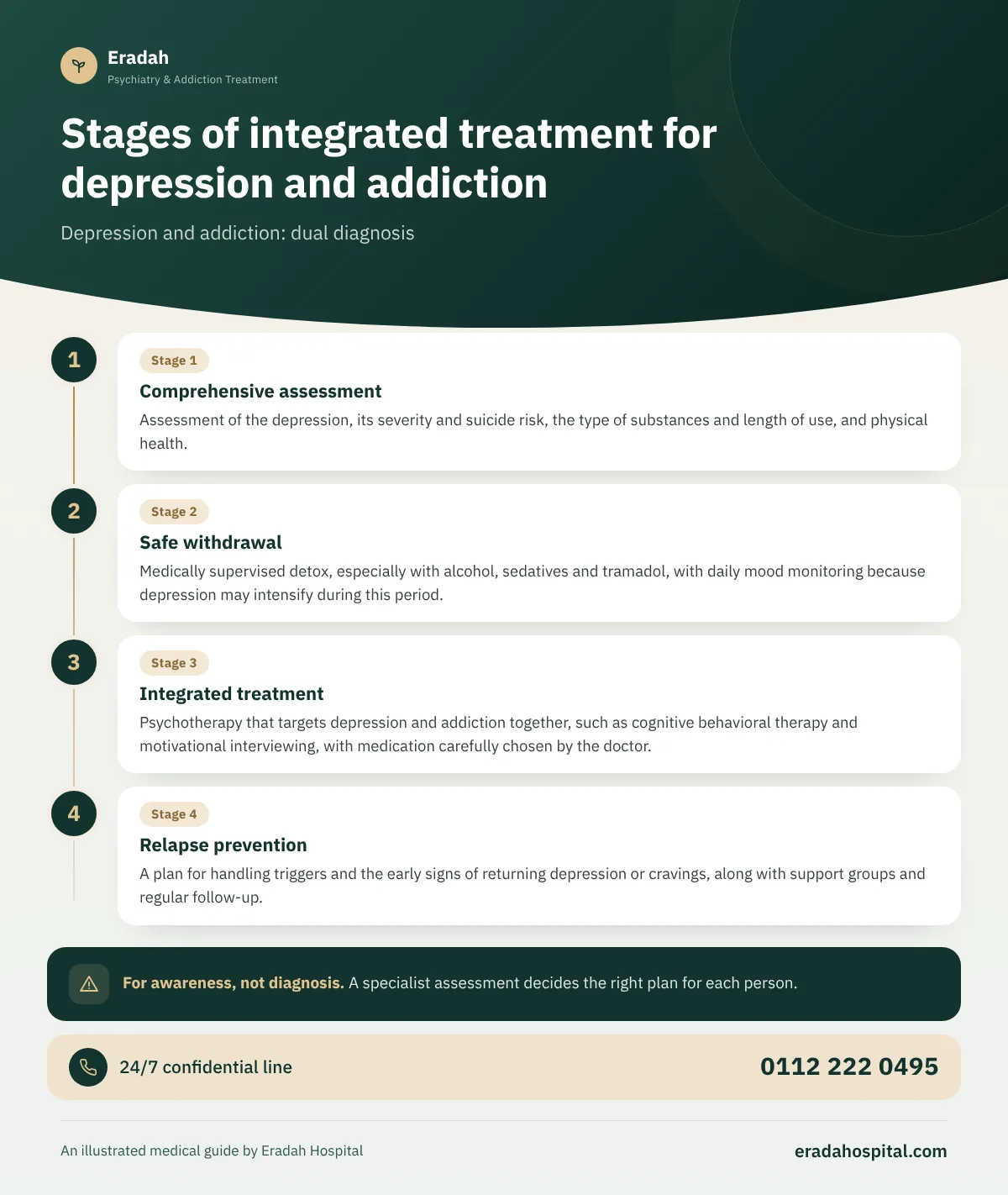
- Stage 1Comprehensive assessment
Assessment of the depression, its severity and suicide risk, the type of substances and length of use, and physical health.
- Stage 2Safe withdrawal
Medically supervised detox, especially with alcohol, sedatives and tramadol, with daily mood monitoring because depression may intensify during this period.
- Stage 3Integrated treatment
Psychotherapy that targets depression and addiction together, such as cognitive behavioral therapy and motivational interviewing, with medication carefully chosen by the doctor.
- Stage 4Relapse prevention
A plan for handling triggers and the early signs of returning depression or cravings, along with support groups and regular follow-up.
It is important for the patient to know that the first weeks after stopping can be hard on mood, that this is expected and temporary and can be managed, and that it is not proof that they "cannot live without the substance." Learn more about dual diagnosis and about depression treatment.
What signs suggest that a person with depression has started using substances?
- A sudden, unexplained improvement in mood or energy followed by a sharp crash.
- Repeated requests for painkillers, sedatives or "sleeping pills," or moving between doctors to get them.
- A growing need for money with no clear reason, or things disappearing from the home.
- A change in circle of friends and staying out late.
- Unusual drowsiness, slow speech, or sharp swings in irritability.
- More talk of hopelessness or death along with substance use, a danger sign that calls for help immediately.
How should a family deal with a son who has depression and addiction together?
The family faces a doubly difficult situation, and the natural reaction is anger or blame. But remember that substance use is often a failed attempt to get rid of real pain. It is better to talk calmly about your worry for him, not accusation, to separate rejecting the substance use from accepting the person, and to look for a center that treats both conditions together, not just one.
Avoid giving him money or medication "to calm him down," and do not try to withdraw the substance from him at home by force, especially alcohol and sedatives, because withdrawal can be dangerous. In any crisis involving talk of death or self-harm: do not leave him alone, and call the ambulance (123) or the mental health support line (16328).
Dual diagnosis treatment at Eradah
Dual diagnosis is at the heart of the work at Eradah Center: one team of psychiatrists and therapists assesses depression and addiction together, supervises safe withdrawal, and builds an integrated psychological and medication treatment plan, with a relapse prevention program and family support, in complete confidentiality. The Fund for Drug Control and Treatment of Addiction hotline (16023) also offers free, confidential treatment to those who need it.
Suicidal thoughts or danger to self? Get help now
- Talk about wanting to die, being a “burden” on others, or life having no meaning
- Severe despair and a feeling that there is no way out and no hope of getting better
- Suddenly saying goodbye to family and friends, giving away personal belongings or putting affairs in order
- Complete withdrawal from people, or a sudden unexplained calm after a period of intense distress
- Increased use of alcohol or drugs, or reckless behavior that puts their life at risk
Do not leave the person alone. Ask them calmly and directly about their thoughts and listen without judgment or blame; asking does not plant the idea, it opens the door to help. Call the ambulance on 123 or take them to the nearest emergency room, or call the mental health support line 16328 (24 hours), and keep medications and anything they could harm themselves with out of reach.
Ambulance 123 Mental health support line 16328