What are the two core symptoms of depression?
Depression centers on two main symptoms, and at least one of them must be present: depressed mood (sadness, emptiness or hopelessness, which may appear as irritability in the young), and loss of pleasure and interest in things that used to make the person happy, which doctors call "anhedonia."
This symptom, one or the other, lasts most of the day, on most days, for at least two weeks, together with other symptoms that complete the picture. A day or two of distress after a hard event is not depression, but weeks of continuous loss of enthusiasm and energy deserve attention.
Importantly, loss of pleasure can be more obvious than sadness itself: the person does not necessarily cry, but stops meeting friends, neglects hobbies, is not excited by any happy news, and says "it doesn't matter to me."
What are the psychological and cognitive symptoms of depression?
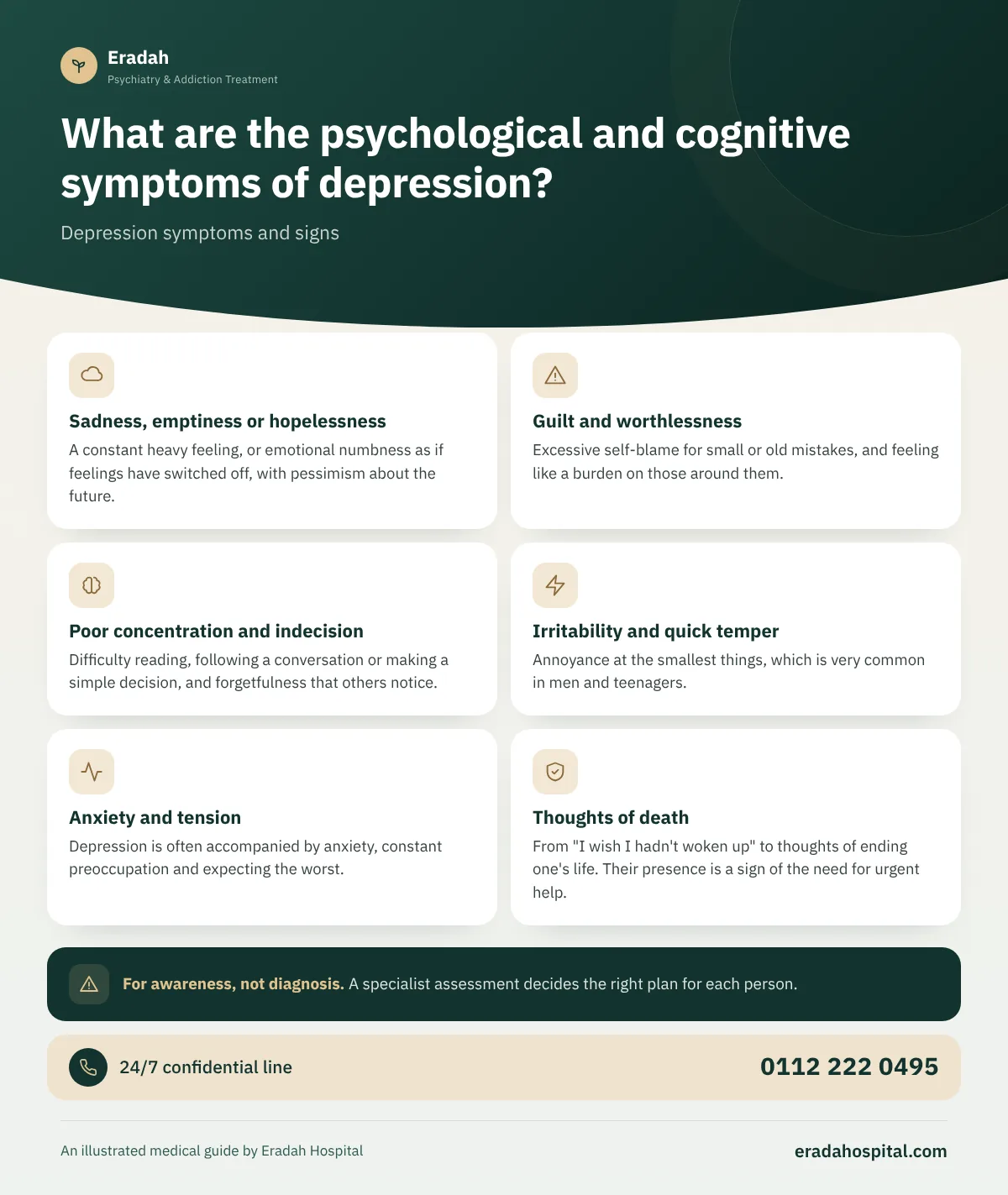
A constant heavy feeling, or emotional numbness as if feelings have switched off, with pessimism about the future.
Excessive self-blame for small or old mistakes, and feeling like a burden on those around them.
Difficulty reading, following a conversation or making a simple decision, and forgetfulness that others notice.
Annoyance at the smallest things, which is very common in men and teenagers.
Depression is often accompanied by anxiety, constant preoccupation and expecting the worst.
From "I wish I hadn't woken up" to thoughts of ending one's life. Their presence is a sign of the need for urgent help.
These negative thoughts are part of the illness, not a truth about the person. Depression colors memory, the present and the future in a dark shade, so the patient remembers failures, forgets successes, and believes things will never change.
What are the physical symptoms of depression?
In Egypt and the Arab world generally, depression often reaches the doctor as a physical complaint: "my body is broken," "a headache that won't go away," "I'm tired all the time and don't know why." The patient moves between clinics and lab tests before anyone considers a psychological cause. The most common physical symptoms:
| Symptom | How the patient often describes it |
|---|---|
| Tiredness and low energy | "I have no energy for anything," exhaustion even after long sleep |
| Sleep disturbance | Insomnia or very early waking with inability to go back to sleep, or sleeping excessively all day |
| Changes in appetite and weight | Loss of appetite and weight loss, or overeating and weight gain |
| Unexplained pain | Headache, back, neck and joint pain, heaviness in the chest or limbs |
| Digestive disturbances | Bloating, constipation, stomach pain, nausea |
| Slowing down or restlessness | Slowed movement and speech that others notice, or being unable to sit still |
| Other changes | Reduced sexual desire, and palpitations or shortness of breath with accompanying anxiety |
How does behavior change with depression?
- Withdrawing from people, avoiding visits and occasions, and frequently declining invitations.
- Neglecting self-care, appearance and personal hygiene, or neglecting the home and children.
- A clear decline in performance at work or school, with frequent absences and lateness.
- Spending long hours in bed or on the phone without real enjoyment.
- Crying easily, or on the contrary, difficulty crying despite distress.
- Smoking more, or turning to alcohol, sedatives or other substances to ease feelings.
- Reckless behavior or disregard for safety, especially in young people.
Do the signs of depression differ between men and women?
In men, sadness may hide behind anger and irritability, excessive immersion in work, sport or the phone, substance use, and complaints of fatigue or sexual performance problems. Because society expects a man to "tough it out," many are slow to seek help until the condition worsens.
In women, depression is more common, and may be linked to hormonal periods such as before menstruation, pregnancy, after childbirth and menopause. Women talk more about sadness, guilt and anxiety, and some sleep or eat more. Postpartum depression is explained in detail on the page types of depression.
Depression across a woman's life stages in brief
The core symptoms are the same, but depression is about one and a half times more common in women according to the World Health Organization, and is linked to specific hormonal periods: before menstruation, pregnancy and after childbirth, and approaching menopause. It often shows up as anxiety, exhaustion, guilt and physical pain, and a woman may appear to be "doing her duties" in front of others while suffering in silence.
We detail the signs of each stage and the treatment options suitable during pregnancy and breastfeeding on the page Symptoms of depression in women: how they change across life stages, and you will also find postpartum depression. Residential treatment at Eradah is for men only, but the first free consultation is available to women and their families to help understand the condition and direct them to the right place.
How does depression appear in teenagers and children?
Children and teenagers do not express depression the way adults do, so it is often misread as "bad manners," "being spoiled" or "just a phase." Signs worth noticing include:
- Irritability and repeated angry outbursts instead of obvious sadness.
- A sudden drop in grades or refusing to go to school.
- Isolating in their room and dropping friends and favorite activities.
- Repeated physical complaints such as headaches and stomachaches with no medical cause.
- Changes in sleep (staying up late and then sleeping during the day) or in eating.
- Statements like "I'm a failure" or "nobody loves me," self-harm, or talk about death.
If parents notice these signs, it is best to talk calmly and without accusation, then consult a child and adolescent psychiatrist, involving the school when needed. Early intervention at this age protects their future, both academically and psychologically.
What are the signs of depression in older adults?
Depression in older adults is often overlooked because it is put down to "old age." But depression is not a normal part of aging. In them it may appear as many physical complaints, loss of appetite and weight loss, slowing and withdrawal, memory and concentration problems that may be mistaken for dementia, and refusing to take medication for chronic illnesses. The risk rises with loneliness, loss of a spouse and chronic illness.
What is the difference between mild, moderate and severe depression?
| Level | The general picture | Effect on life |
|---|---|---|
| Mild | A number of symptoms close to the minimum for diagnosis, with limited severity | The person can continue most tasks but with great effort |
| Moderate | More numerous or more severe symptoms | Clear disruption of work, study or family life |
| Severe | Most symptoms present and strong; suicidal thoughts or psychotic symptoms may appear | Great difficulty performing the simplest tasks, and urgent care may be needed |
Determining the degree helps the doctor choose the right plan, and is done through a clinical interview and sometimes validated scales. Even "mild" depression deserves attention because it can progress if neglected.
How can a family notice the signs of depression?
The family is often the first to notice, even before the person. Watch for a clear change from the person's usual self: the sociable son who has become withdrawn, the energetic mother who no longer leaves her bed, or the calm father who has become quick to anger. A change that lasts for weeks matters more than any single sign.
Avoid phrases like "you have everything, why are you depressed?" or "strengthen your faith and you'll be fine." It is better to say: "I've noticed you've been struggling lately, and I'm worried about you. Would you like us to go see a doctor together?"
Questions to help you assess yourself
- Have you felt sad, down or hopeless on most days over the past two weeks?
- Have you lost interest or pleasure in things you used to love?
- Have your sleep or appetite changed noticeably?
- Do you feel tired or low on energy even without effort?
- Has it become harder to concentrate or make decisions?
- Do you blame yourself a lot or feel worthless?
- Have you had thoughts that you would be better off not being here? If the answer is yes, talk to someone now or call 16328.
If a number of these questions apply to you for more than two weeks, or they affect your life, your next step is to see a psychiatrist. Learn about depression treatment options.
When do depression symptoms call for seeing a doctor immediately?
- Thoughts of death or self-harm to any degree.
- Stopping eating, drinking or caring for oneself.
- Hallucinations or unrealistic ideas, such as feeling guilty about disasters one has nothing to do with.
- Depression after childbirth with thoughts of harming oneself or the baby.
- Depression alternating with periods of excessive energy, reduced sleep and impulsivity, which may point to bipolar disorder.
Suicidal thoughts or danger to self? Get help now
- Talk about wanting to die, being a “burden” on others, or life having no meaning
- Severe despair and a feeling that there is no way out and no hope of getting better
- Suddenly saying goodbye to family and friends, giving away personal belongings or putting affairs in order
- Complete withdrawal from people, or a sudden unexplained calm after a period of intense distress
- Increased use of alcohol or drugs, or reckless behavior that puts their life at risk
Do not leave the person alone. Ask them calmly and directly about their thoughts and listen without judgment or blame; asking does not plant the idea, it opens the door to help. Call the ambulance on 123 or take them to the nearest emergency room, or call the mental health support line 16328 (24 hours), and keep medications and anything they could harm themselves with out of reach.
Ambulance 123 Mental health support line 16328