“He'll either die or end up in prison.” A worn-out mother sometimes says this, and the patient himself sometimes says it in despair. The question of where addiction ends is a legitimate and hard one, and the honest answer has two sides: what really happens if addiction continues, and what happens when treatment begins. Both are real.
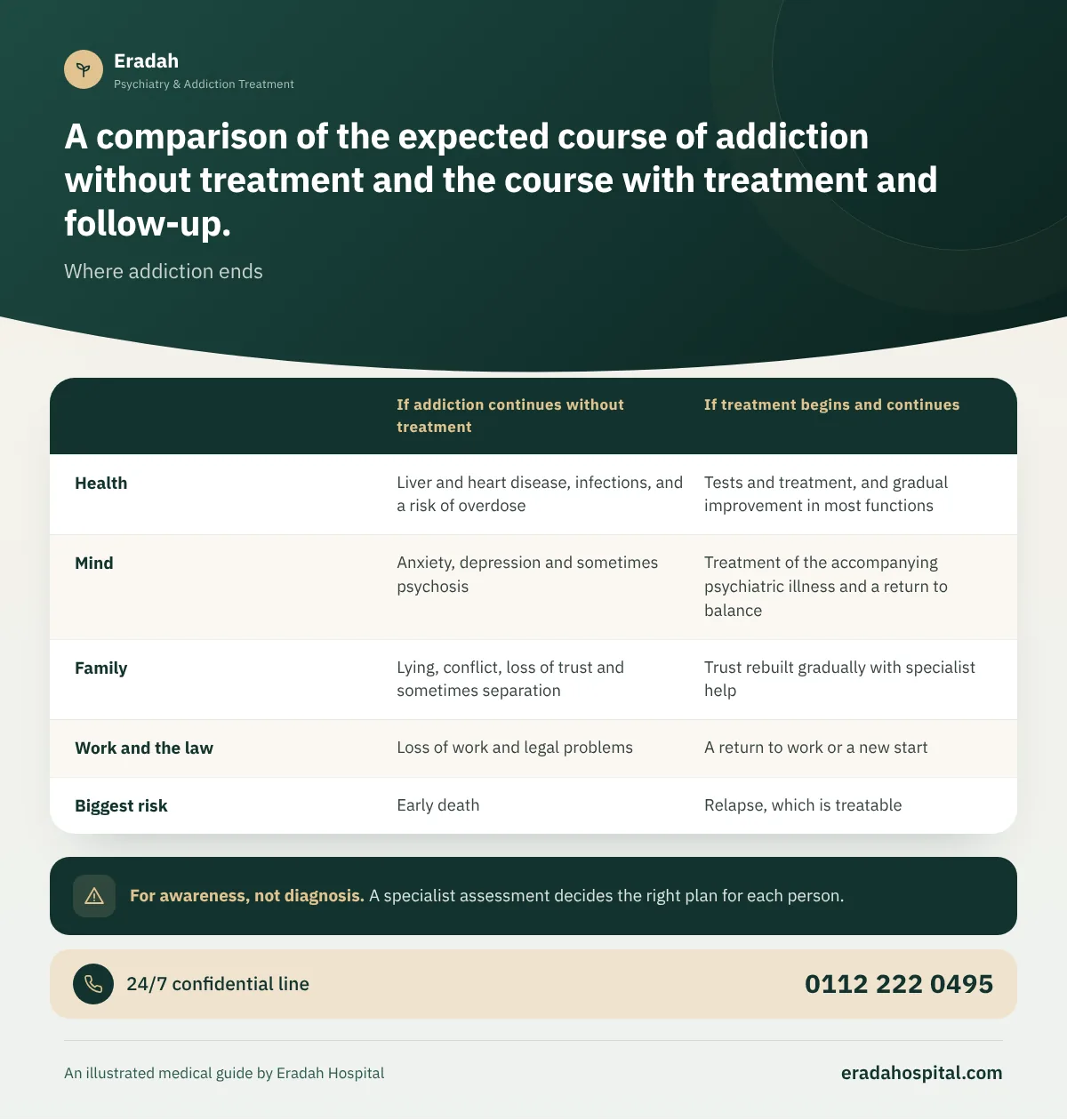
Where addiction ends: two paths, not one
| If addiction continues without treatment | If treatment begins and continues | |
|---|---|---|
| Health | Liver and heart disease, infections, and a risk of overdose | Tests and treatment, and gradual improvement in most functions |
| Mind | Anxiety, depression and sometimes psychosis | Treatment of the accompanying psychiatric illness and a return to balance |
| Family | Lying, conflict, loss of trust and sometimes separation | Trust rebuilt gradually with specialist help |
| Work and the law | Loss of work and legal problems | A return to work or a new start |
| Biggest risk | Early death | Relapse, which is treatable |
Is death the end for a person with addiction?
Not necessarily, but the risk is real. According to the World Health Organization, about 600,000 deaths worldwide in 2019 were linked to drug use, nearly 80% of them related to opioids, and about a quarter of these deaths were directly due to overdose. The rest come from illness, accidents and long-term complications.
Among the most dangerous moments in addiction, the organization notes, is returning to opioids after a break, such as after leaving prison, detox or treatment, because the body has lost its tolerance. The organization also counts injecting and mixing with alcohol and sedatives among the main risk factors. The emergency details are in the overdose guide.
Physical and psychological illness
The US National Institute on Drug Abuse notes that people with addiction often have accompanying health problems, including lung and heart disease, stroke, cancer and psychiatric disorders. With injecting, hepatitis virus and HIV infections are added. Psychologically, long-term use of some substances, such as crystal meth (shabu) and synthetic cannabinoids, can lead to drug-induced psychosis, and may worsen depression and anxiety.
Prison and legal problems
According to the summary of the World Drug Report 2026 from the United Nations Office on Drugs and Crime, about 5.9 million people worldwide were in formal contact with the criminal justice system for drug offenses in 2024, about two thirds of them for use or possession. In Egypt the law opens a different door for those who come forward for treatment of their own accord, as the guide to Egypt's addiction treatment law explains.
Losing family and work
The ending that is often not written in the statistics is the harshest: a wife worn out, children growing up in fear, a father and mother draining their money and health, a job lost. The harms of drugs guide details this impact on the family and society. These losses are not always final; many families come back together once real treatment begins.
The other ending: recovery
In a study published by John Kelly and colleagues in 2017 on a sample representing US adults, 9.1% said they once had a problem with alcohol or drugs and no longer did, and the researchers estimated that tens of millions have resolved these problems in different ways, from formal treatment to support groups and others. So recovery is not a rare exception, as many people think.
Why don't many people reach treatment?
The summary of the World Drug Report 2026 notes that only one in 12 people with drug use disorders receives treatment, and that the proportion among women is much lower. Known reasons include stigma, fear, too few services and not knowing the way, all of which can be overcome with one small first step.
What changes where addiction ends?
- Early treatment, before the harms accumulate.
- Staying in treatment long enough, not stopping at detox.
- Treating accompanying psychiatric illness as part of dual diagnosis.
- A family that knows how to support without being drained.
- Long follow-up that treats relapse as a signal, not an ending.
If you are reading this about yourself or someone you love, the first step may be a phone call. If there are suicidal thoughts or immediate danger, call ambulance 123 or the mental health support line 16328.