"If he wanted to quit, he would have quit." This is the sentence a person with addiction hears most from those around him, and the most unfair to him. Understanding what addiction is scientifically does not excuse the person from responsibility, but it explains why intention alone is not enough, and why many people need real treatment.
What is addiction? The scientific definition
The American Society of Addiction Medicine defines addiction as a chronic, treatable medical disease arising from complex interactions among brain circuits, genetics, the environment, and a person's life experiences, which leads the affected person to use substances or engage in behaviors that become compulsive and to continue them despite the consequences. Psychiatrists use the term "substance use disorder," diagnosed according to the DSM-5 diagnostic manual, which grades severity, as the US National Institute on Alcohol Abuse and Alcoholism explains, as mild when two or three criteria are met, moderate when four or five are met, and severe when six or more are met; what people call "addiction" usually corresponds to the severe level.
Signs that distinguish addiction from mere use
- Using in larger amounts or for longer than the person intended.
- Repeated unsuccessful attempts to cut down or stop.
- Craving and a strong urge that dominate thinking.
- Neglecting work, study, or family because of use.
- Continuing despite clear health, psychological, or social problems.
- Needing larger amounts for the same effect, and withdrawal symptoms when stopping.
The signs a family sees from the outside differ, and they are explained in our guide to signs of drug use.
How does addiction change the brain?
Most drugs act on the brain's reward system, raising dopamine far more strongly than natural rewards such as food and relationships. With repetition the brain adapts: the sensitivity of the reward circuits falls, so the person needs the substance to feel normal, the stress circuits become active in its absence, and the frontal cortex, responsible for judgment, decision-making, and impulse control, weakens. The US National Institute on Drug Abuse notes that brain images of people with addiction show changes in the areas responsible for judgment, decision-making, learning, memory, and behavior control.
The researchers Koob and Volkow describe this process as a three-stage cycle that repeats: binge and intoxication, then withdrawal and negative feelings when the substance is absent, then preoccupation and anticipation, where thinking about the substance and craving it take over. With each cycle the circuit becomes deeper.
Stages of addiction
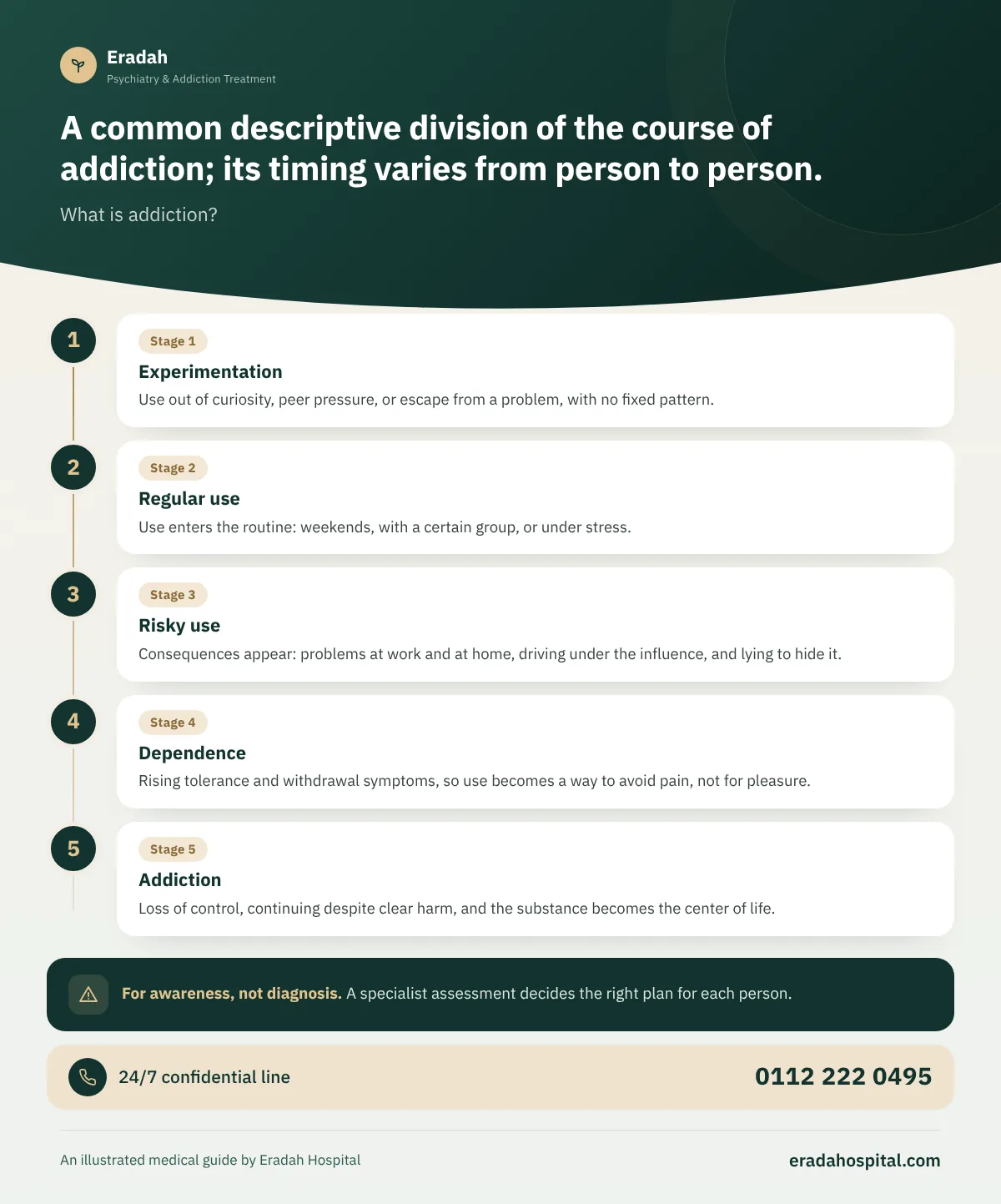
Addiction does not happen suddenly, but usually passes through successive stages. The following division is a common descriptive one, not an official diagnostic classification, and some substances such as shabu and heroin may compress these stages very quickly:
- Stage 1Experimentation
Use out of curiosity, peer pressure, or escape from a problem, with no fixed pattern.
- Stage 2Regular use
Use enters the routine: weekends, with a certain group, or under stress.
- Stage 3Risky use
Consequences appear: problems at work and at home, driving under the influence, and lying to hide it.
- Stage 4Dependence
Rising tolerance and withdrawal symptoms, so use becomes a way to avoid pain, not for pleasure.
- Stage 5Addiction
Loss of control, continuing despite clear harm, and the substance becomes the center of life.
Why is addiction considered a disease?
The US National Institute on Drug Abuse compares addiction to heart disease: both disrupt the normal function of an organ in the body, both have serious harms, both can be prevented and treated in many cases, and either can last a lifetime or lead to death if left untreated. The Institute estimates that genes, together with the influence of the environment on them, are responsible for 40 to 60% of vulnerability. It also notes that relapse rates in addiction are similar to those of chronic diseases such as high blood pressure and asthma, which is why it is treated as a chronic disease.
Is addiction limited to drugs?
Addiction includes substances such as alcohol, drugs, and misused medications such as tramadol and pregabalin, and the American Society of Addiction Medicine notes that addiction can also involve behaviors that become compulsive, which our behavioral addiction section explains. Addiction often occurs together with mental illnesses such as depression and anxiety, which is called dual diagnosis.
When should you ask for help?
If two or more of the signs above appear, or you tried to stop and failed, or withdrawal symptoms appeared, this is the time for an assessment, not for waiting. Some kinds of withdrawal, such as from alcohol and sedatives, can be dangerous and need medically supervised detox. Our guide to addiction treatment explains the stages and programs, and at Eradah the journey begins with a free and confidential first consultation.