What is dopamine?
Dopamine is a small chemical that carries signals between nerve cells, which makes it a neurotransmitter. A cell releases it at its tip, and it crosses a tiny gap called the “synapse” to attach to receptors on the neighboring cell and change its activity. It is then pulled back into the first cell by the “dopamine transporter” or broken down by enzymes.
Remarkably, the cells that make dopamine are very few compared with the billions of cells in the brain. They gather in small areas of the brainstem and hypothalamus, but their fibers reach wide regions. That is why a small disturbance in these groups can show up in movement, mood or behavior.
Outside the brain, dopamine is also made in the adrenal gland, some nerves and the kidneys, and it helps regulate blood vessels and salt excretion. But this “peripheral” dopamine does not cross the blood-brain barrier. That is why dopamine given intravenously in intensive care to treat low blood pressure does not reach the brain or affect mood.
How is dopamine made, and how does it work?
Dopamine production starts from the amino acid tyrosine, found in proteins. A specific enzyme converts it into an intermediate compound called L-DOPA, and a second enzyme converts that into dopamine. The first step is the slowest and controls the amount, and the body regulates it tightly. For this reason, eating foods rich in tyrosine does not directly raise brain dopamine, as is often claimed.
Parkinson’s disease treatment relies on this fact: dopamine itself does not cross into the brain, but L-DOPA does. The patient is given the drug levodopa so that the brain can make the dopamine it has lost, under the supervision of a neurologist.
Dopamine has five types of receptors, divided into two families. The D1 family (D1 and D5) mostly activates the receiving cell, and the D2 family (D2, D3 and D4) mostly suppresses its activity. Most antipsychotic medicines work by blocking D2 receptors, while Parkinson’s medicines called “dopamine agonists” work by activating them.
What are the four dopamine pathways in the brain?
Dopamine does not work in one place. It works through several nerve “routes,” each with a different function. That is why one pathway may need a boost while another needs calming in the same person:
| Course | From where to where | Function | What happens when it is disrupted |
|---|---|---|---|
| Nigrostriatal pathway | From the substantia nigra to the striatum | Starting movement, smooth movement and learning motor skills | Slowness, tremor and stiffness, as in Parkinson’s disease |
| Mesolimbic pathway (the reward pathway) | From the ventral tegmental area to the nucleus accumbens | Motivation, desire and learning from reward | Linked to addiction and to the positive symptoms of psychosis |
| Mesocortical pathway | From the ventral tegmental area to the prefrontal cortex | Focus, planning, working memory and impulse control | Poor attention and planning; linked to ADHD |
| Tuberoinfundibular pathway | From the hypothalamus to the pituitary gland | Suppressing release of the hormone prolactin | Raised prolactin with some antipsychotic medicines |
What does dopamine do in the body?
It drives you to get up and pursue a goal, from drinking water when you are thirsty to finishing a long project.
It rises when an outcome is better than expected, so the brain learns to repeat what led to it.
It is essential for starting movement and keeping it smooth, and its loss in the substantia nigra is the basis of Parkinson’s disease.
It helps the prefrontal cortex hold information, plan and ignore distractions.
It helps regulate alertness and is affected by sleep deprivation.
It suppresses prolactin, and outside the brain it affects blood vessels, the kidneys and the digestive system.
The most important scientific idea here is called “reward prediction error”: dopamine cells do not fire strongly for everything pleasant, but when a reward arrives better than expected. Once a reward becomes fully predictable, the activity shifts to the cue that comes before it, and if the reward is less than expected, activity drops. This is how the brain learns what is worth pursuing, and it is the same mechanism that drugs later exploit.
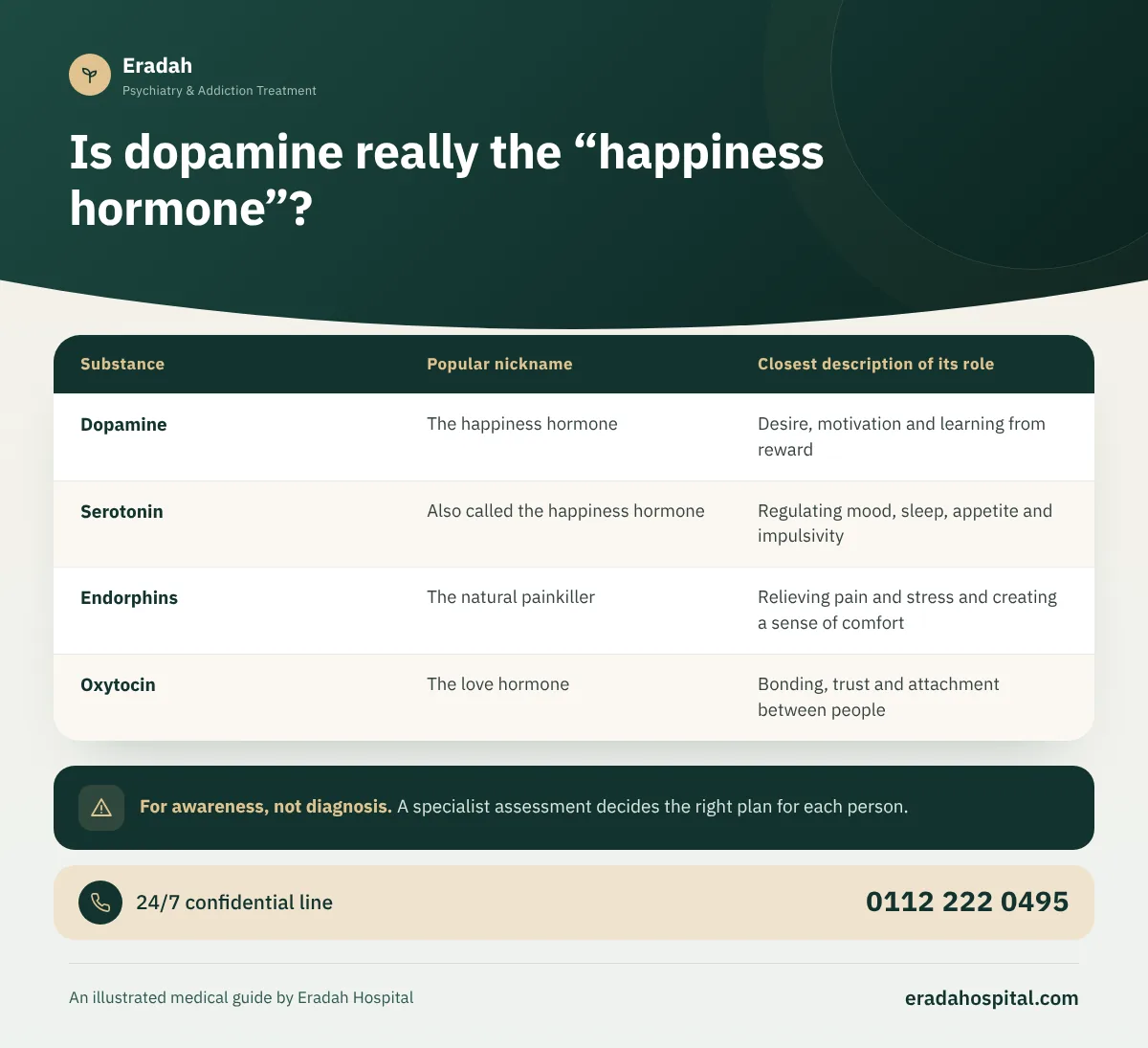
Is dopamine really the “happiness hormone”?
The nickname is popular but it is a misleading oversimplification. Much research suggests that dopamine’s most prominent role is “wanting,” seeking something and anticipating it, more than the feeling of pleasure while getting it. Other chemicals take part in the quiet pleasure after a delicious meal or a warm moment with family, such as endorphins and the body’s own cannabis-like substances.
That is why a person with addiction may crave a substance intensely even though it no longer gives them much pleasure: the wanting has become stronger than the feeling of happiness. Real happiness is also a complex state shared by many chemicals, including serotonin and oxytocin, along with relationships, meaning and circumstances. No single chemical sums it up.
| Substance | Popular nickname | Closest description of its role |
|---|---|---|
| Dopamine | The happiness hormone | Desire, motivation and learning from reward |
| Serotonin | Also called the happiness hormone | Regulating mood, sleep, appetite and impulsivity |
| Endorphins | The natural painkiller | Relieving pain and stress and creating a sense of comfort |
| Oxytocin | The love hormone | Bonding, trust and attachment between people |
How does dopamine balance with other chemicals?
Dopamine works within a balanced network. Glutamate, the main excitatory transmitter, carries context and memory information to it, GABA suppresses its cells, serotonin modulates impulsivity, and norepinephrine, which is responsible for alertness, is made from it. That is why changing one chemical with a medicine or a drug changes the whole network.
Balance here does not mean “more is better.” Too little in the movement pathway causes Parkinson’s symptoms, and too much in the reward pathway is linked to psychosis. Attention itself works best at a middle level and weakens with both severe deficiency and severe excess. We explain both ends in the pages on low dopamine and high dopamine.
Can dopamine be measured with a blood test?
Frankly: there is no blood or urine test that tells you the dopamine level in your brain. Dopamine in the blood comes mainly from the adrenal gland, nerves and kidneys, and it does not enter or leave the brain in a way that reflects what happens inside it. So the tests advertised online to “measure the happiness hormone” make no sense.
- Catecholamine tests in blood or urine: A doctor orders these to look for rare tumors that release these chemicals, such as pheochromocytoma in the adrenal gland, or neuroblastoma in children.
- Dopamine transporter imaging: A nuclear medicine scan that shows the density of dopamine cell endings in the striatum. It helps a neurologist tell Parkinson’s apart from other causes of tremor. It does not measure the “dopamine level.”
- Research imaging: Techniques such as positron emission tomography (PET) are used in research to measure dopamine release during music, games or drug use. They are not routine tests.
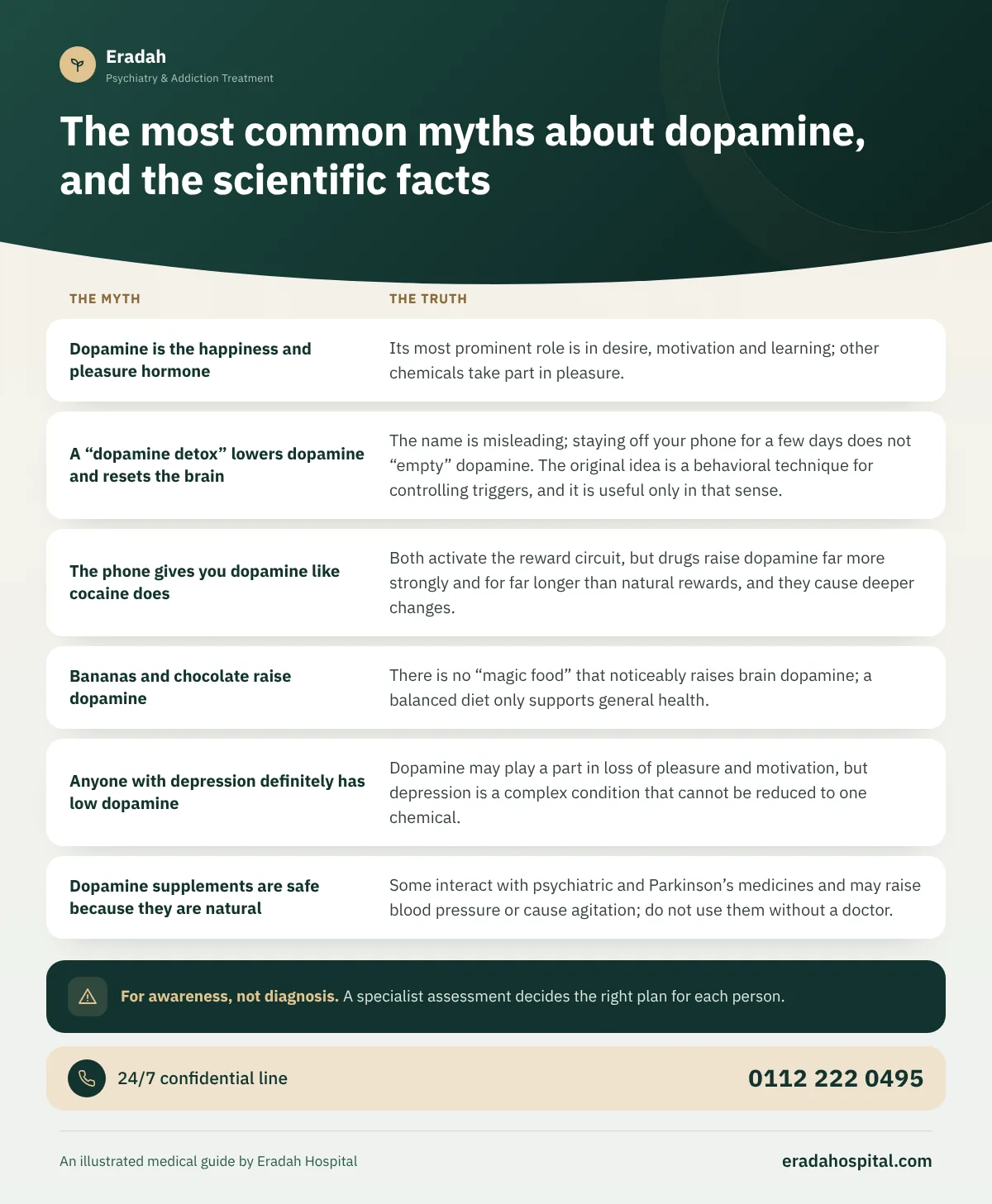
Common myths about dopamine, and the facts
| The myth | The truth |
|---|---|
| Dopamine is the happiness and pleasure hormone | Its most prominent role is in desire, motivation and learning; other chemicals take part in pleasure. |
| A “dopamine detox” lowers dopamine and resets the brain | The name is misleading; staying off your phone for a few days does not “empty” dopamine. The original idea is a behavioral technique for controlling triggers, and it is useful only in that sense. |
| The phone gives you dopamine like cocaine does | Both activate the reward circuit, but drugs raise dopamine far more strongly and for far longer than natural rewards, and they cause deeper changes. |
| Bananas and chocolate raise dopamine | There is no “magic food” that noticeably raises brain dopamine; a balanced diet only supports general health. |
| Anyone with depression definitely has low dopamine | Dopamine may play a part in loss of pleasure and motivation, but depression is a complex condition that cannot be reduced to one chemical. |
| Dopamine supplements are safe because they are natural | Some interact with psychiatric and Parkinson’s medicines and may raise blood pressure or cause agitation; do not use them without a doctor. |
In short, dopamine is part of a balanced system, not a friend to chase or an enemy to get rid of. This system works best with a regular life that includes sleep, movement, goals and relationships. When it is disrupted by illness or a drug, medical treatment is the way forward.
Dopamine guide: everything you need to know
We have gathered everything about dopamine into 5 pages, each answering one question in detail. Choose what you are looking for:
Dopamine deficiency: symptoms and causes
Signs of low dopamine in movement, mood, concentration and sleep, its link to Parkinson’s disease, ADHD and restless legs, and when to see a doctor.
High dopamine: symptoms and causes
What increased dopamine activity looks like in psychosis, mania, stimulant toxicity and medicine side effects, and when it is an emergency.
Ways to increase dopamine naturally
What science actually supports: sleep, exercise, music, small goals and relationships, with a table rating the strength of the evidence and exposing the myths.
Dopamine and addiction
How drugs hijack the reward circuit, why addiction turns into wanting without pleasure, and how the brain recovers with abstinence and treatment.
Dopamine detox: does it reset the brain?
Dopamine detox or dopamine fasting: where the idea came from, why the name is scientifically misleading, which part is useful, and how to do a smart digital fast instead of depriving yourself of every pleasure.
Stimulant overdose or acute psychosis? Call an ambulance (123) immediately
- Chest pain or pressure, a fast irregular heartbeat, or shortness of breath after using cocaine, crystal meth (shabu) or Captagon
- A very high body temperature with heavy sweating or dehydration, and agitation that does not settle
- Seizures, loss of consciousness, or signs of a stroke: a drooping face, a weak arm, sudden slurred speech
- Severe suspiciousness, hallucinations and aggressive behavior that may put the person or others in danger
- Severe muscle stiffness with a high temperature and confusion after starting an antipsychotic or suddenly stopping Parkinson’s medicines
Call an ambulance (123) immediately and do not wait for it to “calm down on its own.” Stay with the person in a quiet, cool, dimly lit place, speak calmly without arguing or restraining them by force, and if they lose consciousness, place them on their side. Tell the paramedics honestly what the person took; this speeds up treatment and is not meant to blame anyone. If there are thoughts of self-harm, call the mental health support line 16328.
Ambulance 123 Mental health support line 16328