“I was taking the sedative so I could sleep and then get up and look after the house and the kids, and nobody imagined I needed treatment.” Women’s addiction stories are often silent: they begin with pain, sleeplessness or a prescription and continue out of sight, because admitting to them seems harder for a woman in a society that shows little mercy.
Is addiction in women different from men?
Yes. The US National Institute on Drug Abuse explains that men use most types of drugs more, but women may follow a different path: for example, women develop cannabis use disorder more quickly after first use, and their distress is more strongly tied to panic attacks and anxiety disorders. A scientific review published in 2010 describes what researchers call the “accelerated” or telescoping course, meaning the gap between starting to use and developing addiction and its consequences may be shorter in women.
Causes of addiction in women and risk factors
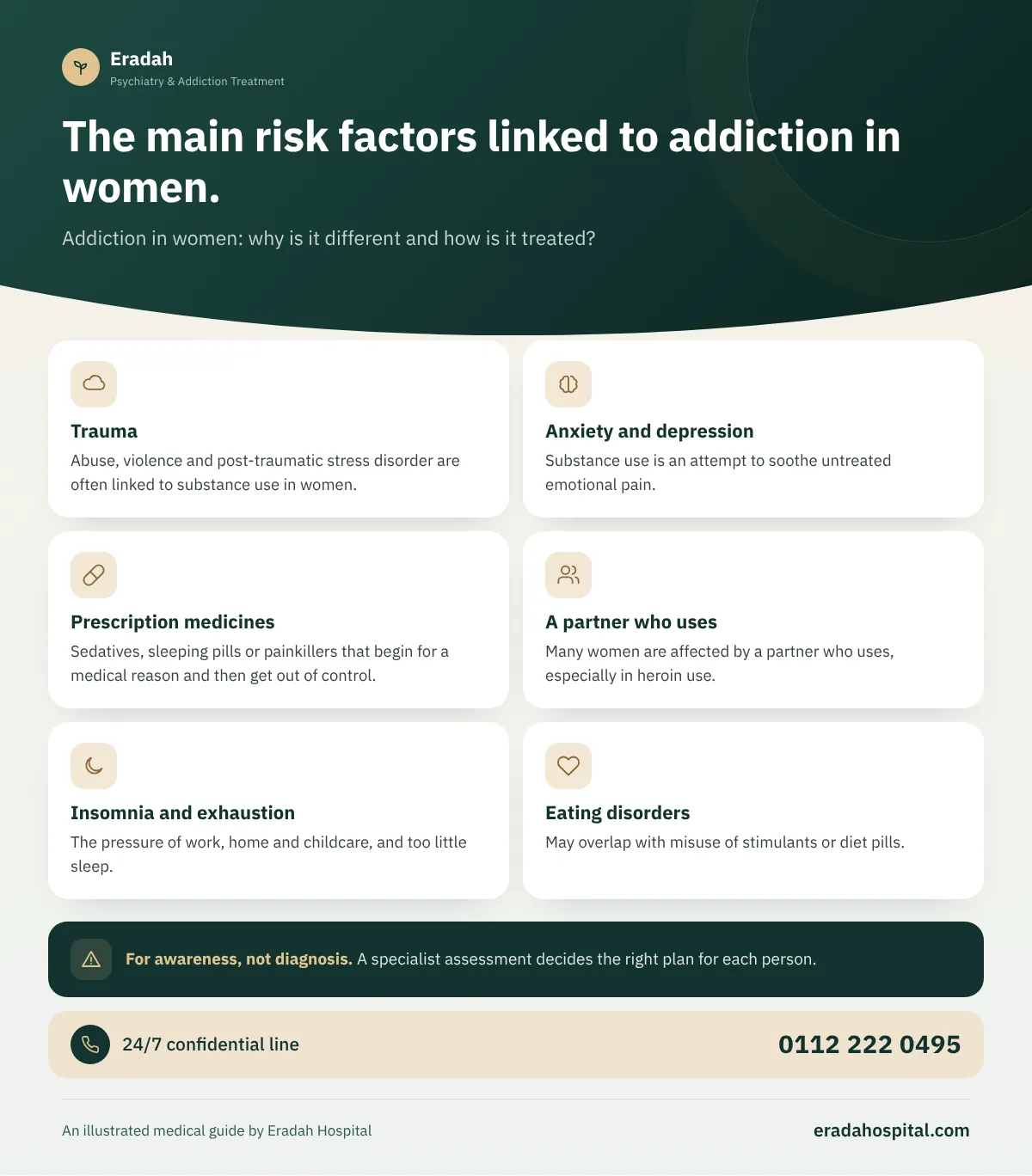
Abuse, violence and post-traumatic stress disorder are often linked to substance use in women.
Substance use is an attempt to soothe untreated emotional pain.
Sedatives, sleeping pills or painkillers that begin for a medical reason and then get out of control.
Many women are affected by a partner who uses, especially in heroin use.
The pressure of work, home and childcare, and too little sleep.
May overlap with misuse of stimulants or diet pills.
The US institute also notes that antidepressants and benzodiazepines send women to emergency departments more often than men, which may be because women are more prone to anxiety and insomnia and so are prescribed these medicines more often. This is why any sedative or sleeping pill should be followed up with the doctor and never increased on your own.
Alcohol and a woman’s body
According to the US National Institute on Alcohol Abuse and Alcoholism, alcohol-related health problems begin sooner and at lower amounts in women than in men. After drinking the same amount, a woman’s blood alcohol concentration is usually higher, because her body contains a lower proportion of water. Women who drink heavily on a regular basis are also more likely than men to develop alcoholic hepatitis, which can be fatal. You can find the details in the harms of alcohol.
Addiction during pregnancy and breastfeeding
Substances a pregnant woman uses reach the fetus. The US National Institute on Drug Abuse states that smoking, or using hashish, opioid painkillers or drugs during pregnancy is linked to double or triple the risk of stillbirth, and that regular use of some substances can cause withdrawal symptoms in the newborn after birth.
Why do women delay seeking treatment?
- Stigma and fear of scandal, which are often harsher on women.
- Fear of losing custody of their children, or of the reaction of a husband and family.
- The difficulty of leaving children and home for the period of treatment.
- Few places dedicated to women or suited to them.
- The belief that a prescribed medicine is “not addiction.”
The US institute stresses that many mothers do not start treatment, or leave it early, because they have no one to care for their children, and that programs that provide childcare and support for motherhood help them stay.
How is addiction in women treated?
The basic principles are the same: a comprehensive assessment, then medically supervised detox when needed, then psychological and behavioral rehabilitation and follow-up to prevent relapse. But treatment for women works better when it takes into account: trauma, approached in a safe therapeutic way that does not reopen the wound; anxiety and depression as part of dual diagnosis; the role of motherhood and children’s needs; and a safe environment free of any exploitation. The same scientific review notes that women are less likely to enter treatment, but sex alone does not predict staying in treatment or success once it has begun.
Does Eradah admit women?
Eradah’s residential treatment program is for men only, and we say so clearly out of respect for your time. But the free, confidential first consultation is open to everyone: you, or a member of your family, can contact us to understand the situation, assess the right step and be directed to a provider of the care needed. You can also ask through the hotline of the Fund for Drug Control and Treatment of Addiction, whose details are on the page about free addiction treatment.
Tips for the family of a woman who uses
The real scandal is leaving an illness untreated, not that a person falls ill. Treat her as a patient who needs support, not as someone guilty, protect her privacy, and help her in practical ways with childcare during treatment. If she is experiencing violence or abuse, safety comes first. The Family Guide offers steps for handling this without confrontation.