What is Xanax?
Xanax is a sedative whose active ingredient is alprazolam. It belongs to the benzodiazepines, the same family of medicines that includes Valium and Rivotril. It is mainly prescribed for generalized anxiety disorder and panic disorder, and it gives a quick feeling of calm and relaxation.
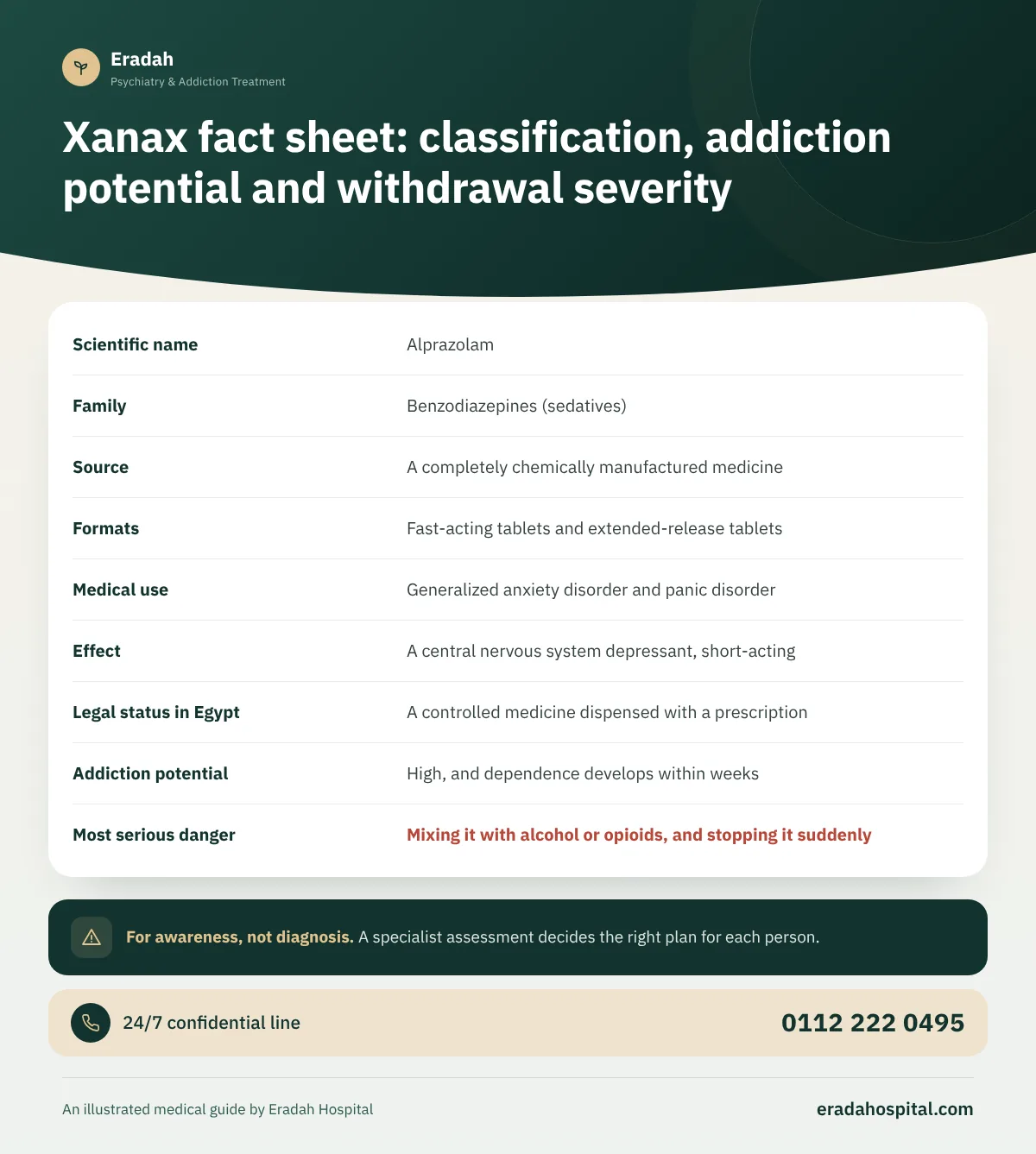
Alprazolam reached the market in the 1980s and became one of the most prescribed sedatives in the world because it quickly eases an anxiety attack. But the very speed that made it useful also made it one of the drugs in its family most associated with misuse and dependence.
It is important to distinguish between a patient who takes Xanax on prescription and under follow-up, and a person who takes it without a prescription, in larger amounts than prescribed, or to get high. The first needs regular medical follow-up to reduce risks, and the second needs a specialist assessment. Neither should stop the medicine suddenly.
Forms and names of Xanax
Alprazolam is available under several brand names depending on the manufacturer, the best known being Xanax. It comes in more than one dosage form:
The most common form; its effect begins within a short time and wears off within hours, so the need for another dose recurs during the day.
The substance is released slowly over the course of the day, and it is mostly prescribed for panic disorder to reduce the ups and downs between doses.
Pills made outside pharmaceutical factories to look identical to the real thing, which may contain far stronger substances.
How does Xanax affect the brain and body?
Xanax acts on GABA receptors. GABA is the neurotransmitter that works as the brain's natural brake. The drug strengthens this braking, calming the excessive nerve signals responsible for anxiety and tension, and its effects show up in several ways:
- Calming anxiety: eases fear, tension and panic attacks within a short time.
- Drowsiness and muscle relaxation: slows reactions and relaxes muscles, which is why driving afterward is warned against.
- Impaired formation of new memories: a person may not remember what happened while the drug was active.
- Respiratory depression: usually mild on its own, but very dangerous with alcohol or opioids.
With daily use, the brain adapts to the presence of the drug, reducing the sensitivity of GABA receptors and raising the activity of excitatory systems. This is where tolerance appears, meaning the need for more to get the same effect, followed by physical dependence, meaning unpleasant symptoms when the drug runs low.
Why does Xanax cause dependence faster than others?
The secret is how long it acts. Xanax reaches its peak blood concentration in about one to two hours, and its half-life is about 11 hours in healthy adults, much shorter than Valium, for example. This creates a repeating cycle: quick relief, then a quick drop in the level of the drug.
That drop can cause what is known as rebound anxiety or between-dose symptoms: tension and nervousness that appear before the next pill is due, so the person thinks their original anxiety is getting worse, when part of it comes from the drug itself. Over time the feeling of safety becomes tied to the pill, and the gap between doses narrows.
| Point of comparison | Xanax | Rivotril | Valium |
|---|---|---|---|
| Active ingredient | Alprazolam | Clonazepam | Diazepam |
| Duration of effect | Short | Long | Very long, with active breakdown products |
| Speed of onset | Fast | Moderate | Fast |
| Between-dose symptoms | Relatively common | Lower | Rare |
| Timing of withdrawal after stopping | Early, within hours to a day or two | After several days | Delayed, and may go beyond a week |
This comparison is general and approximate, and may vary from person to person depending on duration of use and health.
Does Xanax have a legitimate medical use?
Yes. Alprazolam is approved for generalized anxiety disorder and panic disorder, and it can be very helpful for short periods and under follow-up. But recent guidelines favor using it for the shortest possible time, alongside long-term psychological or medication treatment for anxiety that does not cause dependence.
If you take Xanax on prescription and feel you can no longer do without it, that is a known effect of the drug and does not reflect a personal failing. Speak to your doctor honestly, and do not try to stop on your own.
The legal status of Xanax in Egypt
In Egypt, Xanax is a controlled drug dispensed by prescription, and such medicines are subject to strict dispensing rules. Possessing or trading in it without a prescription exposes a person to legal liability. The Fund for Drug Control and Treatment of Addiction offers free, confidential consultation and treatment through hotline 16023.
This is general educational information and not legal advice.
Common myths about Xanax
| The myth | The truth |
|---|---|
| Xanax is completely safe because it is sold in pharmacies | It is a useful medicine in its place, but it is controlled because the risk of dependence and misuse is real. |
| I can't become dependent as long as I follow the prescription | Physical dependence can occur with daily use over weeks, even at prescribed doses. |
| If I feel better, I can stop any day | Stopping suddenly after regular use can cause severe withdrawal and seizures. |
| A little with alcohol does no harm | Together they multiply respiratory depression, which is one of the best-known causes of fatal accidents. |
| Xanax cures anxiety for good | It relieves symptoms temporarily, while treating the roots of anxiety needs long-term psychological or medication treatment. |
Xanax guide: everything you need to know
We have gathered everything about Xanax into 6 pages, each answering one question in detail. Choose what you are looking for:
Harms of Xanax
From poor memory and concentration and accidents to falls in older adults, and most seriously, slowed breathing when mixed with alcohol or opioids.
Causes of Xanax addiction
Why does an anxiety medicine turn into dependence? The roles of short duration of action, untreated anxiety, genetics and environment.
Signs of Xanax addiction
The physical and behavioral signs families notice, and the difference between physical dependence on a prescribed medicine and addiction.
Xanax withdrawal symptoms
They begin early after stopping and can be severe, reaching seizures, which is why gradual reduction under medical supervision is needed.
Xanax addiction treatment
A carefully planned gradual reduction that may include switching to a longer-acting sedative, alongside treatment of the original anxiety and relapse prevention.
How long Xanax stays in the body
How long it stays in urine, blood, saliva and hair, and why some rapid tests may not detect it.
How should a family respond if they suspect Xanax misuse?
- Do not suddenly take the medicine away from the person or hide it from them; stopping suddenly can be dangerous.
- Ask calmly about the prescription and the doctor following the case, and notice whether the box runs out before it should.
- Watch for any mixing with alcohol, opioid painkillers or tramadol; this is the greatest danger.
- Keep sedative medicines at home in a locked place, away from teenagers.
- Ask for a specialist consultation to assess the situation and set a safe tapering plan.
Benzodiazepines in numbers
Sources: the US Food and Drug Administration (FDA) 2020 warning, and the US Centers for Disease Control and Prevention (CDC) report on benzodiazepine-related overdoses.
Signs of Xanax poisoning: call an ambulance (123) immediately
- Deep sleep from which the person cannot be woken by calling or shaking, or loss of consciousness
- Slow, shallow or irregular breathing, especially if they have been drinking alcohol or using opioids
- Blue lips or nails and cold skin
- Severe confusion, very slurred speech and inability to stand
- Seizures or an epileptic fit, especially within days of stopping suddenly
Call an ambulance on 123 immediately, place the person on their side so they do not choke, and stay with them. Do not try to wake them with water or coffee. Keep the medicine box or any pills you find to give to the doctor.
Call the ambulance 123