What is TV series addiction?
You tell yourself “one episode and then I’ll sleep,” then the episode ends on a cliffhanger, and the next one starts automatically after five seconds, and you find yourself at 3 a.m. on episode six. This is not just weak willpower; the experience is carefully designed to make stopping hard.
Watching several episodes back to back in one sitting is called “binge-watching.” It is a widespread behavior and is not a problem in itself. But it comes close to behavioral addiction when its features appear: loss of control over viewing time, continuing despite harm, preoccupation with the series throughout the day, and distress when prevented from watching. Researchers study it as part of screen addictions.
Why is it so hard to stop?
- Autoplay: removes the moment of decision; stopping takes an action, while continuing takes nothing.
- Cliffhangers: leave the brain with an “unfinished task” that nags at it until it finds out what happens.
- Reward: every exciting twist in the story gives a small boost of dopamine.
- Escape: the series is an alternative world that offers relief from the day’s pressures and difficult feelings.
- Attachment to characters: gives a sense of companionship, especially to people who feel lonely.
Signs of TV series addiction
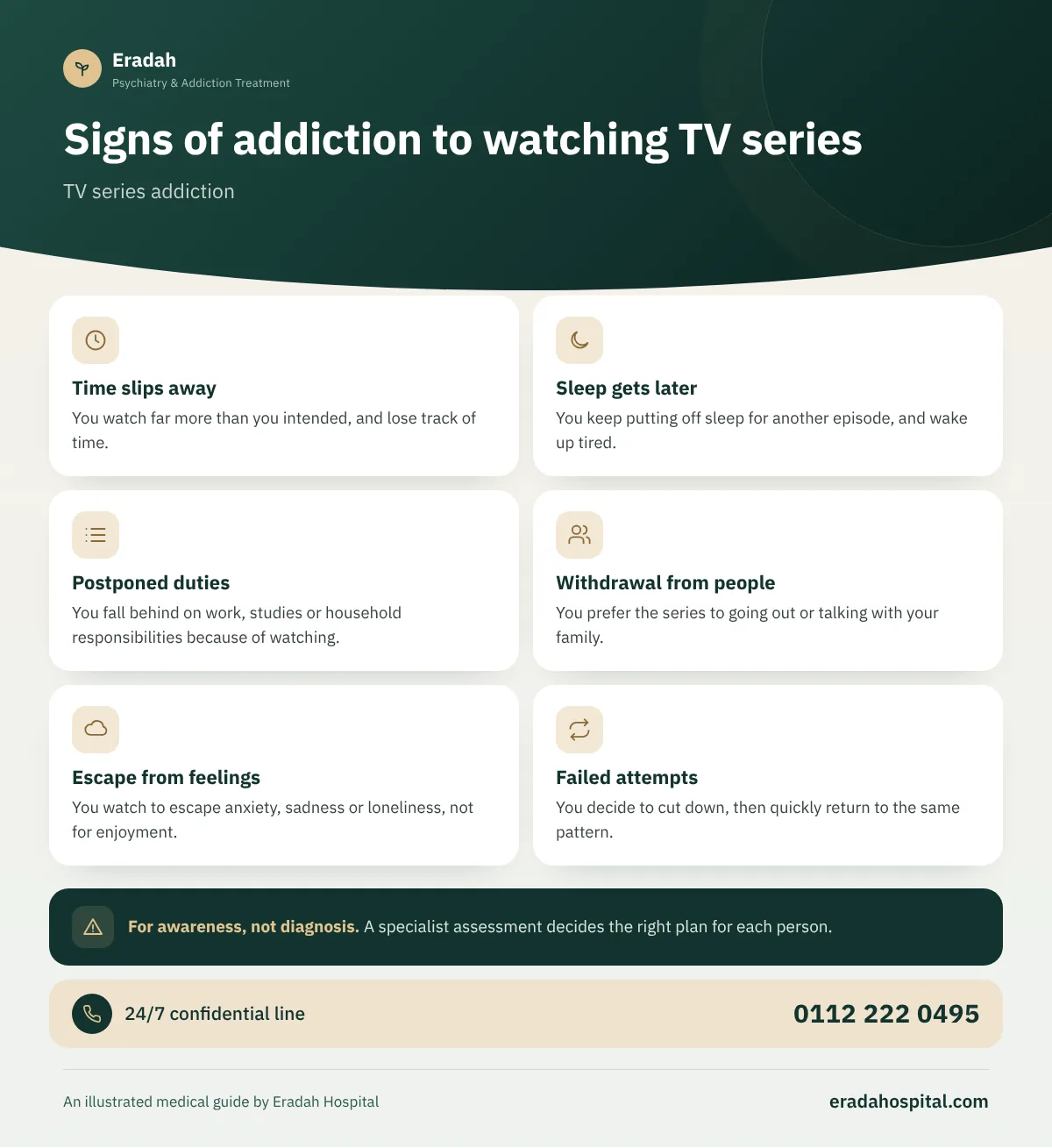
You watch far more than you intended, and lose track of time.
You keep putting off sleep for another episode, and wake up tired.
You fall behind on work, studies or household responsibilities because of watching.
You prefer the series to going out or talking with your family.
You watch to escape anxiety, sadness or loneliness, not for enjoyment.
You decide to cut down, then quickly return to the same pattern.
Harms of excessive TV series watching
The clearest harm falls on sleep: a study published in the Journal of Clinical Sleep Medicine found that people who binge-watch sleep with lower quality and feel more tired, and that the main reason is the mental stimulation before bed that makes relaxing harder. Added to this are long hours of inactivity and the back pain and weight gain that follow, mindless eating in front of the screen, reduced concentration and productivity, and isolation. Watching to escape difficult feelings may also delay treatment of depression or anxiety, so mood improves during the episode and then worsens afterward.
How do you control your viewing time?
- Turn off autoplay in the platform settings; the simplest step and the one with the most effect.
- Decide the number before you start: “two episodes tonight,” and say it aloud or write it down.
- Stop in the middle of an episode, not at its end; cliffhangers pull you toward the next one.
- Give it a time slot that ends at least an hour before bed.
- Do not watch in bed, and leave the phone or screen outside the bedroom.
- Watch with someone; shared watching is slower and more social.
- Ask yourself before pressing play: do I want to enjoy myself, or am I escaping from something?
Is watching hiding hopelessness or suicidal thoughts? Get help now
- Complete withdrawal from family and from work or study for weeks in front of the screen
- Persistent sadness or emptiness and loss of enjoyment in everything outside the series
- Talk about death or about life being meaningless
- Going without sleep or food for many hours with severe exhaustion
Do not get into a sharp confrontation about the screen; stay close to the person, ask calmly how they are feeling, and listen without blame. Asking about suicidal thoughts does not plant them but opens the door to help. If their life is at risk, call the ambulance on 123 or go to the nearest emergency room, or call the mental health support line 16328, available around the clock, and keep medications and anything they could harm themselves with out of their reach.
Ambulance 123 Mental health support line 16328