What is screen addiction?
Phones, computers and games have become part of study, work and communication, and we cannot and should not do without them. But for some people use turns from a tool they control into something that controls them: the day begins and ends with the screen, hours go by that were not planned, and they feel distressed when they are away from it.
We use the term “screen addiction” as an umbrella for four closely related patterns: compulsive gaming, compulsive scrolling of social networking sites, attachment to the phone itself, and compulsive use of pornography. They share the medium, the screen available at all times, and many mechanisms in the brain, but they differ in their content and in how far they are medically recognized.
The criterion that separates ordinary use from problematic use is the same one the World Health Organization uses for gaming disorder: impaired control, giving the behavior increasing priority over other interests, and continuing despite negative consequences, with clear harm to personal, family, school or work life.
Why is it hard to stay away from the screen?
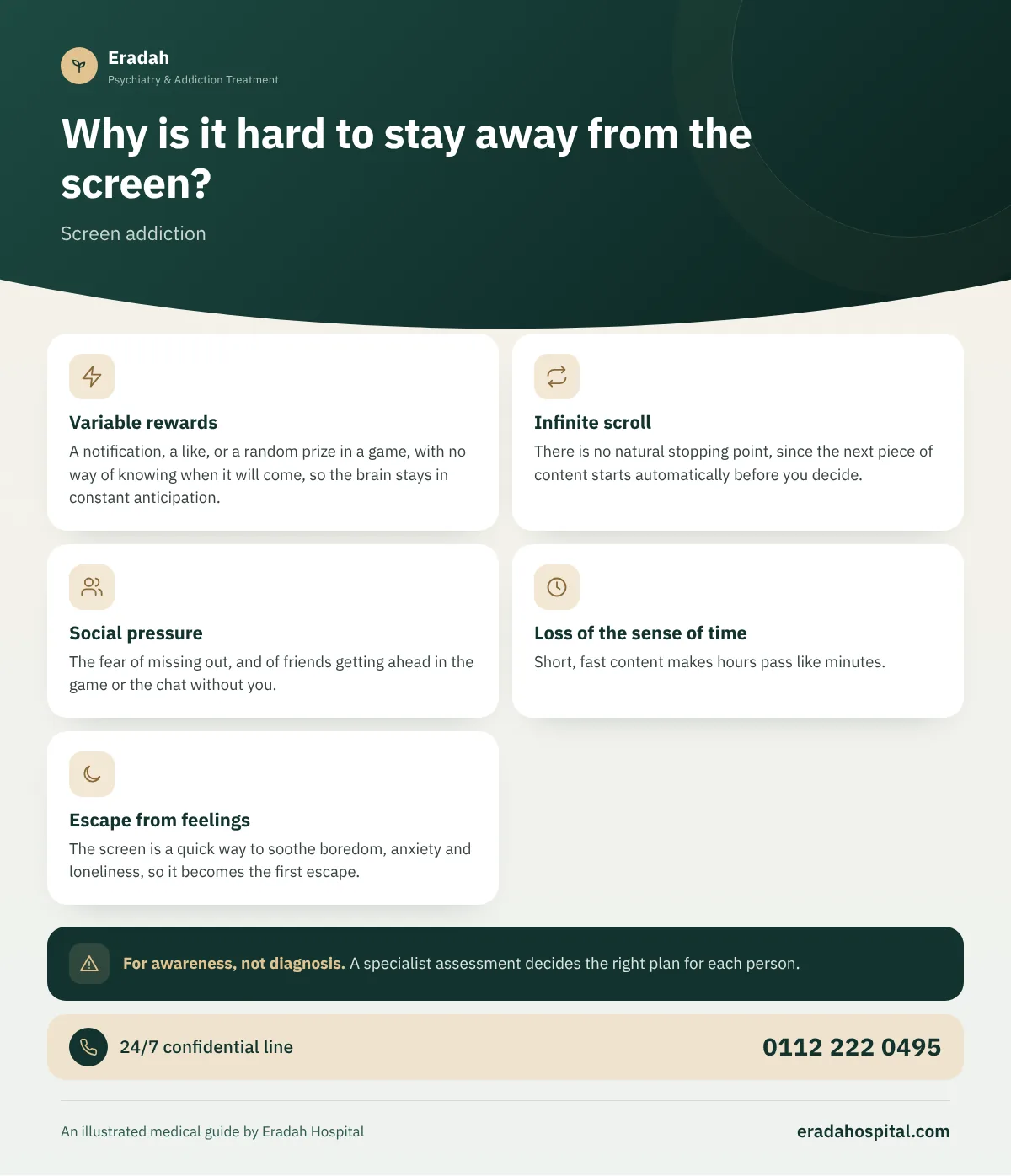
Many apps and games are carefully designed to keep users engaged for as long as possible. This is not so much a conspiracy as a business model that depends on attention. Understanding these mechanisms helps families and individuals resist them rather than blame themselves:
A notification, a like, or a random prize in a game, with no way of knowing when it will come, so the brain stays in constant anticipation.
There is no natural stopping point, since the next piece of content starts automatically before you decide.
The fear of missing out, and of friends getting ahead in the game or the chat without you.
Short, fast content makes hours pass like minutes.
The screen is a quick way to soothe boredom, anxiety and loneliness, so it becomes the first escape.
With repetition, the brain learns to link any moment of free time or tension with reaching for the phone, so the behavior becomes almost automatic. The causes pages for each behavior explain these mechanisms in detail, such as the causes of video game addiction and the causes of social media addiction.
Types of screen addiction
Each type in this family has a full guide and separate pages on its signs, causes, harms and treatment. Here is a short card for each:
Video game addiction
Gaming disorderAlso known as: Game addiction
Recognized in the international classification ICD-11, and shown as loss of control over playing time despite harm.
- Medical recognition
- Official diagnosis in ICD-11 (gaming disorder)
- How common
- A small proportion of gamers, and higher among adolescent males
- Most affected group
- Children, teenagers and young males
- Addiction potential
High
When should you seek help? If loss of control over gaming continues for months and studies, sleep or relationships have declined because of it.
Social media addiction
Social media addictionAlso known as: Social networking addiction
Compulsive browsing of social platforms, linked to anxiety, constant comparison and lower self-esteem.
- Medical recognition
- Not an official diagnosis, but a problematic usage pattern recognized in research
- How common
- About 11% of teenagers in a recent European survey
- Most affected group
- Teenagers, with girls more affected
- Addiction potential
High
When should you seek help? If scrolling steals your sleep and focus, or is tied to anxiety, comparison and persistent sadness.
Smartphone addiction
Smartphone addictionAlso known as: Phone addiction
Attachment to the device itself and anxiety when separated from it, which is worryingly common among children and teenagers.
- Medical recognition
- Not an official diagnosis in ICD-11 or DSM-5-TR
- How common
- Very common to varying degrees, and there is no agreed figure
- Most affected group
- Children, teenagers and university students
- Addiction potential
Moderate
When should you seek help? If anxiety when away from your phone keeps you from sleeping, working or connecting with your family.
Pornography addiction
Compulsive pornography useCompulsive consumption that is hard to stop despite harm, falling under compulsive sexual behavior disorder in ICD-11.
- Medical recognition
- Falls under compulsive sexual behavior disorder in ICD-11
- How common
- Not precisely known, and estimates vary widely
- Most affected group
- Mostly teenagers and young males
- Addiction potential
High
When should you seek help? If your repeated attempts to stop have failed and the use affects your relationships, work or sense of self.
Internet addiction
Internet addictionAlso known as: Problematic internet use
Loss of control over internet use to the point that it takes priority over sleep, work and relationships despite harm.
- Medical recognition
- A research concept, not a separate diagnosis
- How common
- About 6% worldwide (31 countries)
- Most affected group
- Males and residents of the Eastern Mediterranean
- Addiction potential
Strong
When should you seek help? If attempts to cut down have failed, or the use is accompanied by depression, violence, debt or substance use.
TV series addiction
Binge-watchingAlso known as: Binge-watching
Back-to-back episodes for hours that are hard to stop, at the expense of sleep and work, fueled by platform design and escape from feelings.
- Medical recognition
- Not an official diagnosis
- How common
- Very common, and the compulsive pattern is less clear-cut
- Most affected group
- People who watch at night or to escape their feelings
- Addiction potential
Moderate
When should you seek help? If loss of control continues despite trying, or is accompanied by severe insomnia, isolation or persistent sadness.
Digital drugs
Digital drugsAlso known as: Binaural beats
Audio files marketed as producing drug-like effects with no scientific evidence; the real risks are to hearing and sleep, and curiosity about trying drugs.
- Medical recognition
- Not a drug and not a medical diagnosis
- How common
- 5.3% in the 2021 Global Drug Survey
- Most affected group
- Young people and those who have tried cannabis or hallucinogens
- Addiction potential
Weak
When should you seek help? If interest in them comes with prolonged withdrawal from others, insomnia or sadness, or if signs of real substance use appear.
How do the types of screen addiction differ?
The four types are similar in the medium, but each has its own character in motivation, who is most affected, and medical recognition:
| Type | Medical recognition | Main motivation | Most vulnerable |
|---|---|---|---|
| Video game addiction | Official diagnosis in ICD-11 | Achievement, competition and escape | Teenagers and young men |
| Social media addiction | Not an official diagnosis | Social acceptance and comparison | Teenagers, with girls more affected |
| Smartphone addiction | Not an official diagnosis | Attachment to the device and fear of disconnection | Children, teenagers and university students |
| Pornography addiction | Under compulsive sexual behaviour disorder in ICD-11 | Relief of tension, then a cycle of shame | Mostly teenagers and young adults |
Note that smartphone addiction is often the “vessel” in which the other types happen; a person may be attached to the phone because it is their way into gaming or scrolling. That is why a good assessment starts with the question: what exactly do you do on the screen, and why?
How common is screen addiction?
There is no single figure for screen addiction, because definitions and measures differ between studies. But a large European survey by the World Health Organization covering about 280,000 children and adolescents gives a clear picture:
The WHO stresses that gaming disorder itself affects only a small proportion of gamers, and that most people who play have no disorder. There are no unified, accurate Egyptian figures, so we rely on documented international numbers. Source: the HBSC survey by the WHO Regional Office for Europe, and the WHO's frequently asked questions on gaming disorder.
How many hours of screen time are appropriate for children?
The World Health Organization recommends the following for young children: no screens for infants under one year, no sedentary screen time for one-year-olds, and no more than one hour a day of sedentary screen time for children aged two to four, with less being better, while encouraging active play, reading and storytelling with parents.
For older children and teenagers, what matters more than the number of hours is the type of content, the timing and what it replaces: does the screen take the place of sleep? Or of homework, sports and time with the family? Is it used alone in the bedroom at night?
- Keep devices out of bedrooms at night and charge them in a shared place.
- Screen-free times for everyone, such as meals and the hour before bed.
- Age-appropriate parental control tools, with the reason explained to the child.
- Real alternatives: sports, hobbies, and outings with family and friends.
- Parents being role models in how they use their own phones.
What are the shared risks of screen addiction?
The four types share a set of harms, though their severity differs from one type to another and from one person to another:
- Sleep: staying up late, delayed bedtime and poorer quality, usually the first thing affected.
- Focus and study: distracted attention and lower achievement and productivity.
- Mood: anxiety, irritability, constant comparison with others and sadness, with a cycle of guilt after long use.
- Body: eye strain, neck and back pain, little movement and weight gain.
- Relationships: withdrawal from the family, repeated arguments about the device, and sometimes a cooling of the marital relationship.
- Digital safety: cyberbullying, blackmail and exposure to harmful content, especially for children.
Details are on the harms pages for each type, such as the harms of smartphone addiction and the harms of pornography addiction.
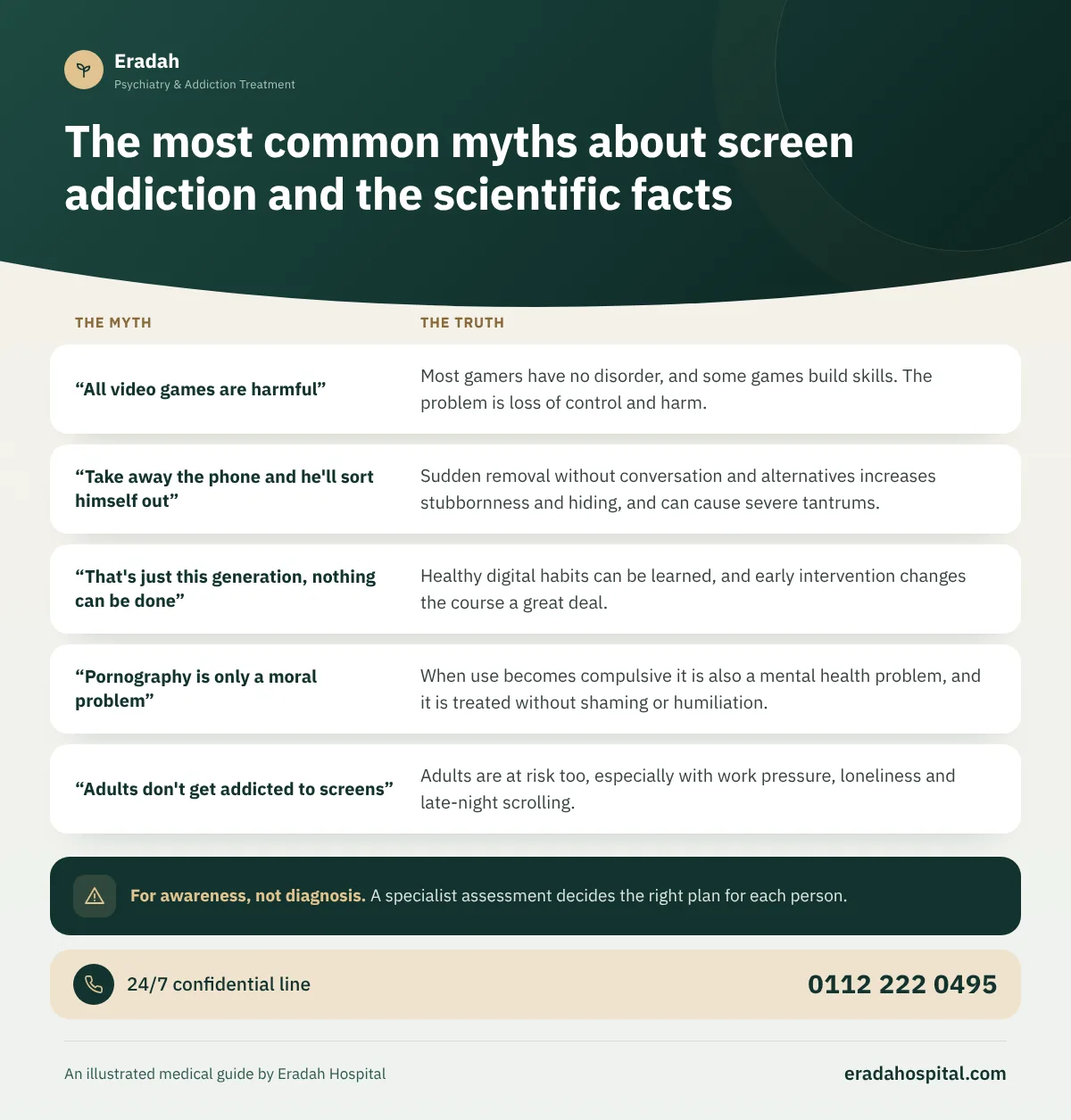
Common myths about screen addiction
| The myth | The truth |
|---|---|
| “All video games are harmful” | Most gamers have no disorder, and some games build skills. The problem is loss of control and harm. |
| “Take away the phone and he'll sort himself out” | Sudden removal without conversation and alternatives increases stubbornness and hiding, and can cause severe tantrums. |
| “That's just this generation, nothing can be done” | Healthy digital habits can be learned, and early intervention changes the course a great deal. |
| “Pornography is only a moral problem” | When use becomes compulsive it is also a mental health problem, and it is treated without shaming or humiliation. |
| “Adults don't get addicted to screens” | Adults are at risk too, especially with work pressure, loneliness and late-night scrolling. |
When does screen addiction need a specialist?
Ask for a specialist assessment if you notice any of the following in yourself or your child over an extended period. This list is for awareness and is not a diagnosis.
- Repeated failure to reduce usage time despite promises and attempts.
- A clear decline in study or work, or frequent absences because of late nights.
- Severe tantrums, aggression or sadness when away from the device.
- Withdrawal from family, friends and activities that used to be enjoyable.
- Hiding use, lying about it, or spending money in games without the family's knowledge.
- Anxiety, depression or thoughts of death appearing, in which case help must be sought immediately.
Treatment relies mainly on cognitive behavioral therapy, reorganizing the digital environment and family therapy, along with treating any accompanying anxiety, depression or attention-deficit/hyperactivity disorder. You will find the practical steps on the treatment pages, such as treating video game addiction and treating social media addiction.
How can a family deal with screen addiction?
- Choose a calm time for the conversation, and start by asking what he likes about the device before talking about the problem.
- Agree together on written rules for times and places, with clear and reasonable consequences.
- Reduce time gradually instead of sudden bans, and fill the gap with real alternatives.
- Get to know the games and apps your child uses, and who they communicate with.
- If you discover a teenager using pornography, talk calmly and without scandal or humiliation, and seek a specialist's help.
- Look for what is behind the behavior: bullying, loneliness, anxiety or school problems.
- Be a role model; children learn from how you use your phone more than from your advice.
Despair, suicidal thoughts or online blackmail? Get help now
- Talk of wanting to die or of life having no meaning
- Complete isolation in the room and stopping eating or sleeping for days
- Intense fear or panic after a message or threat online
- Violent tantrums or threats to harm himself or others when the device is taken away
- Saying goodbye to friends or suddenly getting rid of important belongings
- A child or teenager facing ongoing cyberbullying or online blackmail
Stay with the person and do not leave them alone, listen without blame or punishment at this moment, and remove any dangerous objects from their reach. Call the ambulance (123) or go to the nearest emergency room, and you can call the mental health support line 16328 around the clock. In cases of blackmail, keep the messages and do not respond to the blackmailer, and ask the relevant authorities for help.
Ambulance 123 Mental health support line 16328