What is chronic insomnia?
Chronic insomnia is more than “not enough sleep.” It is a condition in which a person cannot get enough sleep even though the conditions are right: the bed is comfortable, the time is available and they are tired, yet they stay awake, or wake up and cannot fall back asleep. It is diagnosed when this happens at least three nights a week for three months or more and affects the daytime.
In the International Classification of Diseases ICD-11, chronic insomnia has code 7A00 and sits in a separate chapter for sleep-wake disorders, not in the chapter on mental disorders. But psychiatry pays close attention to it because it accompanies most mental disorders, because it may precede them or make them worse, and because it is one of the most common routes to misuse of sleeping pills and sedatives.
Importantly, doctors no longer regard insomnia as merely a “symptom” of another illness that disappears when that illness is treated. Even when it begins with depression, anxiety or pain, it can take on a life of its own and continue after the original cause improves, which is why it is treated as a disorder in its own right.
What does chronic insomnia look like at night and during the day?
There is no separate symptoms page, so here we summarize the usual picture that people with insomnia describe:
Lying down for a long time with a mind that won't stop thinking and a tense body.
Waking several times in the night and having trouble getting back to sleep.
Waking much earlier than planned and being unable to sleep again.
A feeling that sleep was light and gave no real rest.
Tiredness, poor concentration and memory, irritability, and growing worry about the coming night.
A distinctive feature is that many people with insomnia feel tired all day, yet cannot sleep during a nap either. The need for sleep has not decreased, but a state of alertness keeps the body from “switching itself off.”
How common is chronic insomnia?
These are estimates from the American Academy of Sleep Medicine and the UK's National Health Service. Insomnia is more common in women, especially around menopause, with advancing age, and in people under stress or with depression or anxiety. We do not give Egyptian figures here because no reliable published statistics are available.
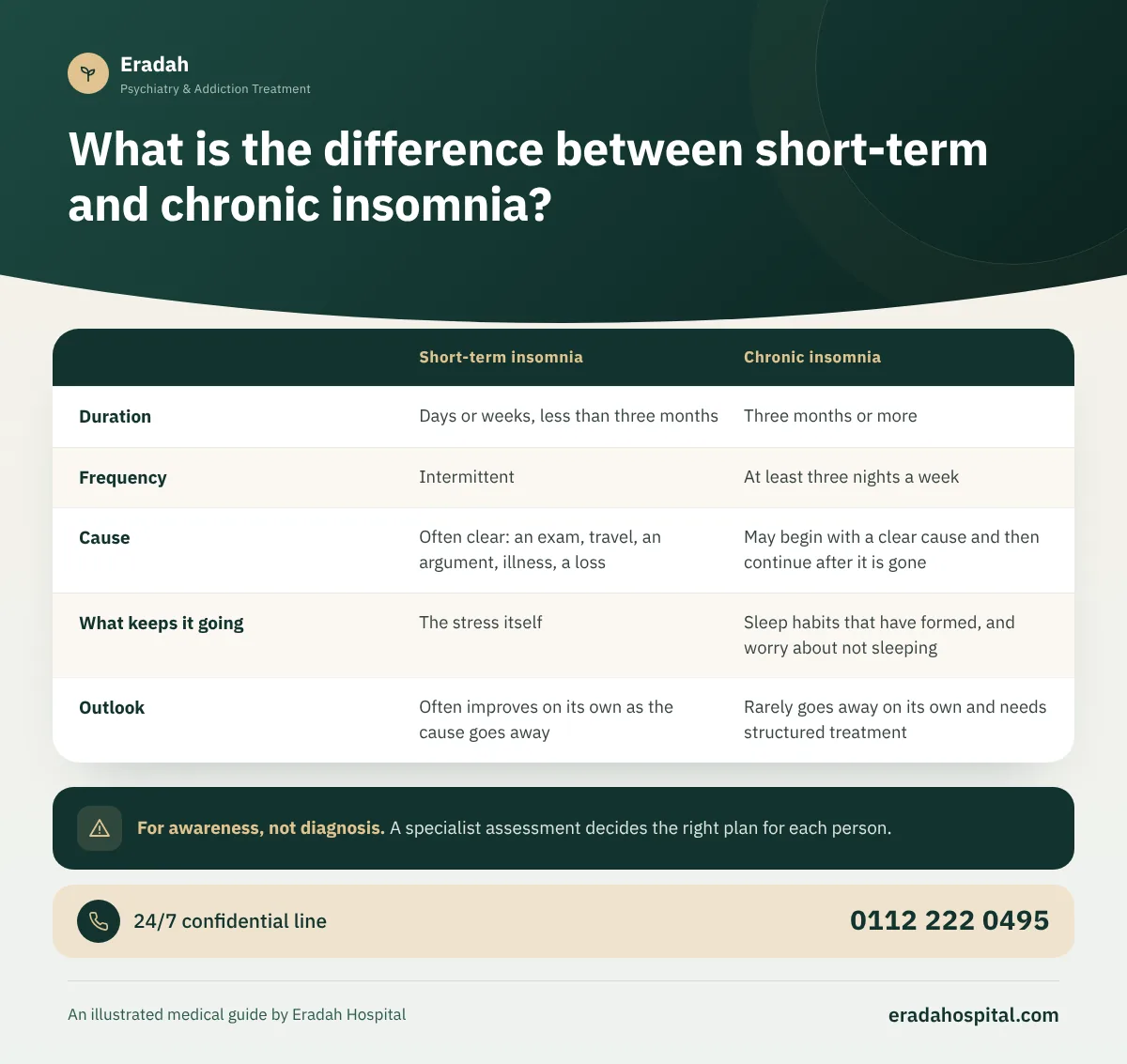
What is the difference between short-term and chronic insomnia?
| Short-term insomnia | Chronic insomnia | |
|---|---|---|
| Duration | Days or weeks, less than three months | Three months or more |
| Frequency | Intermittent | At least three nights a week |
| Cause | Often clear: an exam, travel, an argument, illness, a loss | May begin with a clear cause and then continue after it is gone |
| What keeps it going | The stress itself | Sleep habits that have formed, and worry about not sleeping |
| Outlook | Often improves on its own as the cause goes away | Rarely goes away on its own and needs structured treatment |
What happens in the body and brain with insomnia?
Sleep is regulated by two systems: “sleep pressure,” which builds the longer you stay awake, and the “body clock,” which sets the times of sleepiness and wakefulness according to light and darkness. In chronic insomnia a third factor is added: hyperarousal, a nervous system on alert, an active mind and raised stress hormones at a time when there should be calm.
As difficult nights repeat, the brain learns to associate the bed with tension and thinking instead of rest. That is why many people feel sleepy in front of the TV, then become fully “awake” the moment they enter the bedroom. This learning is what cognitive behavioral therapy for insomnia targets.
How do you tell insomnia from other sleep disorders?
- Obstructive sleep apnea: loud snoring and pauses in breathing that a partner notices, with severe daytime sleepiness, and it needs assessment in a sleep lab.
- Restless legs syndrome: an urgent need to move the legs with an unpleasant sensation that gets worse in the evening and when lying down.
- Circadian rhythm disorder: like a teenager who cannot fall asleep until very late but sleeps well if left to their own schedule.
- Insufficient sleep opportunity: someone who sleeps little because of work or voluntary late nights needs more time asleep, and is not considered to have insomnia.
- Natural short sleepers: a few people are fine with less sleep and have no daytime effects, and they need no treatment.
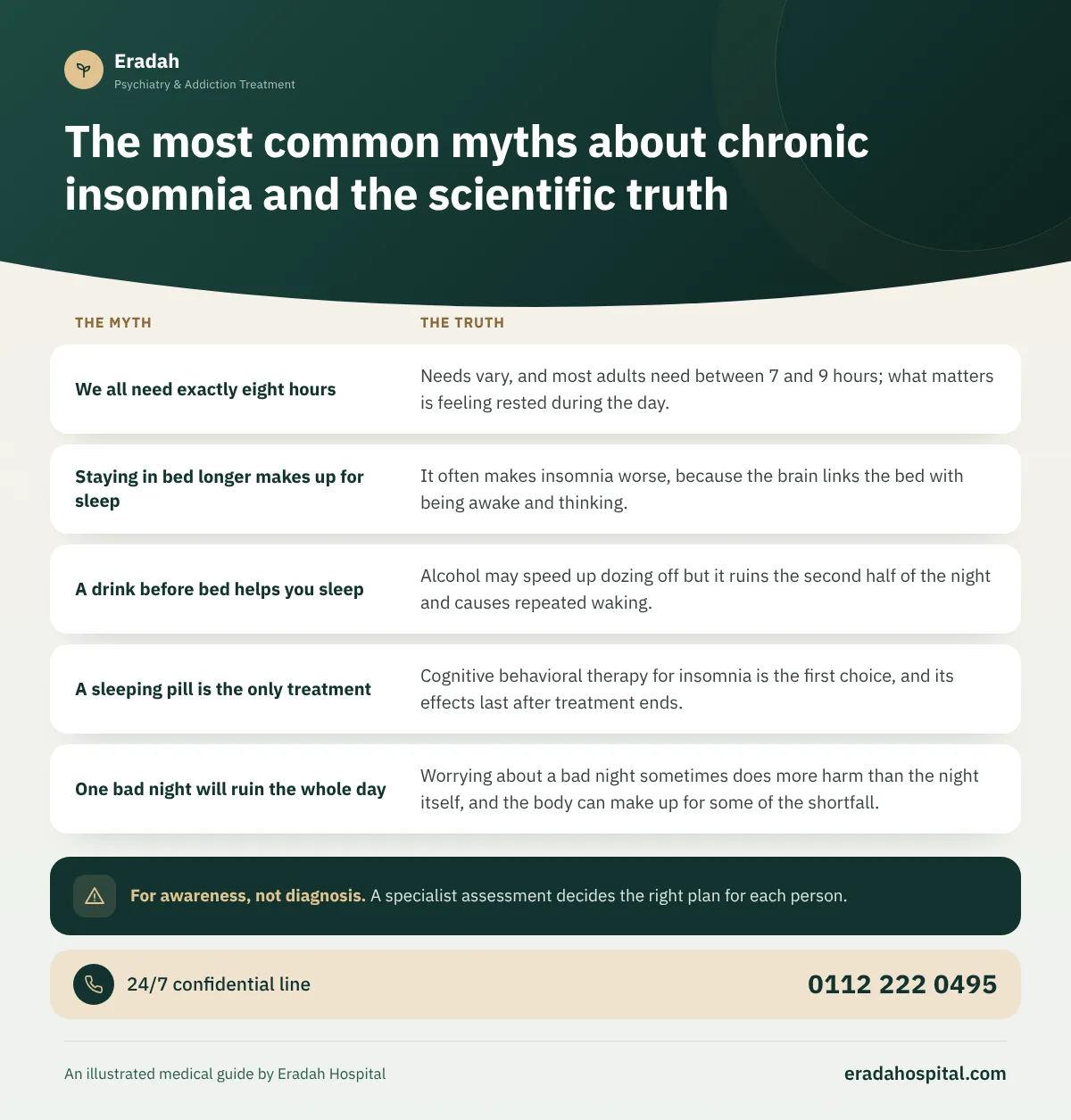
Common sleep myths and the truth
| The myth | The truth |
|---|---|
| We all need exactly eight hours | Needs vary, and most adults need between 7 and 9 hours; what matters is feeling rested during the day. |
| Staying in bed longer makes up for sleep | It often makes insomnia worse, because the brain links the bed with being awake and thinking. |
| A drink before bed helps you sleep | Alcohol may speed up dozing off but it ruins the second half of the night and causes repeated waking. |
| A sleeping pill is the only treatment | Cognitive behavioral therapy for insomnia is the first choice, and its effects last after treatment ends. |
| One bad night will ruin the whole day | Worrying about a bad night sometimes does more harm than the night itself, and the body can make up for some of the shortfall. |
When do you need to see a doctor?
- Difficulty sleeping has lasted more than three months or has not improved with changes in habits.
- Daytime tiredness is affecting your work, studies or driving.
- You rely on a sleeping pill, sedative or alcohol every night in order to sleep.
- Your partner notices loud snoring or pauses in breathing while you sleep.
- The insomnia comes with persistent sadness, severe anxiety or painful memories.
- Thoughts of death or self-harm have appeared, and here help is urgent.
The assessment starts with a two-week sleep diary in which you record bedtimes, wake times, naps, caffeine and medications, followed by an interview exploring physical, psychological and medication-related causes. The doctor may order tests or a sleep study if another disorder is suspected.
Can chronic insomnia be overcome?
Yes. Cognitive behavioral therapy for insomnia is the first-line treatment in the guidelines of the American Academy of Sleep Medicine, and the US National Center for PTSD notes that it improves sleep in about 7 out of 10 people who complete it. More importantly, its benefit lasts after the sessions end, because it changes what keeps the insomnia going.
How can the family help someone with insomnia?
- Do not dismiss the complaint with phrases like “just go to sleep”; insomnia is not a choice.
- Help create a quiet home at night, and reduce lighting, noise and screens late in the evening.
- Do not share sleeping pills or sedatives with anyone, and do not buy them for them without a prescription.
- Watch for hard nights turning into reliance on alcohol or medication.
- Notice accompanying signs of sadness or anxiety, and encourage a specialist assessment.
Chronic insomnia guide: everything you need to know
We have gathered everything about chronic insomnia in 4 pages, each answering one question in detail. Choose what you are looking for:
Causes of chronic insomnia
Why does insomnia start and why does it continue? The three-factor model, stress and mental disorders, illnesses and medications, and caffeine, screens and shift work.
Harms and complications of chronic insomnia
What ongoing sleep loss does to concentration, mood, the heart and metabolism, and the risk of accidents, depression and misuse of sleeping pills.
Treating chronic insomnia
Cognitive behavioral therapy for insomnia as a first choice, sleep hygiene rules, when medication is used, and the risks of dependence on sleeping pills.
Chronic insomnia and addiction
How a sleeping pill or a glass of alcohol turns into dependence, why insomnia gets worse after stopping drugs, and how both are treated together.
Insomnia with suicidal thoughts or severe hopelessness? Get help now
- Talking about wanting to die, or saying that eternal sleep would be better than this exhaustion
- Severe hopelessness and a feeling that the suffering will never end, with sleep collapsing for days in a row
- Taking increasing amounts of sleeping pills or mixing them with alcohol or sedatives
- Severe confusion, seizures or hallucinations after suddenly stopping a sedative or alcohol
- Irresistible sleepiness that puts the person or others at risk, such as falling asleep while driving
Stay with the person and listen calmly and without judgment, ask them directly about their thoughts, and do not leave them alone. Call an ambulance (123) or go to the nearest emergency room, or call the mental health support line 16328, and keep sleeping pills, sedatives and anything that could hurt them out of their reach.
Ambulance 123 Mental health support line 16328