What is phone addiction?
Phone addiction is a common description of a relationship with the smartphone that has gotten out of control: the person reaches for the phone without a conscious decision, checks it dozens of times for no reason, feels tense if they forget it or its battery runs out, and finds it hard to put down even when they want to sleep, study or talk to someone they love.
The key difference between it and video game addiction is that the attachment here is to the device itself and the habit of checking, not to a specific activity. The phone puts messages, news, video, shopping, work and communication in one pocket, which is why it is harder to stay away from than any other device: it is always with you, and there is always something new on it.
Is phone addiction a recognized medical diagnosis?
Frankly: no. "Phone addiction" does not exist as a stand-alone diagnosis in the international classification ICD-11 or the American manual DSM-5. The only behavioral addiction officially recognized in the field of screens is gaming disorder, alongside gambling disorder outside this field.
That is why researchers use the term "problematic smartphone use," meaning use with elements of dysfunction such as anxiety when the phone is absent or neglecting other activities because of it, and they measure it with scales that borrow features of addiction such as loss of control, preoccupation and continuing despite harm. The term "nomophobia" has also spread to describe fear of being without a phone, which is a common description, not a diagnosis.
| Question | The answer |
|---|---|
| Is the problem real? | Yes, studies link it to poorer sleep and more anxiety and depression, although causation has not yet been settled |
| Does a doctor diagnose it? | The doctor assesses the pattern and its impact, and looks for recognized conditions that may lie behind it, such as anxiety, depression or ADHD |
| Does it need treatment? | Yes, when it causes clear harm, usually through changing habits and psychotherapy rather than medication |
| Why hasn't it been adopted yet? | Because the phone is a means for many activities, and researchers disagree on measurement tools and on the line between heavy use and illness |
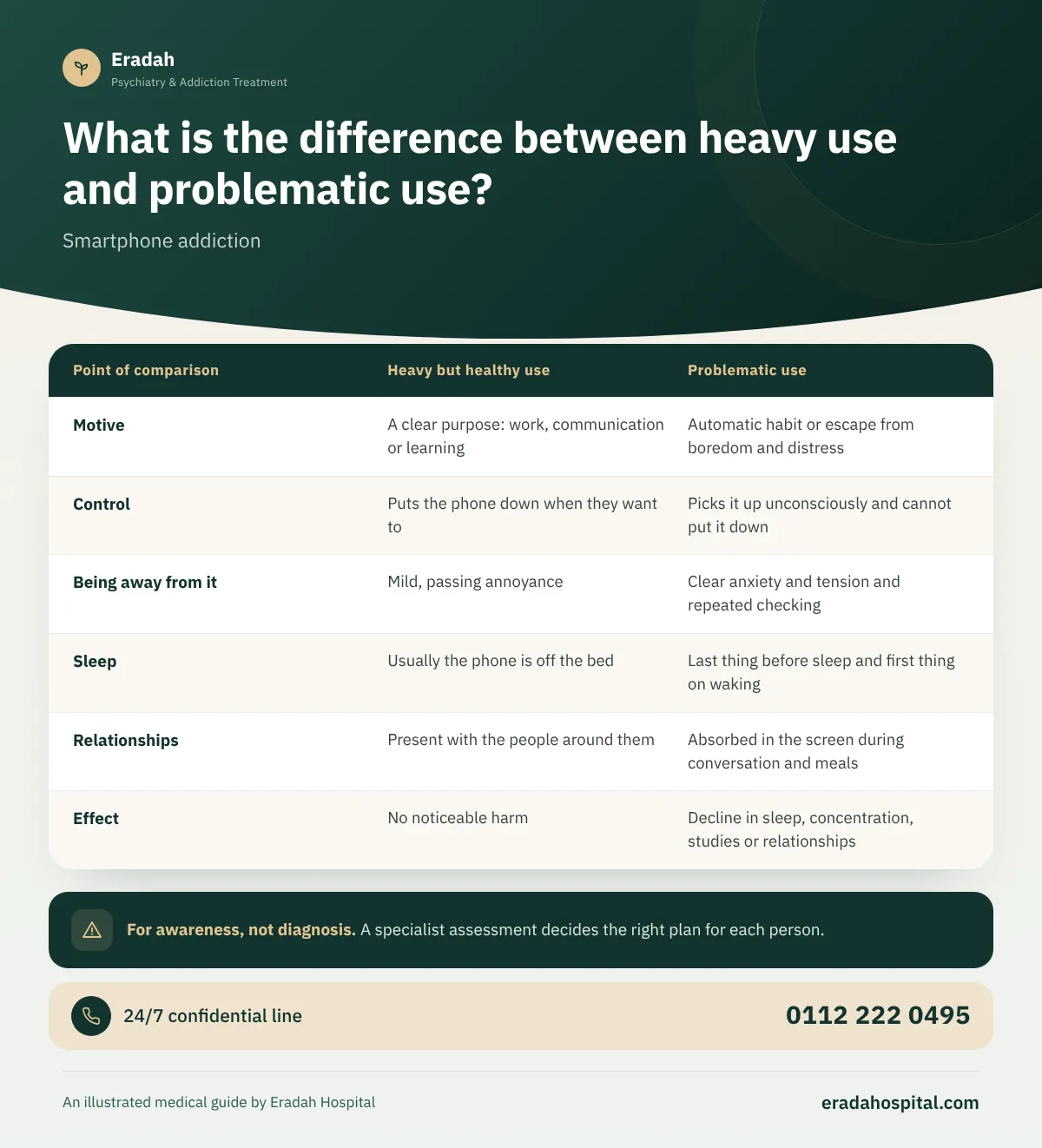
What is the difference between heavy use and problematic use?
You may use your phone for long hours because your job depends on it, with no problem at all. Or you may use it less but be unable to put it down in a meeting or at the dinner table. So we ask about the nature of the relationship, not the number alone:
| Point of comparison | Heavy but healthy use | Problematic use |
|---|---|---|
| Motive | A clear purpose: work, communication or learning | Automatic habit or escape from boredom and distress |
| Control | Puts the phone down when they want to | Picks it up unconsciously and cannot put it down |
| Being away from it | Mild, passing annoyance | Clear anxiety and tension and repeated checking |
| Sleep | Usually the phone is off the bed | Last thing before sleep and first thing on waking |
| Relationships | Present with the people around them | Absorbed in the screen during conversation and meals |
| Effect | No noticeable harm | Decline in sleep, concentration, studies or relationships |
How common is problematic phone use?
These figures are estimates and vary widely with the method of measurement, and there are no unified national Egyptian figures. But the reality families in Egypt see every day, from the child who will only eat in front of a video to the teenager up late on his phone, makes awareness of this problem a necessity, not a luxury.
Source: Sohn et al., systematic review and meta-analysis in BMC Psychiatry (2019).
Why do we check the phone every few minutes?
Each check of the phone is like pulling a small lottery ticket: you may find an important message, a like or an exciting piece of news, or you may find nothing. This unpredictable reward activates the brain's reward circuit and releases dopamine, so the brain learns that "looking at the phone" may be rewarded at any moment.
With repetition the movement becomes an automatic habit triggered by simple cues: a vibration, a moment of boredom in a queue, or a passing feeling of anxiety. The problem is that the person no longer decides to use the phone and finds themselves holding it without a decision. We explain how apps exploit this mechanism on the causes of phone addiction page.
Who is most at risk of phone addiction?
The phone is the center of their social life, and their ability to hold back is not yet fully developed.
They use checking to reassure themselves and ease tension, which increases anxiety in the long run.
The phone fills the void and postpones facing difficult feelings.
They are drawn to fast switching between content and find boredom hard to bear.
A culture of "always available" erases the line between work time and rest time.
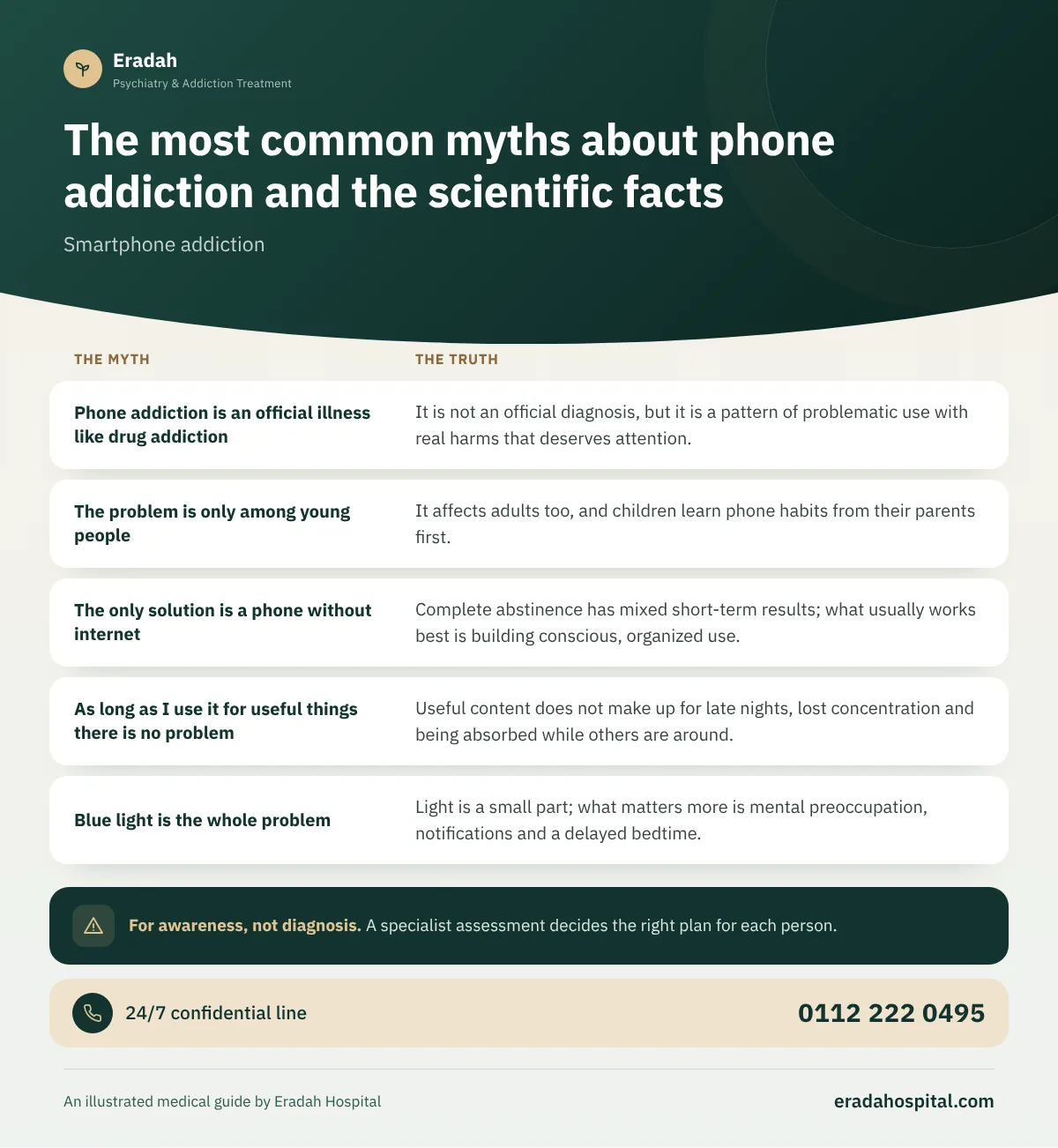
Common myths about phone addiction and the facts
| The myth | The truth |
|---|---|
| Phone addiction is an official illness like drug addiction | It is not an official diagnosis, but it is a pattern of problematic use with real harms that deserves attention. |
| The problem is only among young people | It affects adults too, and children learn phone habits from their parents first. |
| The only solution is a phone without internet | Complete abstinence has mixed short-term results; what usually works best is building conscious, organized use. |
| As long as I use it for useful things there is no problem | Useful content does not make up for late nights, lost concentration and being absorbed while others are around. |
| Blue light is the whole problem | Light is a small part; what matters more is mental preoccupation, notifications and a delayed bedtime. |
How does it differ from gaming and social media addiction?
| Problem | What draws the person in? | Example of the behavior |
|---|---|---|
| Smartphone addiction | The device, checking, notifications and switching between apps | Opening the phone aimlessly every few minutes |
| Video game addiction | The activity of playing, achievement and competition | Long play sessions on any device |
| Social media addiction | Interaction, social comparison and recognition | Browsing platforms and following likes and comments |
The three problems often overlap in the same person, but identifying the main axis helps choose the right first step in treatment.
How can families protect their children from phone addiction?
The World Health Organization recommends that infants under one year have no screen exposure at all, and that sedentary screen time for children aged two to four not exceed one hour a day, with "less is better." The American Academy of Pediatrics, in its recent guidance, focuses on the quality of content, parental involvement, and keeping devices out of bedrooms and late-night hours, rather than just counting minutes.
A child who sees their parents absorbed in their phones all the time will do the same, whatever advice they hear.
The dining table, bedrooms, and the car on short trips.
Do not rush to give a child a personal phone; start with clear rules and protection settings.
Ask your children what they do on the phone and what bothers them about it.
Phone addiction guide: everything you need to know
We have gathered everything about phone addiction in 4 pages, each answering one question in detail. Choose what you are looking for:
Signs of smartphone addiction
Compulsive checking, anxiety when away from the phone and being absorbed in it during conversation, and how the signs appear in children, teenagers and adults, with self-assessment questions.
Causes of smartphone addiction
How notifications, infinite scrolling and autoplay create the checking habit, and the role of fear of missing out, anxiety, loneliness and the family environment.
Harms of smartphone addiction
Its effect on sleep, attention, the neck and eyes, mood and relationships, the danger of using the phone while driving, and its effect on children's development.
Treatment of phone addiction
A practical digital detox plan, phone settings that reduce temptation, cognitive behavioral therapy, a family plan, and when you need a specialist.
Severe distress or thoughts of self-harm? Get help now
- Talk of death or that life is not worth living, or goodbye messages on the phone or platforms
- A breakdown or severe panic after online bullying, threats or blackmail over the phone
- Violent outbursts in which they hurt themselves or others when the phone is taken away
- Total isolation in the room for days with stopping eating, sleeping or studying
- Obvious despair and a sudden stop in talking to family and friends
Stay with the person, speak to them calmly and listen without blame or mockery, and do not make taking the phone a punishment in the moment of crisis. If there is a danger to their life, call an ambulance (123) or take them to the nearest emergency room, or call the mental health support line 16328 (24 hours). In cases of blackmail, keep the messages and do not delete them, and ask the relevant authorities for help.
Ambulance 123 Mental health support line 16328