What is social media addiction?
By "social media addiction" or "social networking addiction", people mean the condition in which browsing turns from a means of connection, knowledge and entertainment into compulsive behavior that takes over time, attention and mood, and continues even though the person knows it harms them and wishes they could cut down.
Researchers use the term problematic social media use, which the World Health Organization in Europe defines as a behavioral pattern with addiction-like symptoms: inability to control use, withdrawal-like feelings when stopping, neglect of other activities, and facing negative consequences in daily life because of excess.
This does not mean everyone who spends long on their phone is addicted. A student following lessons and classmates' groups, or a business owner running a page, uses platforms heavily but for a clear purpose and under their own control. The deciding factor is who controls whom: do you use the platform, or has it become what sets your day and your mood?
When does a browsing habit become an addiction?
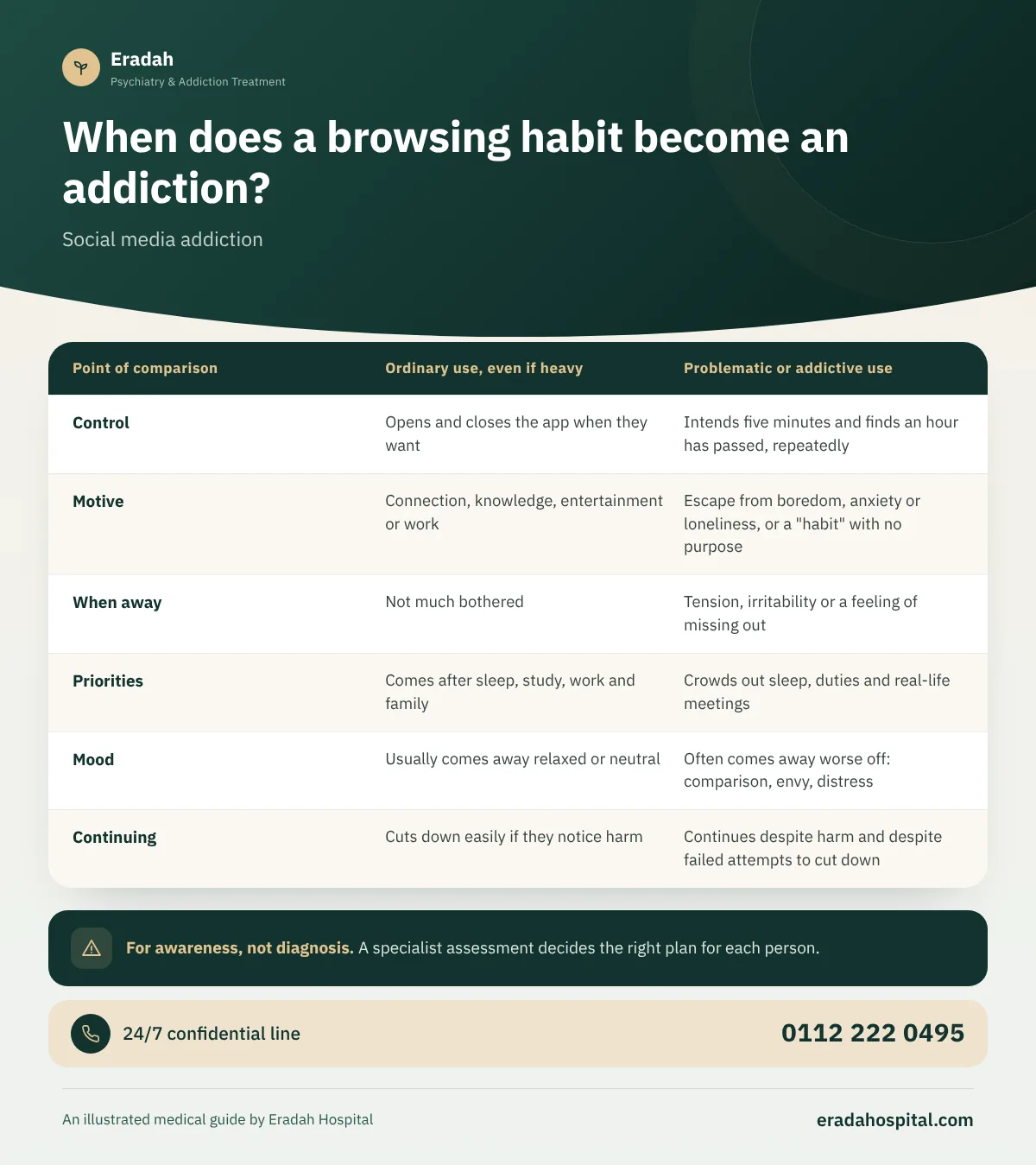
Many people go through days of excessive browsing, especially on holidays or in stressful periods. But a habit stays a habit as long as the person can stop when they want and does not pay a clear price in sleep, study and relationships. The following table shows the difference:
| Point of comparison | Ordinary use, even if heavy | Problematic or addictive use |
|---|---|---|
| Control | Opens and closes the app when they want | Intends five minutes and finds an hour has passed, repeatedly |
| Motive | Connection, knowledge, entertainment or work | Escape from boredom, anxiety or loneliness, or a "habit" with no purpose |
| When away | Not much bothered | Tension, irritability or a feeling of missing out |
| Priorities | Comes after sleep, study, work and family | Crowds out sleep, duties and real-life meetings |
| Mood | Usually comes away relaxed or neutral | Often comes away worse off: comparison, envy, distress |
| Continuing | Cuts down easily if they notice harm | Continues despite harm and despite failed attempts to cut down |
Is social media addiction a recognized mental illness?
The honest answer: not yet as a separate official diagnosis. The International Classification of Diseases (ICD-11) recognized "gaming disorder" and "gambling disorder" among disorders due to addictive behaviors, but it did not set a specific diagnosis for social networking platforms. The American diagnostic manual, the DSM-5, did not include it either.
Even so, the phenomenon is real and widely studied, and public health reports take it seriously: in 2023 the US Surgeon General issued an official advisory titled "Social Media and Youth Mental Health", and the American Psychological Association issued health recommendations in the same year on adolescents' use of it. A psychiatrist can assess and treat the condition even though it has no separate diagnostic name, especially since it often comes with anxiety, depression or attention problems.
Is social media addiction common? The available figures
Prevalence estimates vary widely between studies depending on the measure used and the age group, so here we present only figures from reliable official sources:
Sources: the World Health Organization Regional Office for Europe (the HBSC survey, which covered about 280,000 adolescents in 44 countries and regions), and the US Surgeon General's 2023 advisory. No unified, up-to-date national Egyptian figures are available so far, and a link between hours and symptoms does not by itself prove that one causes the other.
Who is most at risk of problematic use?
Anyone can fall into the trap of compulsive scrolling, but some groups are more at risk, chiefly:
The teenage brain is highly sensitive to reward and social acceptance, while the areas that control impulses are not fully developed until about the mid-twenties.
Surveys show higher rates among them, which may be linked to the weight of comparison over appearance and images.
Platforms can become a way to escape difficult feelings, easing them for the moment and increasing them in the long run.
The constant search for new stimuli and difficulty stopping make endless scrolling more attractive.
Someone who lacks real relationships or lives with long-term emptiness may compensate with a virtual world that does not truly meet the need.
The full details of these factors, and of how platforms themselves are designed, are on the causes of social media addiction page.
What happens in the brain during compulsive scrolling?
Scrolling works on the same reward circuit affected by addictive substances, though to a lesser degree. Every like, comment or enjoyable video is a small reward accompanied by activity in the dopamine system, which is responsible for motivation and the wish to repeat.
More important, these rewards are intermittent and unpredictable: you do not know when the exciting post or the awaited notification will appear, and this kind of variable reward is the strongest at cementing and repeating behavior, just like slot machines. With repetition, opening the app becomes an automatic motion that happens before the person consciously decides, especially when bored or tense.
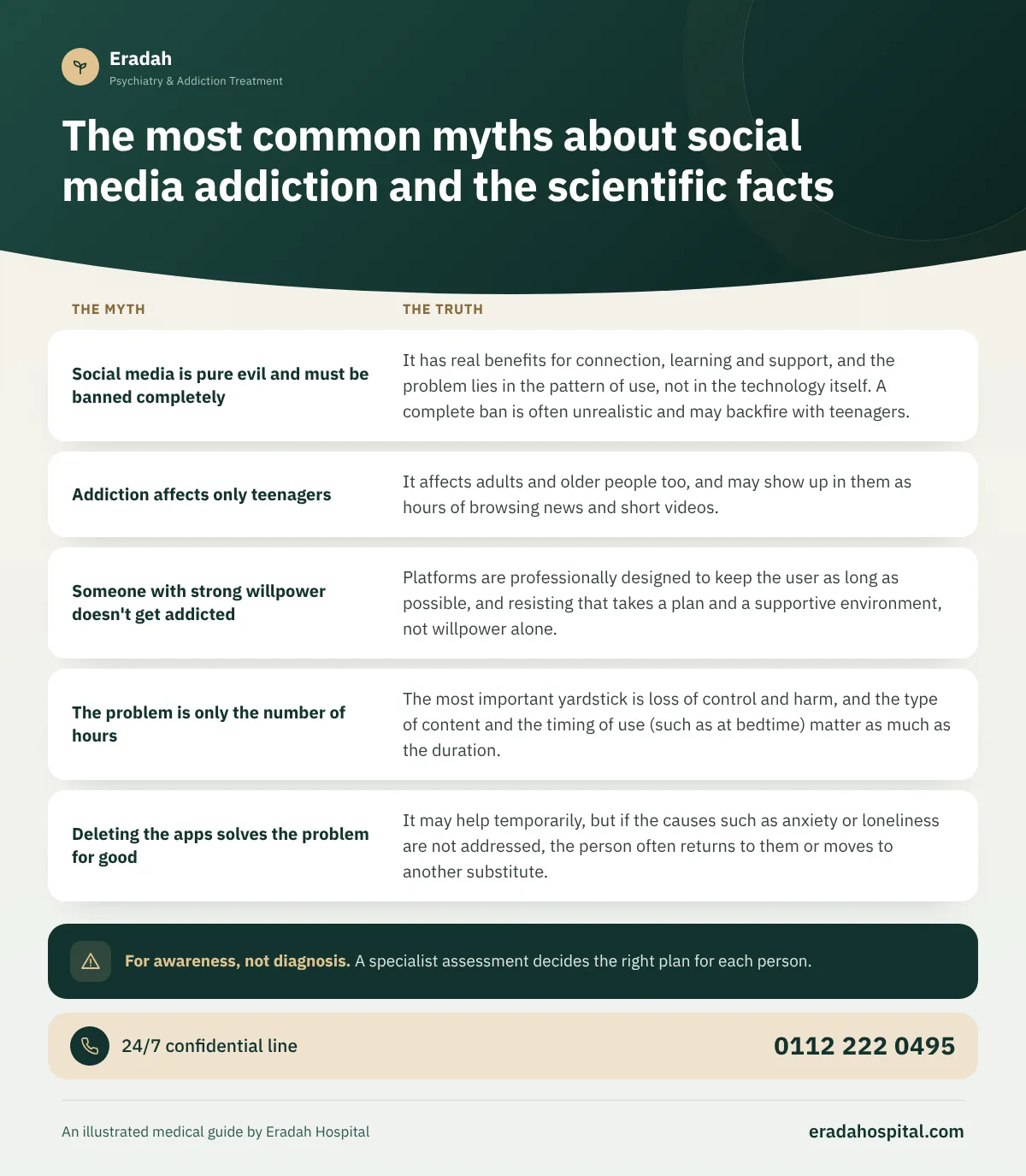
Common myths about social networking addiction and the facts
| The myth | The truth |
|---|---|
| Social media is pure evil and must be banned completely | It has real benefits for connection, learning and support, and the problem lies in the pattern of use, not in the technology itself. A complete ban is often unrealistic and may backfire with teenagers. |
| Addiction affects only teenagers | It affects adults and older people too, and may show up in them as hours of browsing news and short videos. |
| Someone with strong willpower doesn't get addicted | Platforms are professionally designed to keep the user as long as possible, and resisting that takes a plan and a supportive environment, not willpower alone. |
| The problem is only the number of hours | The most important yardstick is loss of control and harm, and the type of content and the timing of use (such as at bedtime) matter as much as the duration. |
| Deleting the apps solves the problem for good | It may help temporarily, but if the causes such as anxiety or loneliness are not addressed, the person often returns to them or moves to another substitute. |
Does social media have benefits? A balanced view
It is only fair to say that the US Surgeon General's own advisory pointed to potential benefits, such as a sense of belonging, connecting with people who share interests, and getting support, especially for those who live in isolation or face difficult circumstances. Platforms also allow learning, work and self-expression.
So Eradah does not aim to frighten families about technology, but to help people use it consciously. It is more useful to ask "how, when and why do you use it, and what does it do to you?" instead of "do you use social media?" And if the phone itself is the center of attachment more than the platforms, the phone addiction guide may help you.
What is the family's role in prevention and help?
The family is the first line of defense, especially with children and teenagers. The American Psychological Association recommends that the level of supervision match the child's age and maturity and gradually move toward independence. What really helps:
- Parents being role models: it is hard to ask a son to put down his phone when we do not put ours down at the dinner table.
- Agreeing on clear, announced rules, such as keeping devices out of bedrooms at night and away from mealtimes and study time.
- Talking about the content, not just the time: what is he watching? How does he feel afterward? Is he being harassed?
- Providing real, enjoyable alternatives: sports, meeting friends, hobbies, and family time without screens.
- Building trust so that the son turns to his family when facing bullying or blackmail instead of hiding it for fear of punishment.
Social media addiction guide: everything you need to know
We have gathered everything about social media addiction into 4 pages, each answering one question in detail. Choose what you are looking for:
Signs of social media addiction
Behavioral, psychological and physical signs in teenagers and adults, non-diagnostic self-assessment questions, and how the family can start the conversation calmly.
Causes of social media addiction
How notifications, likes, endless scrolling and algorithms draw us in, and the role of anxiety, loneliness, comparison and fear of missing out.
Harms of social media addiction
The effect of compulsive use on sleep, concentration, body image, mental health and relationships, and the risks of bullying and online blackmail for teenagers.
Treatment of social media addiction
Practical steps for regulating use and designing the digital environment, cognitive behavioral and family therapy, and when you need a specialist.
Bullying, online blackmail or suicidal thoughts? Get help now
- Talk of wanting to die, of life being meaningless, or of being a "burden" on the family
- A sudden collapse after a message, post or online scandal, or intense fear of private photos or information being published
- Complete withdrawal from family and friends and suddenly deleting accounts, with clear sadness or hopelessness
- Self-harm or talk of it, or saying goodbye to people and giving away personal belongings
- Sleeplessness for several days in a row with agitation or severe hopelessness
Do not leave the person alone; ask calmly what they are going through and listen without blame or violently confiscating the phone. In cases of blackmail, do not pay and do not delete the messages; keep the evidence and report it to the competent authorities. If thoughts of self-harm appear, call an ambulance on 123 or take them to the nearest emergency room, or call the mental health support line 16328 (24 hours).
Ambulance 123 Mental health support line 16328