Why do we bite our nails in the first place?
Nail biting seems like a meaningless behavior, but it actually serves a function for the person: it eases tension, breaks boredom, or occupies the hand and mind while waiting. When a behavior serves a function, the brain repeats it until it becomes a habit.
Researchers agree that nail biting, like other body-focused repetitive behaviors, results from an interaction between biological predisposition, emotional state and environment. The same mechanisms operate in all of us to different degrees, so not everyone who bites their nails has a psychological problem.
Emotion regulation: stress, boredom and frustration
Studies have found that biting increases in specific emotional situations, most notably anxiety, stress, boredom, frustration and impatience. Biting gives a quick feeling of release or occupation, so the nervous system learns that it is an "answer" that is always available.
An exam, an interview, a dispute or waiting for a result; biting temporarily releases some of the tension.
Watching TV, long lectures or sitting in transit.
A task that isn't going the way the person wants, or a situation beyond his control.
Reading, studying or working on a computer, when the hand is busy without awareness.
Some studies have linked these behaviors to traits of perfectionism and impatience: a person who finds it hard to relax or who is bothered when things are not done perfectly may turn to biting to release this pressure, or to "even out" a nail edge that looks uneven to them.
Automatic habit: when the hand works without awareness
With repetition, biting moves from the region of conscious decision to the region of automatic habits in the brain, so it happens in response to cues the person doesn't notice: sitting in a certain place, placing a hand near the face, or watching a screen. That is why many people say: "I didn't notice until my fingers were in my mouth."
This automatic nature explains why the usual advice, "just stop," doesn't work; a person can't stop what he doesn't notice. That is why effective methods always begin with training awareness of the moment the behavior starts.
Sensory factors: rough edges and extra skin
Physical sensation plays an important role: a broken nail edge, extra skin around the nail or dryness can trigger a strong urge to "clean it up" with the teeth. Some people find the feel of the nail or the sound of biting soothing in itself. That is why nail care and moisturizing the hands reduce sensory triggers.
Do genetics and family play a role?
Yes. Reviews indicate that more than 30% of people who bite their nails have another family member who does the same, and twin studies point to a genetic contribution to these behaviors. Imitation adds to this; a child learns from watching his parents or siblings how to cope with stress, including biting.
A tense family atmosphere, or one full of conflict, may also increase biting in children, not because it is a direct "cause," but because it raises the level of tension that the child looks for a way to release.
The link to anxiety, ADHD and other conditions
Severe biting appears at a higher rate in people with certain mental health conditions, which makes it important to look at the whole picture:
| The situation | Nature of the link |
|---|---|
| Attention-deficit/hyperactivity disorder | One of the conditions most linked to it in children, because of the need for movement, stimulation and impulsivity |
| Anxiety disorders | Biting is a way to release constant tension |
| Obsessive-compulsive disorder | They share the same spectrum and may occur together in some people |
| Oppositional defiant disorder | Observed in some studies at a higher rate in children who bite their nails |
| Other repetitive behaviors | Such as hair pulling, skin picking and lip biting, which often occur together in the same person |
Nail biting does not mean any of these conditions is present, but if their other signs appear it is worth assessing them, because treating them also eases the biting.
Why do children bite their nails more than adults?
A child does not yet have enough tools to express or cope with stress, so he turns to soothing physical behaviors. Biting may start with big changes in his life: starting school, a new sibling, moving house, or parents' disputes. For some children it also develops from early thumb sucking into nail biting later, and some learn the habit from classmates at school.
Common daily triggers
The cause is what makes a person prone to biting, while the trigger is the moment it starts. Knowing your own triggers is the most important step in understanding your pattern:
| Type of trigger | Examples |
|---|---|
| Activities | Watching screens, reading, studying, driving, phone calls |
| Feelings | Anxiety, boredom, frustration, waiting, embarrassment |
| Physical sensation | A broken nail edge, extra skin, dry hands |
| Times and places | In bed before sleep, the work desk, the classroom |
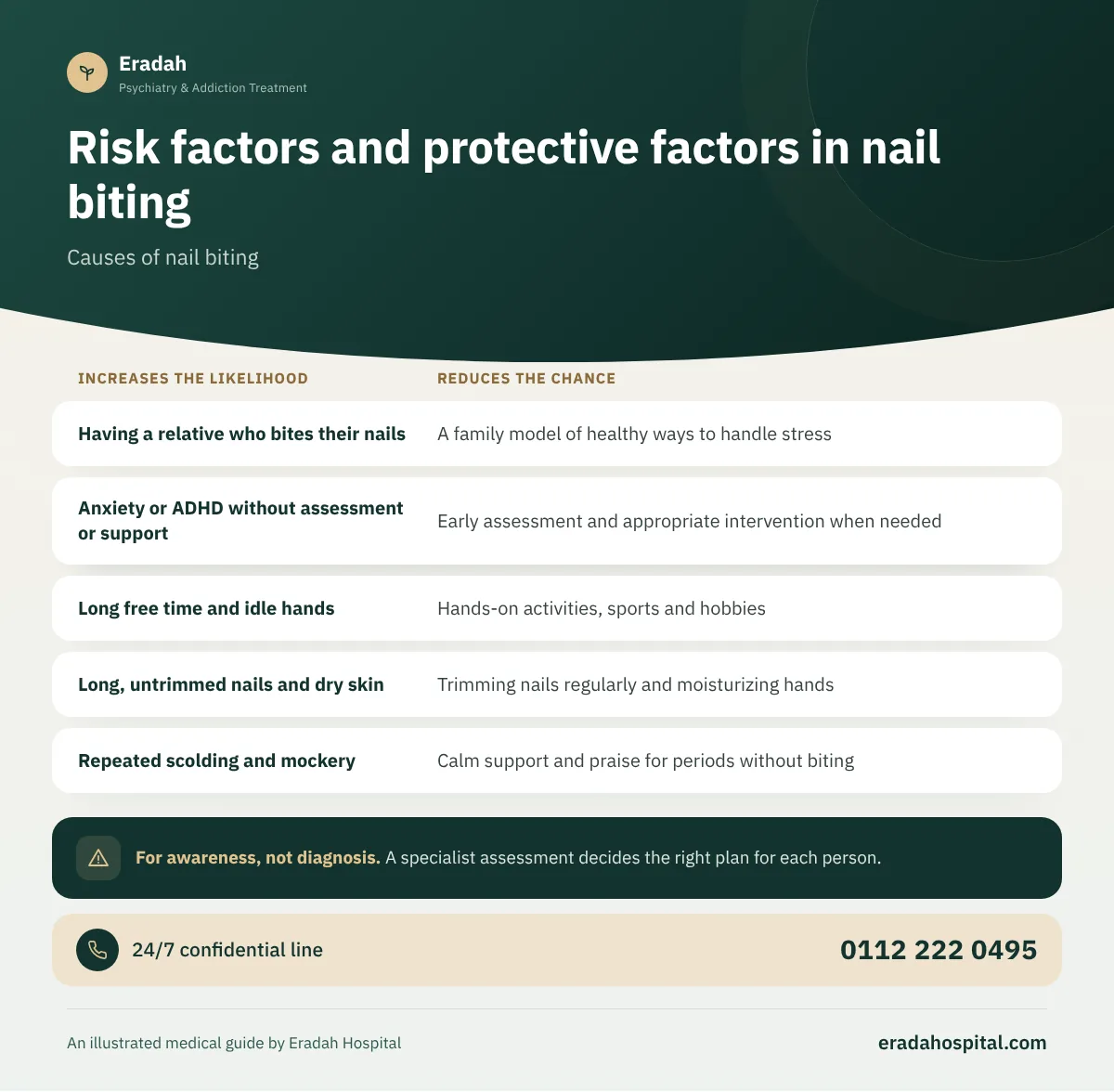
Risk and protective factors in nail biting
| Increases the likelihood | Reduces the chance |
|---|---|
| Having a relative who bites their nails | A family model of healthy ways to handle stress |
| Anxiety or ADHD without assessment or support | Early assessment and appropriate intervention when needed |
| Long free time and idle hands | Hands-on activities, sports and hobbies |
| Long, untrimmed nails and dry skin | Trimming nails regularly and moisturizing hands |
| Repeated scolding and mockery | Calm support and praise for periods without biting |
Common myths about the causes of biting
- "It's caused by calcium deficiency": there is no evidence that a mineral or vitamin deficiency is a common cause of biting.
- "It's caused by worms": the relationship is the reverse; biting can carry worm eggs to the mouth, not the other way around.
- "The child does it out of stubbornness": he often isn't even aware of what he's doing, and stubbornness as an explanation raises tension and solves nothing.
- "Biting is a sign of serious mental illness": most people who bite their nails do not have a psychiatric disorder.
Once you understand what drives the biting, the practical steps become clearer; you will find them in detail on the page how to stop it.