What are compulsive habits?
Many parents notice their child biting their nails while studying, or their daughter twisting and pulling locks of hair while lost in thought. Most of the time it is a passing habit. But in some children and adults the behavior becomes repetitive and hard to control, and leaves a clear mark on the body and mind.
Doctors call this group body-focused repetitive behaviors. These are acts repeated on the skin, hair or nails, such as nail biting, hair pulling, biting the lips or inside of the cheek, and skin picking. What unites them is that the person repeatedly tries to cut down or stop without success, and the behavior causes distress, harm or embarrassment.
In the Eradah guide we focus on the two best-known behaviors in this family: nail biting and hair-pulling disorder (trichotillomania). We placed them in the behavioral addiction section because they share with addiction the loop of craving, repetition and difficulty stopping, although medically they are closer to obsessive-compulsive disorder than to addiction in the strict sense.
Are compulsive habits a medical diagnosis?
Yes, once they reach a certain level of severity. The WHO's International Classification of Diseases (ICD-11) places a whole group titled body-focused repetitive behavior disorders under obsessive-compulsive and related disorders, including hair-pulling disorder and skin-picking disorder, as well as a category for other types that includes nail biting and cheek biting. The American DSM-5-TR also places hair-pulling disorder among the disorders related to obsessive-compulsive disorder.
The difference between these behaviors and classic obsessive-compulsive disorder is that here the person usually does not perform the act to prevent a frightening thought or an imagined disaster, but to relieve tension or a physical urge, and sometimes feels a degree of relief or pleasure during it. You will find a broader comparison on the page about obsessive-compulsive disorder.
Why are compulsive habits hard to stop?
These behaviors usually run in a repeating loop that can be summarized in clear stages:
- Stage 1The trigger
Stress, boredom, concentrating on studying or a screen, or the feeling of a rough hair or an uneven nail.
- Stage 2Rising tension
An inner urge to touch the nail or hair that grows and is hard to ignore.
- Stage 3Behavior
Biting or pulling that sometimes happens consciously and sometimes automatically without noticing.
- Stage 4Temporary relief
A feeling of relief or release that reinforces the behavior in the brain.
- Stage 5Regret and shame
Noticing the damage causes embarrassment and new tension, which restarts the loop from the beginning.
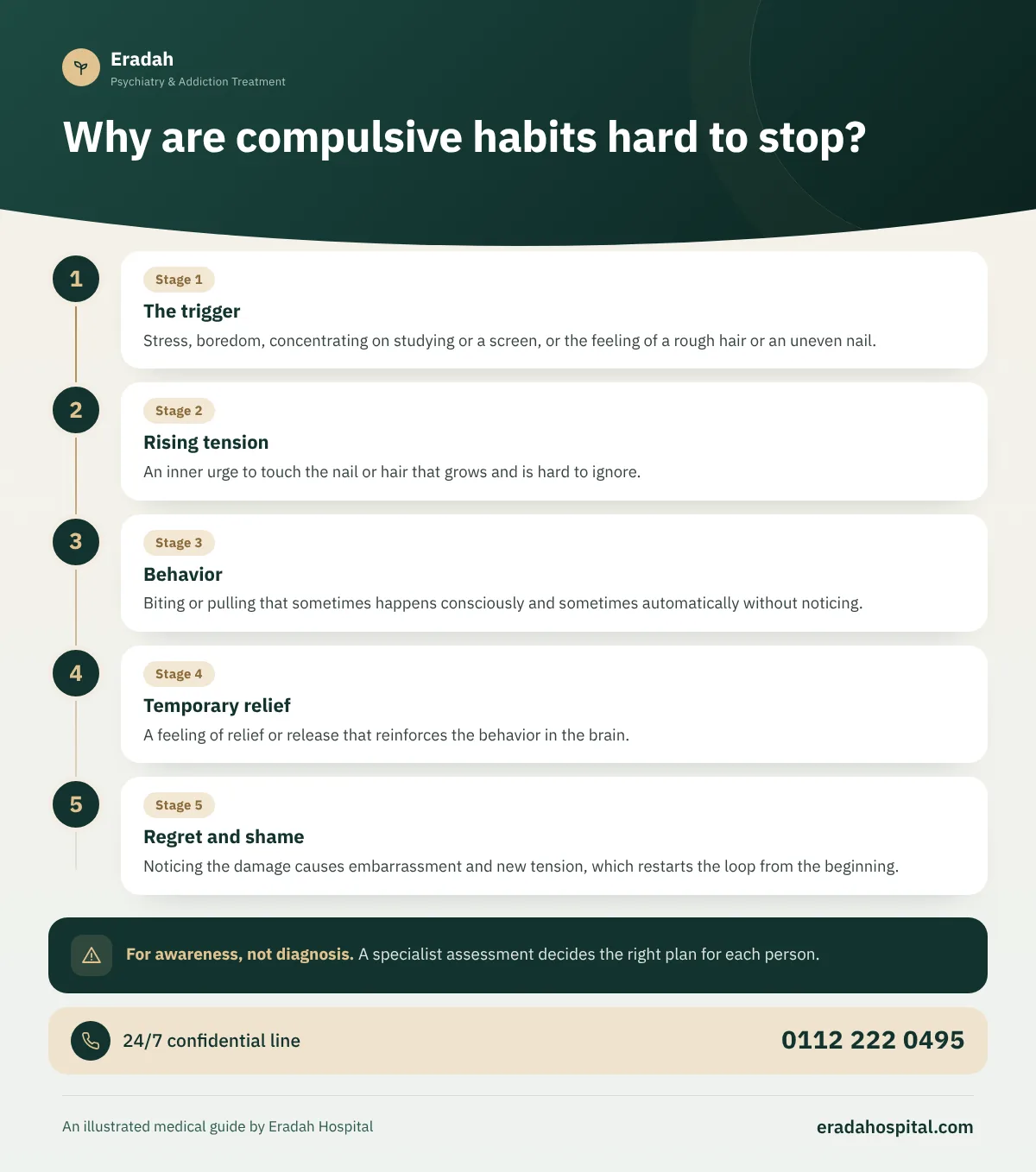
Specialists distinguish between two patterns: automatic behavior, which happens without awareness while reading or watching TV, and focused behavior, which happens consciously in response to tension or a strong urge. Most people have a mix of both, and each pattern has different treatment tools. Details are in the causes of nail biting and the causes of hair-pulling disorder.
Types of compulsive habits
Each behavior in this family has a full guide and separate pages on its causes and treatment. Here is a short card for each:
Nail biting
OnychophagiaA habit that often begins in childhood and may continue, leading to infections around the nails and damage to the teeth.
- Medical recognition
- Classified among body-focused repetitive behaviors in ICD-11 when severe
- How common
- Very common among children and teenagers
- Most affected group
- School-age children and teenagers
- Addiction potential
Low
When should you seek help? If it causes infections or bleeding around the nails, or continues despite attempts to stop and causes embarrassment and tension.
Hair-pulling disorder
TrichotillomaniaAlso known as: Hair pulling
A repeated urge to pull out hair that leads to noticeable bald patches, and responds well to behavioral therapy.
- Medical recognition
- Official diagnosis in ICD-11 and DSM-5-TR (trichotillomania)
- How common
- About 1–2% of people by estimates, and more common in females
- Most affected group
- Often early adolescence
- Addiction potential
Moderate
When should you seek help? If noticeable bald patches appear in the hair or eyebrows, or it causes isolation and intense embarrassment.
What is the difference between nail biting and hair-pulling disorder?
| Point of comparison | Nail biting | Hair-pulling disorder |
|---|---|---|
| Medical name | Onychophagia | Trichotillomania |
| Medical recognition | Among the other types of body-focused repetitive behaviors in ICD-11 when severe | Separate official diagnosis in ICD-11 and DSM-5-TR |
| How common | Very common in childhood and adolescence | Less common, estimated at about 1–2% of people |
| Usual starting point | Usually school-age childhood | Usually between ages 10 and 13 |
| Visible effect | Short, worn-down nails and infections around them | Bald patches in the hair, eyebrows or eyelashes |
| Main treatment | Habit reversal training and nail protection | Habit reversal training as part of cognitive behavioral therapy |
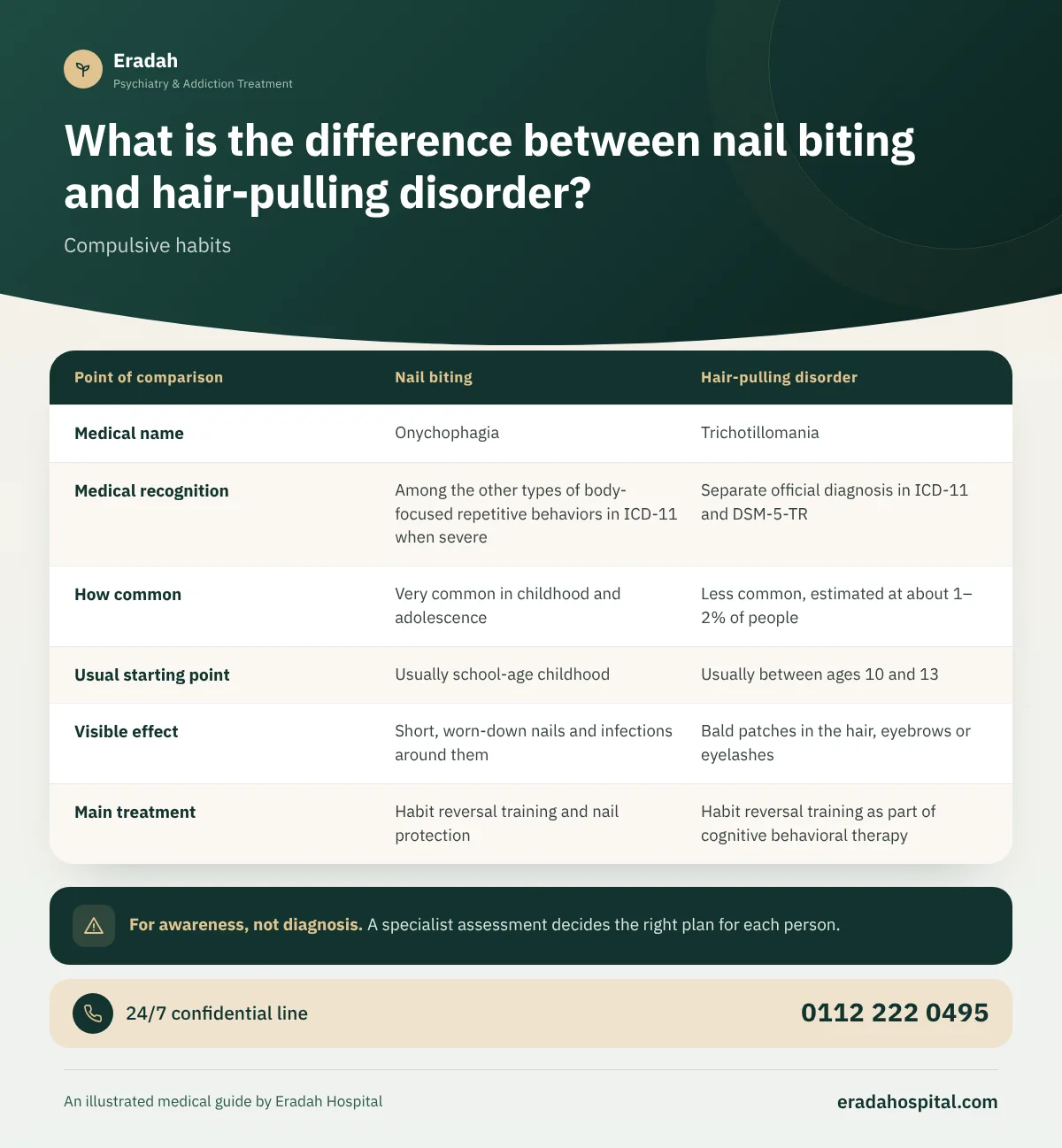
The two behaviors share the fact that the physical damage can usually be treated, since nails and hair grow back in most cases once the behavior stops, and that the hardest part is breaking the loop itself.
Compulsive habits in children and teenagers
Children and teenagers are the group most affected by this family. According to the UK's National Health Service, hair-pulling disorder usually begins between ages 10 and 13, while nail biting often appears at school age. They may be linked to exams, changing schools, bullying or trouble at home, or appear for no clear reason.
The most common mistake parents make is to scold, mock or punish, or to put bitter substances on the nails without explanation. These methods increase stress and shame, so the behavior increases or becomes secret. It is better to use calm observation and encouragement, help the child learn when and where the behavior happens, and give them alternatives for their hands.
What harms do compulsive habits share?
- Skin and nails: wounds, bacterial or fungal infections around the nails, and deformed nails.
- Hair: noticeable bald patches, and hair growth in the area may change if pulling continues for years.
- Mouth and teeth: nail biting can wear down or chip the front teeth, and carries germs from the hand to the mouth.
- Mind: embarrassment and shame, and avoiding events, swimming, shaving or medical exams.
- Relationships and confidence: hiding hands or hair with hats, worry about others' comments, and lower self-esteem.
- Co-occurring disorders: often accompanied by anxiety, depression, obsessive-compulsive disorder or attention-deficit/hyperactivity disorder.
Common myths about compulsive habits
| The myth | The truth |
|---|---|
| “It's just spoiled behavior and he'll stop if punished” | Punishment increases stress and shame, and the behavior responds to behavioral therapy and calm support, not scolding. |
| “Someone who pulls out their hair has a serious mental illness” | Hair-pulling disorder is a relatively common disorder within the obsessive-compulsive spectrum, and most people with it live normal lives. |
| “He does it to get attention” | Most people with it try hard to hide the behavior, and it often happens without awareness. |
| “There's no treatment except willpower” | Habit reversal training is a structured treatment with good evidence, and it teaches practical skills that do not rely on willpower alone. |
| “The hair won't grow back” | In most cases hair grows back once pulling stops, and the earlier treatment starts the better. |
How are compulsive habits treated?
Treatment is based mainly on habit reversal training, a cognitive behavioral approach with several steps: noticing when and where the behavior happens and what comes before it, then learning a “competing response” that occupies the hands when the urge arrives, such as squeezing a foam ball or making a fist, then adjusting the environment to reduce opportunities, with support from the family.
- Record the situations and times when the behavior increases.
- Keep the nails short and neatly trimmed, or put medical tape on the fingertips.
- Wear a head covering or light gloves at the hardest times, such as studying and watching TV.
- Use fidget toys to keep the hands busy during long periods of sitting.
- Breathing exercises and physical activity to ease stress.
- Tell a trusted person, since sharing it eases anxiety for many people.
There are no medications specifically for these behaviors, and the UK's National Health Service notes that antidepressants are not usually prescribed for hair-pulling disorder. But a psychiatrist may treat accompanying anxiety, depression or obsessions when present. Details are in treating nail biting and treating hair-pulling disorder.
When do compulsive habits need a specialist?
Ask for an assessment from a psychiatrist or behavioral therapist if you notice any of the following. This list is for awareness and is not a diagnosis.
- Wounds, bleeding or repeated infections around the nails.
- Noticeable bald patches in the hair on the head, eyebrows or eyelashes.
- Swallowing or chewing hair.
- Repeated failed attempts to stop despite a sincere wish to.
- Avoiding school, events or relationships because of embarrassment.
- Persistent anxiety or sadness, or obsessive thoughts or other repeated rituals.
How can a family help someone with a compulsive habit?
- Do not comment on the behavior in front of others, and do not use mockery or nicknames.
- Agree with your child on a calm, private signal that alerts them when the behavior starts without their awareness.
- Praise the attempts and the good days, not only the perfect result.
- Look with them for sources of stress at school or at home and deal with them.
- Provide alternatives for the hands in the places where the behavior often happens.
- If the behavior continues or leaves a clear mark, seek a specialist's help without delay or embarrassment.