Can you stop biting your nails for good?
Yes, many people stop completely, whether through organized self-effort or with a specialist's help. Change depends less on willpower than on breaking the automaticity: making the behavior visible to the person, then putting a ready alternative in its place, then reducing the triggers that call it up.
The plan varies with the severity of the biting, the person's age and any accompanying conditions. A young child needs an approach based on the family and rewards, an adult who has bitten for twenty years may need structured behavioral sessions, and someone with severe anxiety or ADHD benefits from treating those too.
Step one: awareness and tracking the pattern
Before any attempt to stop, watch yourself for a week or two and record each time: the time, place, activity and the feeling before biting. You may find that most biting happens in just one or two situations, which makes the task much easier. You can also ask someone close to remind you with a gentle, agreed signal.
Habit reversal training: the strongest proven method
Habit reversal training (HRT) is a behavioral treatment that studies have shown to be superior to placebo in increasing nail length, and it is considered the core treatment for all body-focused repetitive behaviors. It consists of clear stages:
- 1Awareness training
Describing the behavior precisely and learning to notice the cues that come before it, such as raising the hand toward the mouth or feeling the edge of the nail.
- 2The competing response
When feeling the urge, the person makes a movement that does not allow biting, such as clenching the fist or holding an object, for about a minute or until the urge passes.
- 3Social support
A person close to you praises your commitment and gently reminds you when you forget the response, without blame.
- 4Generalization and follow-up
Applying the skill in every situation, and regularly reviewing what worked and what did not.
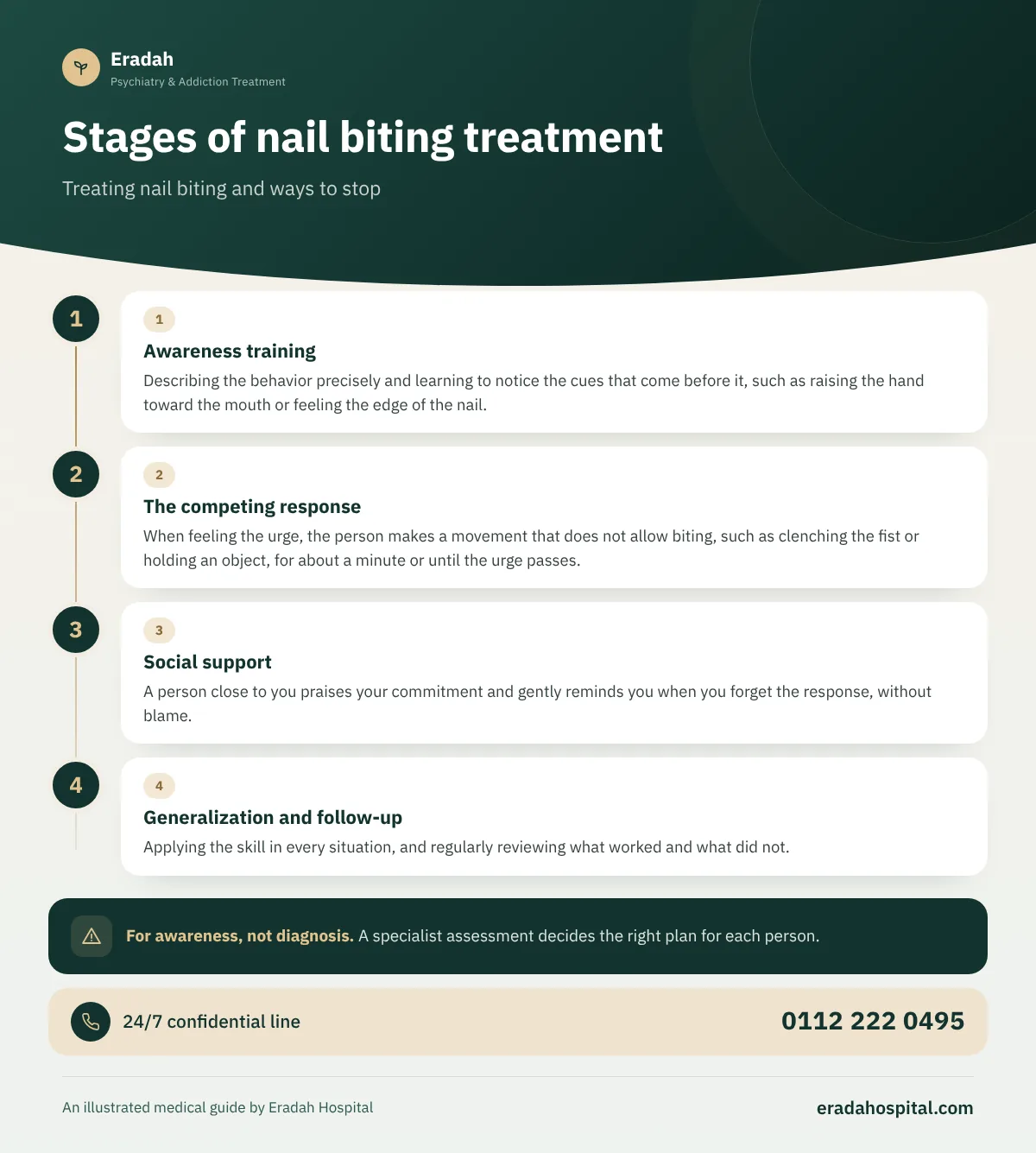
The competing response should be inconspicuous and usable anywhere, so that the person does not avoid it in social situations.
Comprehensive behavioral treatment and cognitive therapy
Comprehensive behavioral treatment (ComB) expands the idea of habit reversal, addressing five aspects that drive biting: sensation, thoughts, feelings, movement and place. Each aspect has a suitable tool; someone who bites from boredom needs stimulation alternatives, someone who bites from stress needs calming skills, and someone who bites because of rough edges needs nail care.
Cognitive behavioral therapy and acceptance and commitment therapy add work on accompanying thoughts such as "I can't stop" or "the edge has to be even right now," and learning to accept the urge as a passing sensation without acting on it.
Practical tools that help you every day
Short, neat nails reduce the edges that tempt you to bite.
A clear, bitter-tasting polish alerts you when a finger goes into the mouth; it is a reminder tool, not a punishment.
Medical tape or light gloves during usual biting times such as watching TV and at bedtime.
A stress ball, a small fidget toy or hands-on activities during screen time and lectures.
Moisturizing the hands and removing extra skin with proper clippers instead of the teeth.
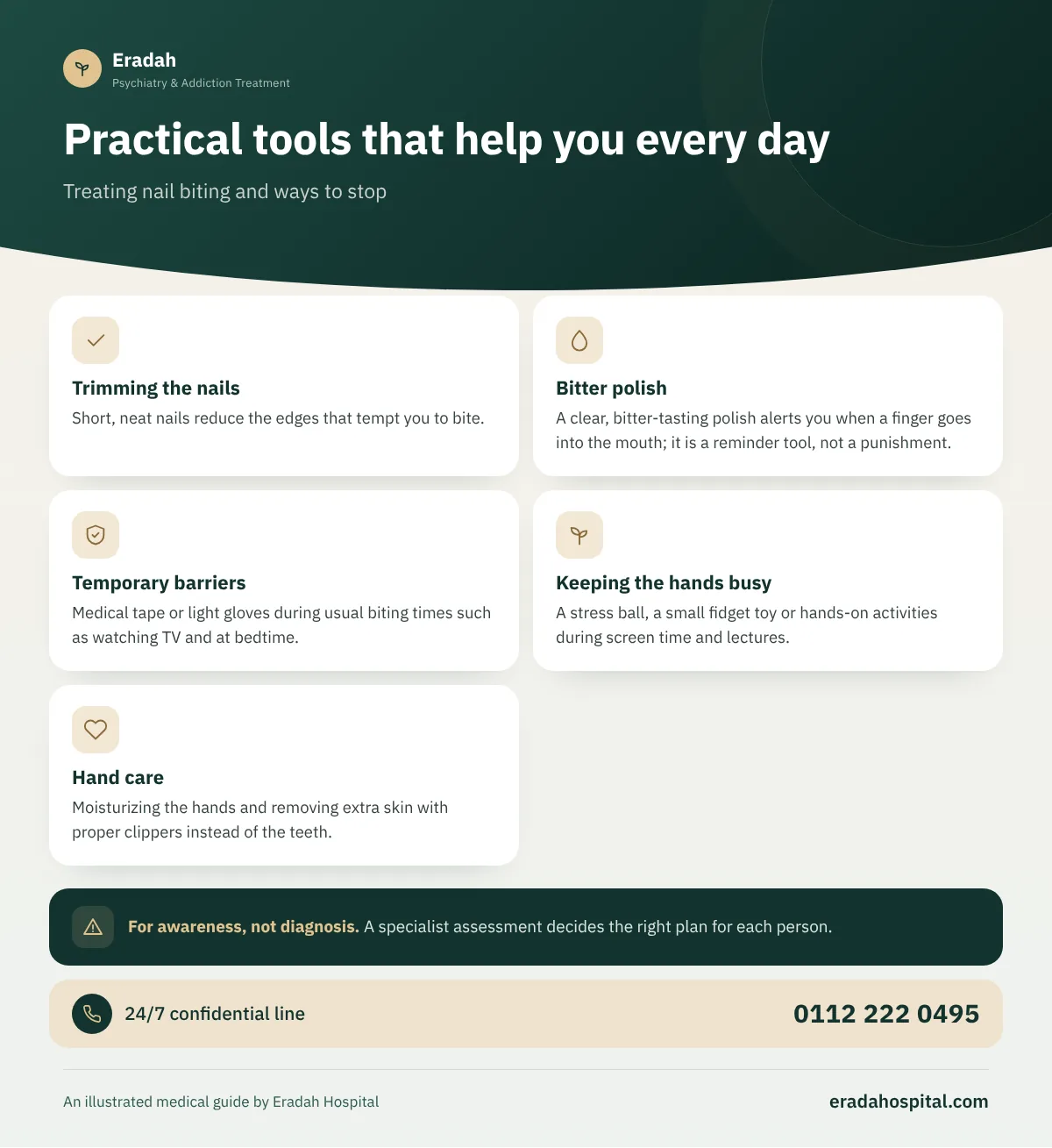
These tools work best as part of a behavioral plan; bitter polish alone may stop working once the person gets used to it.
How do you help your child stop without punishment?
- Talk to him calmly and ask for his participation in the plan; a cooperative child succeeds more than a monitored one.
- Agree on a gentle secret signal for reminders instead of commenting in front of others.
- Use a simple reward chart for days or periods without biting, and praise the effort, not only the result.
- Provide alternatives for his hands during TV and homework, such as clay or a stress ball.
- Reduce the stress around him as much as you can, and look for the source of his worry if there is one.
- Avoid slapping his hand, mockery and comparing him with his siblings; they increase biting in secret.
What is the decoupling technique?
Decoupling is a simple self-help technique developed for body-focused repetitive behaviors, based on redirecting the movement: when the hand starts heading toward the mouth, the person quickly carries the movement on to another place such as the ear or hair, then lowers it. Small studies have shown encouraging results, and it is used as a complementary tool, not a replacement for habit reversal.
Are there medications to treat nail biting?
There is no approved medication for nail biting. Some substances, such as N-acetylcysteine (NAC) and selective serotonin reuptake inhibitor antidepressants, have been studied in small studies with limited or temporary results. A psychiatrist may prescribe medication when there is severe accompanying anxiety, OCD or ADHD, after a full assessment. Do not use any medication or supplement for this purpose without medical advice, especially for children.
Caring for the nails and skin during recovery
During the period without biting, the nails gradually grow back over months, helped by moisturizing the skin around the nails, keeping them clean and trimming them regularly. If redness, swelling, pain or pus appear around the nail, or infections recur, see a dermatologist because they may need medical treatment. Seeing the nails improve reinforces the motivation to continue.
What if you go back to biting?
A temporary return to biting is common, especially during stressful periods such as exams or work problems. It does not mean the effort was wasted; the skills you learned are still there. Review the trigger that came before the return, reactivate your tools such as bitter polish and the competing response, and treat yourself kindly, as you would a friend trying to change.
When do you need a specialist for nail biting?
- You have seriously tried self-help steps for several months without improvement.
- The biting causes wounds, recurrent infections or deformed nails.
- It comes with severe anxiety, obsessive thoughts or other repetitive behaviors.
- It clearly affects your confidence, relationships or work.
- In a child, the biting comes with hyperactivity, learning difficulties or obvious fears.
Choosing a hospital for nail biting treatment
Let's be frank: most people who bite their nails do not need a hospital or a residential stay at all. What is usually needed is a behavioral therapist skilled in habit reversal training, and a psychiatrist who can pick up on anxiety, OCD or attention problems that may lie behind the biting. So the more precise question is: which clinic or center has this particular expertise? These are signs to help you judge:
- The specialist begins by recording the biting pattern, its situations and times before suggesting any solution.
- He explains the competing response you will practice, and follows up on how you apply it between sessions.
- He checks for possible disorders such as OCD or ADHD when there are signs of them.
- He refers to a dermatologist if recurrent infections appear around the nail.
- With children he rejects punishment and shaming, and teaches parents encouragement instead.
At Eradah, severe biting is treated through outpatient clinics and the day program, with a behavioral plan set by psychological specialists under the supervision of Dr. Mahmoud El-Sawy, Consultant Psychiatrist and Addiction Specialist. We receive children and teenagers for assessment, treatment and follow-up, involving parents gently. If you want to understand the roots first, read why do we bite our nails?.
Have you tried many times and found your fingers back in your mouth? Call or message us on WhatsApp at 01122220495 at any hour; the first consultation is free and no one but you sees it, or book an assessment appointment here. Note that residential treatment at Eradah is for men only, and is rarely needed in this condition.
Nail biting treatment at Eradah
At Eradah Psychiatry & Addiction Treatment Center, severe biting is first approached with an assessment that identifies its pattern, its triggers and any accompanying conditions such as anxiety, ADHD or OCD. Then we set a behavioral plan based on habit reversal training and comprehensive behavioral treatment, involving the family in a supportive way for children and teenagers, with psychiatric follow-up when needed.