What is nail biting?
Nail biting, which doctors call onychophagia, is repeatedly putting the fingers in the mouth and biting the nail or the skin around it. Many people do it without noticing while reading, watching TV, or in moments of stress and waiting.
In most cases it remains a simple habit that needs no more than awareness and a few practical tricks. But in some people it turns into a repeated behavior that is hard to stop, causing wounds, infections and deformed nails, and making the person hide their hands out of embarrassment in social situations.
Most importantly, a person who bites their nails is not "badly brought up" or "weak-willed." This behavior has roots in the way the nervous system handles stress, boredom and stimulation, and it shares one mechanism with other behaviors such as hair pulling and skin picking.
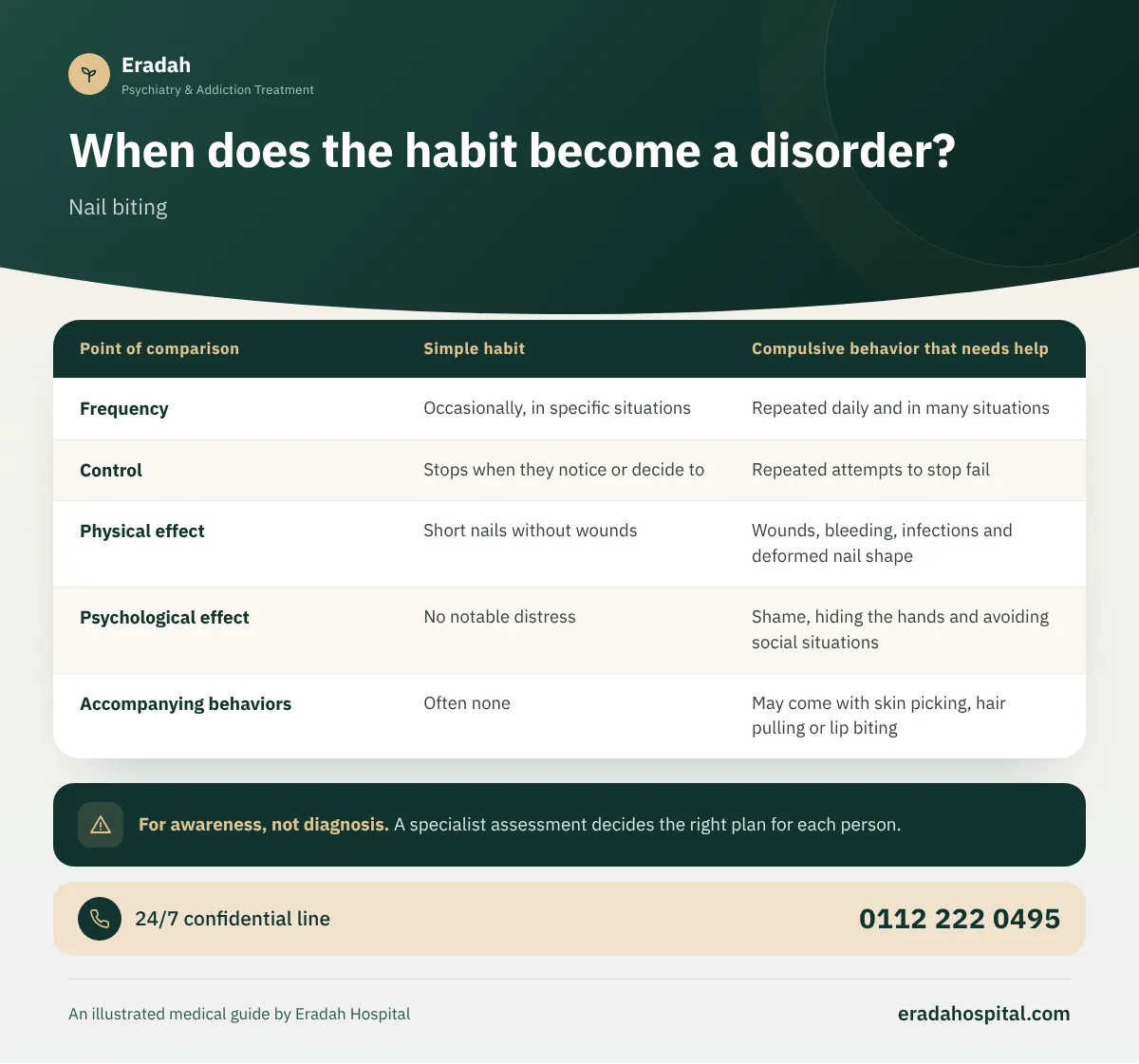
When does the habit become a disorder?
It is not measured by the number of times, but by three things: has the person tried to stop and been unable? Is there clear physical harm? Does it cause distress or affect their life?
| Point of comparison | Simple habit | Compulsive behavior that needs help |
|---|---|---|
| Frequency | Occasionally, in specific situations | Repeated daily and in many situations |
| Control | Stops when they notice or decide to | Repeated attempts to stop fail |
| Physical effect | Short nails without wounds | Wounds, bleeding, infections and deformed nail shape |
| Psychological effect | No notable distress | Shame, hiding the hands and avoiding social situations |
| Accompanying behaviors | Often none | May come with skin picking, hair pulling or lip biting |
Where does nail biting fall in medical classifications?
Severe nail biting falls under a group called body-focused repetitive behaviors (BFRBs), which also includes trichotillomania, skin picking and cheek biting. Medical references classify them within the spectrum of obsessive-compulsive disorder because some of their mechanisms are similar, although they differ in that the behavior usually brings relief or satisfaction rather than merely easing an obsessive thought.
In the American manual DSM-5, nail biting is given as an example under "other specified obsessive-compulsive and related disorders," and in the international classification ICD-11 it falls under "body-focused repetitive behavior disorders" in the other specified category (6B25.Y). It is diagnosed as a disorder only if it is repeated and causes physical harm and clear distress, with failed attempts to stop.
How common is nail biting?
The rate usually falls with age, but a considerable number of adults keep biting since childhood or return to it in periods of pressure. There are no documented Egyptian figures, although its wide spread is evident in every society.
What does it look like? Common patterns
Biting varies from person to person, but two patterns can be recognized that often occur together in the same person:
Happens without awareness during concentration, viewing or driving, and the person notices only after seeing the damage.
Happens with awareness in response to stress, boredom or a feeling of a rough edge on the nail that must be "evened out."
Very short nails and jagged edges, red or peeling skin around the nail, and sometimes biting of the skin itself.
It may come with skin picking around the nails, lip and cheek biting, or thumb sucking in children.
What complications can it cause to the nails, teeth and skin?
Nail biting seems harmless, but continuing for years can leave real effects:
- Infection around the nail (paronychia): the most common complication, showing as redness, swelling and pain, and pus may form.
- Nail deformity: permanently short nails and damage to the base and surface of the nail with long-term biting.
- Dental problems: wearing or chipping of the front teeth, gum inflammation, and possible effects on tooth alignment.
- Spread of infection: from the mouth to the fingers and back, such as warts, some viral infections and intestinal parasites in children.
- Psychological and social impact: embarrassment about the look of the hands and avoiding handshakes or appearing in photos.
Rarely, infection can spread to deeper tissues if neglected, so repeated infections around the nails should not be left without a medical examination.
Nail biting in children: when should parents worry?
Biting is very common among children, usually starting after age three or four, and many stop on their own as they mature. There is no need to worry if it is occasional and causes no wounds. But it is advisable to consult a doctor if:
- It causes wounds, bleeding or repeated infections.
- It comes with clear signs of anxiety, fears or trouble sleeping.
- It appears with other repetitive behaviors such as hair pulling or skin picking.
- It comes with attention difficulties or hyperactivity that affect schoolwork.
- The child has become embarrassed about their hands or is being bullied because of it.
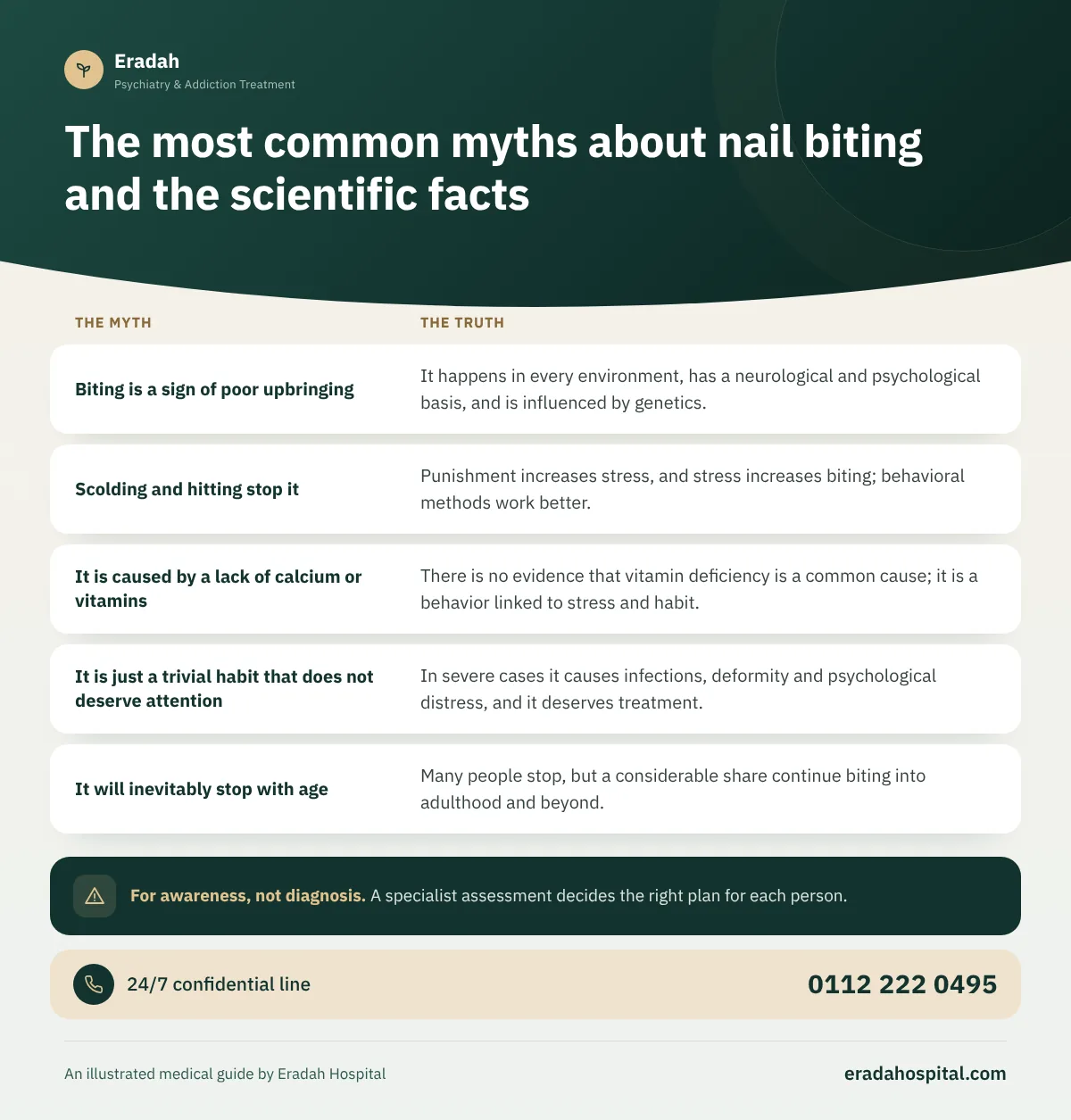
Myths and facts about nail biting
| The myth | The truth |
|---|---|
| Biting is a sign of poor upbringing | It happens in every environment, has a neurological and psychological basis, and is influenced by genetics. |
| Scolding and hitting stop it | Punishment increases stress, and stress increases biting; behavioral methods work better. |
| It is caused by a lack of calcium or vitamins | There is no evidence that vitamin deficiency is a common cause; it is a behavior linked to stress and habit. |
| It is just a trivial habit that does not deserve attention | In severe cases it causes infections, deformity and psychological distress, and it deserves treatment. |
| It will inevitably stop with age | Many people stop, but a considerable share continue biting into adulthood and beyond. |
How can the family respond without blame or embarrassment?
What hurts a child or teenager most in this situation is repeated comments in front of others, slapping the hand, and mockery. These methods increase shame and tension and push them to bite in secret. It is more helpful for the family to agree with them on a gentle secret signal to alert them, to praise periods without biting, and to notice the situations in which biting increases so as to understand what lies behind it.
With adults, support comes through encouragement, not monitoring; the decision ultimately belongs to the person, and the family's role is to make it easier, not turn it into a daily battle.
When should you see a doctor, and which specialist is right?
See a dermatologist if there is redness, swelling and pain around the nail, pus, a fever, or a permanent change in the shape of the nail. See a dentist if there is wear or pain in the front teeth. A psychiatrist or psychotherapist is appropriate when the person fails to stop despite wanting to, or when biting comes with severe anxiety, other compulsive behaviors or clear psychological distress.
Nail biting guide: everything you need to know
We have gathered everything about nail biting in 2 pages, each answering one question in detail. Choose what you are looking for:
Causes of nail biting
How emotions such as stress, boredom and frustration, automatic habit, sensory factors, genetics, anxiety and hyperactivity contribute to the start and persistence of biting, and its everyday triggers.
Treatment of nail biting
Habit reversal training and comprehensive behavioral therapy, practical tools such as keeping nails short and bitter-tasting polish, ways to help children, and when you need a specialist.