How is hashish processed inside the body?
After use, THC travels to the blood and then to the brain and other organs, and because it dissolves in fat, part of it is stored in fatty tissue and released slowly over days and weeks.
The liver converts THC into several byproducts, chiefly a temporary active one, then an inactive one called THC-COOH, which is excreted slowly in the urine. This byproduct is what most urine tests look for, so the result can be positive long after the psychological effect has gone.
The active substance itself, which appears in blood and saliva and points to relatively recent use.
An inactive byproduct that stays longer in urine and points to use, not to current impairment.
How long does hashish stay in the body by type of test?
Urine (single use or occasional use)
Urine (regular use several times a week)
Urine (chronic daily use)
Blood
Saliva
Hair
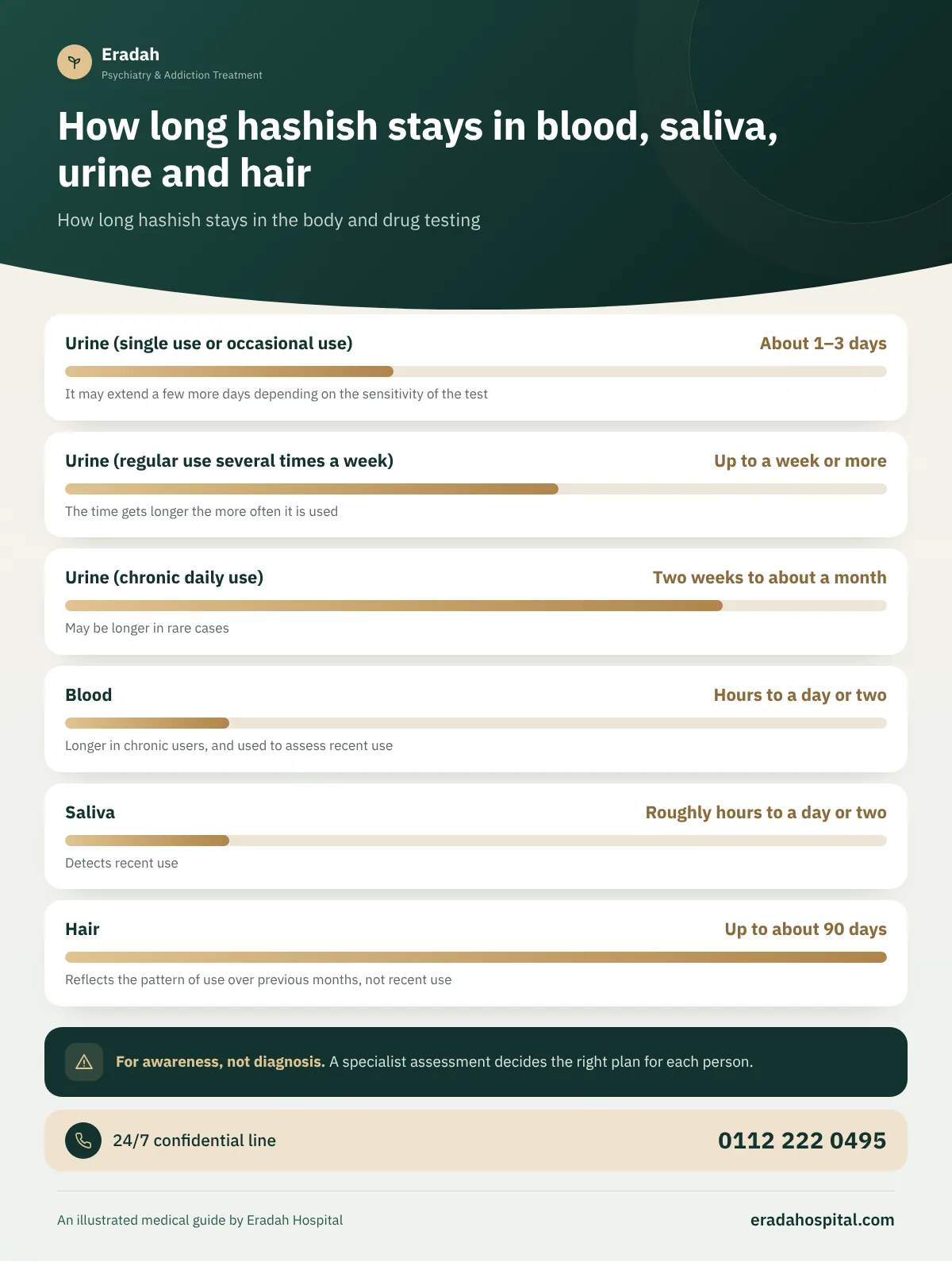
These times are approximate and vary with the laboratory, the sensitivity of the test, the cutoff used, and the individual. For an accurate interpretation of a specific result, consult your doctor or the laboratory.
Why does hashish stay in the body longer than most drugs?
Most drugs dissolve in water and leave in the urine within a few days, but THC dissolves in fat. With daily use it builds up in fatty tissue, then is gradually released into the blood, where it is converted and leaves in the urine. That is why a chronic user's test may be positive for weeks after the last use, while the test of someone who used once may turn negative within days.
Factors that affect how long hashish stays in the body
| Factor | Effect |
|---|---|
| Frequency and duration of use | The most important factor: daily use over long periods lengthens the time greatly |
| Potency of the substance | Varieties higher in THC leave a larger amount of byproducts |
| Body fat percentage | More body fat may lengthen the storage and release period |
| Metabolism and liver function | A slower metabolism slows clearance |
| Test sensitivity and cutoff | More sensitive tests detect smaller amounts and for longer |
What is the difference between a screening test and a confirmatory test?
- Preliminary test (strip or cassette): Quick and inexpensive, based on antibodies, and gives a positive or negative result above a certain cutoff, but it can sometimes be wrong.
- Confirmatory laboratory test: Using chromatography and mass spectrometry equipment, it identifies the substance and its amount accurately, and is requested after a positive result or in official cases.
Can a positive result appear without using hashish?
A false positive on the preliminary test is possible but not common, and may occur with certain medications. Also, some CBD products on the market may contain amounts of THC that the label does not mention, leading to a genuine positive result. Secondhand exposure to hashish smoke rarely suffices to exceed the cutoff under ordinary conditions.
How does a doctor interpret a hashish test result?
A positive urine result means THC byproducts are present above a certain level, but it does not tell exactly when use happened, how much was used, or whether the person was under the influence at the time of the test. For this reason the doctor interprets the result in light of the medical history and examination, not in isolation.
In treatment programs, tests may be repeated at intervals to follow the level falling gradually after stopping, which helps tell leftovers from old use apart from new use. The laboratory interprets this follow-up carefully, because urine concentration itself differs from one sample to another.
Does a standard drug test detect hashish and other substances together?
Most multi-panel strips used in laboratories and emergency rooms include a cannabis slot alongside opioids, stimulants, benzodiazepines and others. But each slot detects a specific group of substances, so a negative result in one slot does not mean the body is free of all drugs, especially newer synthetic substances.
Does a hashish test detect Strox?
Mostly no. The usual cannabis test looks for natural THC byproducts, while synthetic cannabinoids such as Strox are different chemicals that need special tests. So a hashish test can be negative in someone using Strox, which is important information for families and doctors.
Does the time in the body differ if the hashish is eaten?
The active substance is the same, so the test detects it however it entered the body. But absorption from edibles is slower and the effect lasts longer, and the timing of when byproducts appear may differ slightly. The deciding factor in detection time remains how often and for how long it has been used.
When are hashish tests requested?
- In the emergency room: With acute psychosis, repeated vomiting or unexplained intoxication.
- In treatment programs: To monitor adherence, and used in incentive systems to reward negative tests.
- Before hiring or at workplaces: According to each employer's regulations.
- In legal cases: Through official procedures and confirmatory tests.
A positive result is not enough on its own to diagnose addiction; diagnosis needs a medical assessment, as described on the page hashish addiction symptoms.