What is the drug GHB?
GHB stands for gamma-hydroxybutyric acid, a substance the brain itself makes in very small amounts, but when it is taken from outside in much larger amounts it becomes a powerful depressant of the nervous system.
The DEA explains that GHB is found in the brain in very small concentrations as a by-product of the breakdown of the neurotransmitter GABA, and that what is sold is a powder dissolved in liquid, so it looks like a clear, colorless liquid with a slightly salty taste. It is mostly produced in illicit laboratories, which means the concentration of any bottle is unknown.
There are also closely related substances, the best known being GBL and 1,4-butanediol, which the body converts into GHB after they are taken, so they give the same effect according to the DEA, and they are sometimes used instead of it. People often talk about GHB and GBL as if they were one thing.
Does GHB have a medical use?
Yes. In 2002 the US Food and Drug Administration approved sodium oxybate, the pharmaceutical form of GHB, to reduce sudden attacks of muscle weakness (cataplexy) and improve daytime sleepiness in people with narcolepsy, with restricted distribution through a central pharmacy according to the DEA. A scientific review from 2021 notes that it is also used therapeutically in some countries for alcohol use disorders and alcohol withdrawal.
How does GHB affect the brain?
According to the review by Felmlee and colleagues (2021), GHB binds to its own receptors and to GABA type B receptors, and most of its therapeutic and toxic effect comes from activating the latter. The DEA describes its effect as a depression that increases with the amount and resembles the effect of barbiturates. The person usually passes through two stages:
- At first: euphoria, relaxation and lowered inhibition, and sometimes a feeling like mild stimulation.
- Then: drowsiness and problems with movement and memory, which can suddenly turn into loss of consciousness.
The same review stresses that the curve linking GHB concentration to its effect is “steep,” meaning a small increase in the amount can take a person from drowsiness to a coma, which is why overdoses happen so often.
Forms and names of GHB
GHB is mostly sold as a liquid, and sometimes as a powder to be dissolved, and NIDA notes that it can be swallowed or its powder inhaled. Its common street names worldwide include “G” and “liquid ecstasy.” Its pharmaceutical name is sodium oxybate. The name “liquid ecstasy” is completely misleading, because ecstasy is a stimulant that is entirely different in its effect and danger.
Why is GHB misused?
According to the DEA, GHB misuse spread in the 1990s among teenagers and young adults in the nightclub scene. Motives cited by medical sources include:
- Seeking euphoria and relaxation as a substitute for alcohol, with the mistaken belief that it is “cleaner.”
- Lowered inhibition, and the belief that it increases desire, which is linked to risky behavior.
- The belief that it helps build muscle or sleep, without any medical supervision.
- Using it with other substances at parties to change their effect, which is the most dangerous pattern.
A clinical trial published in 2007 indicates that GHB produced somewhat higher euphoria and pleasure than flunitrazepam and alcohol in people who use party drugs, and the researchers concluded that its potential for misuse is high.
GHB compared with ecstasy and Roofies
| GHB | Ecstasy (MDMA) | Roofies | |
|---|---|---|---|
| Type | Nervous system depressant | A stimulant with a mild hallucinogenic effect | A sedative-hypnotic benzodiazepine |
| Common form | Usually a clear liquid | Tablets or capsules | Tablets |
| Medical use | Sodium oxybate for narcolepsy | No approved use | Insomnia in some countries |
| Main risk | Coma and suppressed breathing with alcohol | Rise in temperature, pulse and blood pressure | Memory loss and suppressed breathing when mixed |
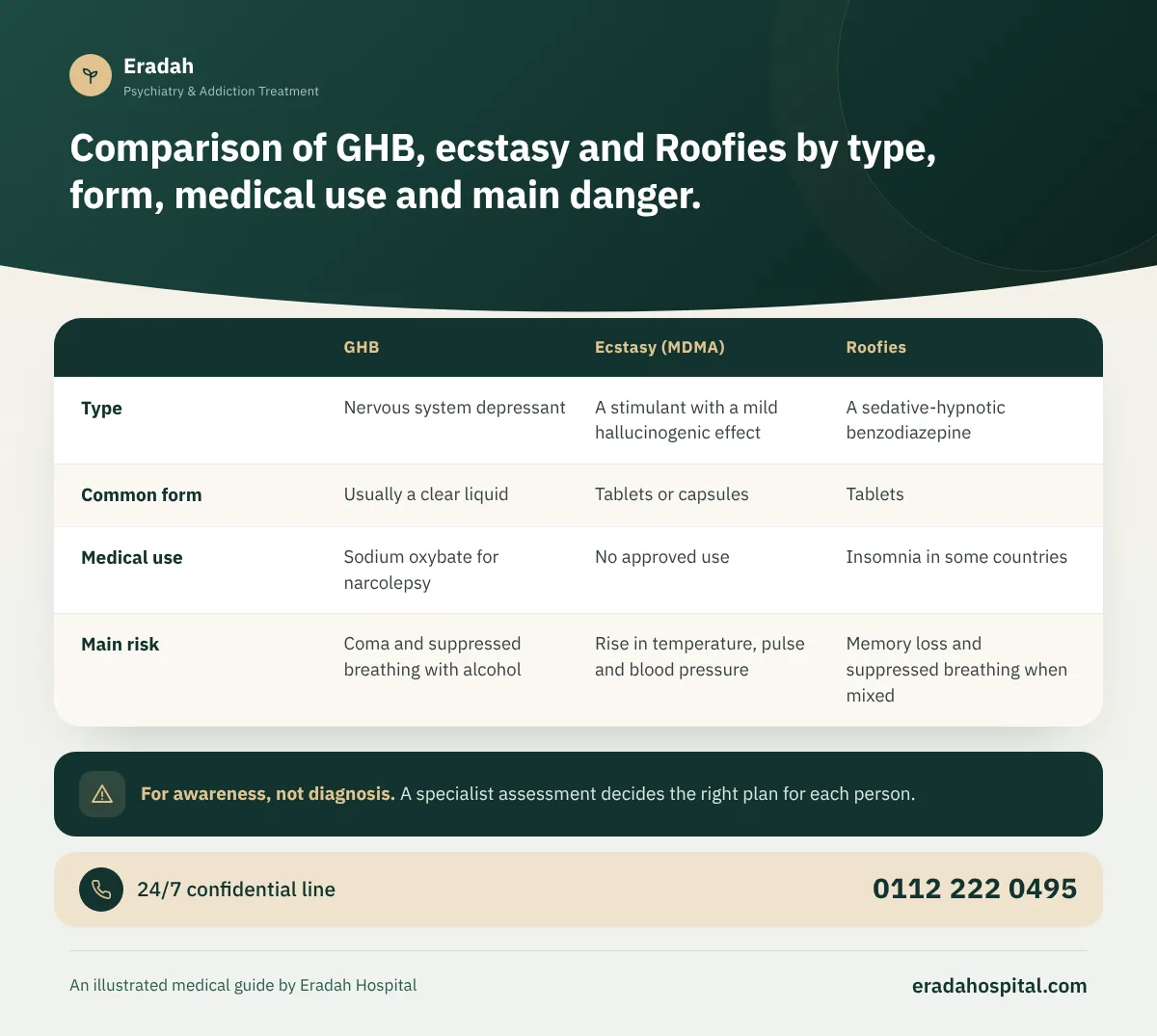
What GHB and Roofies have in common is that both are depressants that cause drowsiness and memory problems, which is why they have been linked together to assaults, while ecstasy differs from them in being a stimulant.
GHB and being drugged without knowing
NIDA states that GHB has been used in sexual assaults because of the strength of its sedative effect and because, being an almost colorless liquid, it is easy to hide in a drink. A person who experienced this is not responsible for what happened, needs prompt medical care and psychological support, and can contact the mental health support line, 16328. Because GHB disappears from the body within hours, going to the hospital quickly is very important. We explain the signs and what to do in detail in symptoms of GHB use.
The legal status of GHB
According to the World Health Organization’s Expert Committee on Drug Dependence, GHB is currently listed in Schedule IV of the 1971 United Nations Convention on Psychotropic Substances. In Egypt, dealing in or possessing it outside the medical framework is an offense that exposes a person to legal liability. The Fund for Drug Control and Treatment of Addiction offers free, confidential treatment through hotline 16023.
This is general educational information and not legal advice.
GHB in numbers
Sources: the DEA’s assessment of the substance (October 2025), and the StatPearls review on GHB poisoning.
GHB guide: everything you need to know
We have gathered everything about GHB into 2 pages, each answering one question in detail. Choose what you are looking for:
Harms of GHB to the body and mind
Learn about the harms of the drug GHB: sudden coma and suppressed breathing, why mixing it with alcohol is deadly, vomiting while unconscious, GBL burns, and addiction and its dangerous withdrawal.
GHB use symptoms and signs of addiction
How can you tell that someone is using GHB? Signs of use and addiction, sudden sleep followed by waking, signs of being drugged with GHB without knowing, and why testing must happen within a few hours.
Found a strange bottle of liquid with your child? What to do
- Do not taste the liquid or smell it up close, because some types are corrosive industrial substances.
- Do not confront them while they are under the influence; first make sure they are conscious and breathing normally.
- Ask them calmly about the setting: parties? Friends? Do they mix it with alcohol? Since when?
- If they use it every day, do not ask them to stop suddenly; its withdrawal can be dangerous and needs supervision.
- Ask for a specialized, confidential consultation for assessment and a suitable plan.
- Remember the ambulance number, 123, and learn the danger signs at the bottom of this page.
Harms, symptoms, withdrawal and treatment in brief
Harms: the most serious are sudden coma and suppressed breathing, especially with alcohol, and vomiting while unconscious, along with dependence. Details in harms of the drug GHB.
Symptoms: euphoria then drowsiness, unsteadiness, memory problems, and sudden sleep that is hard to wake from. See signs of GHB use.
Withdrawal: the StatPearls review notes that severe GHB withdrawal can develop within 24 hours into severe agitation and disturbed pulse and blood pressure, can be life-threatening and can last up to 15 days, which is why it needs medically supervised detox, usually inside a treatment facility.
Treatment: according to NIDA there are no medications approved specifically for treating GHB addiction, but behavioral therapies such as cognitive behavioral therapy and contingency management are effective, along with treating any anxiety or depression as part of a dual diagnosis, and follow-up after a residential program.
Danger signs after GHB use: call an ambulance (123) immediately
- Loss of consciousness or deep sleep from which the person cannot be woken by calling or touch
- Slow or weak breathing, or breathing that stops for periods
- Seizures or sudden muscle tremors
- Vomiting while drowsy or with reduced awareness, or a cold body and slow pulse
- Severe agitation, confusion or hallucinations after stopping regular use
Call ambulance (123) immediately. If the person is unconscious but breathing, place them on their side so they do not choke on vomit. Stay with them and do not leave them alone to “sleep it off.” Do not give them food, drink or any medicine, and tell the paramedics everything you know about what they took and when.
Call the ambulance 123