Why is GHB overdose so common?
The UK's FRANK service notes that the difference between the amount that gives the desired effect and the amount that causes a severe overdose is very small, and the review by Felmlee and colleagues describes the curve linking its concentration to its effect as "steep," which is why overdoses happen repeatedly.
Two things make this worse: according to FRANK, the strength of the liquid varies from one bottle to another, and the effect can take from 10 minutes to an hour to appear, so the person thinks the substance "didn't work" and repeats the dose, and then both effects arrive together.
Immediate harms of GHB
The US National Institute on Drug Abuse (NIDA) notes that low amounts may cause nausea, while higher amounts can lead to:
- Loss of consciousness and coma.
- Seizures.
- Slowed breathing and heart rate.
- Low body temperature.
- Nausea and vomiting.
- Death.
The StatPearls review adds that coma may start suddenly and the person may then wake suddenly within hours, and that some users become agitated or aggressive before, during or after the period of deep drowsiness, with muscle twitching and memory loss.
Harms of GHB to the body's organs
| Organ | Harm |
|---|---|
| Brain | Drowsiness followed by sudden loss of consciousness, seizures or muscle twitching, memory loss, and sometimes agitation. |
| Lungs | Respiratory depression that can go as far as breathing stopping for periods, and that multiplies with alcohol. |
| Heart | Slowed heart rate and low blood pressure. |
| Digestive system | Nausea and vomiting, the danger of choking on vomit while unconscious, and mouth and throat burns from undiluted GBL. |
| Muscles | Poor control of movement and balance, with a risk of falls and injuries. |
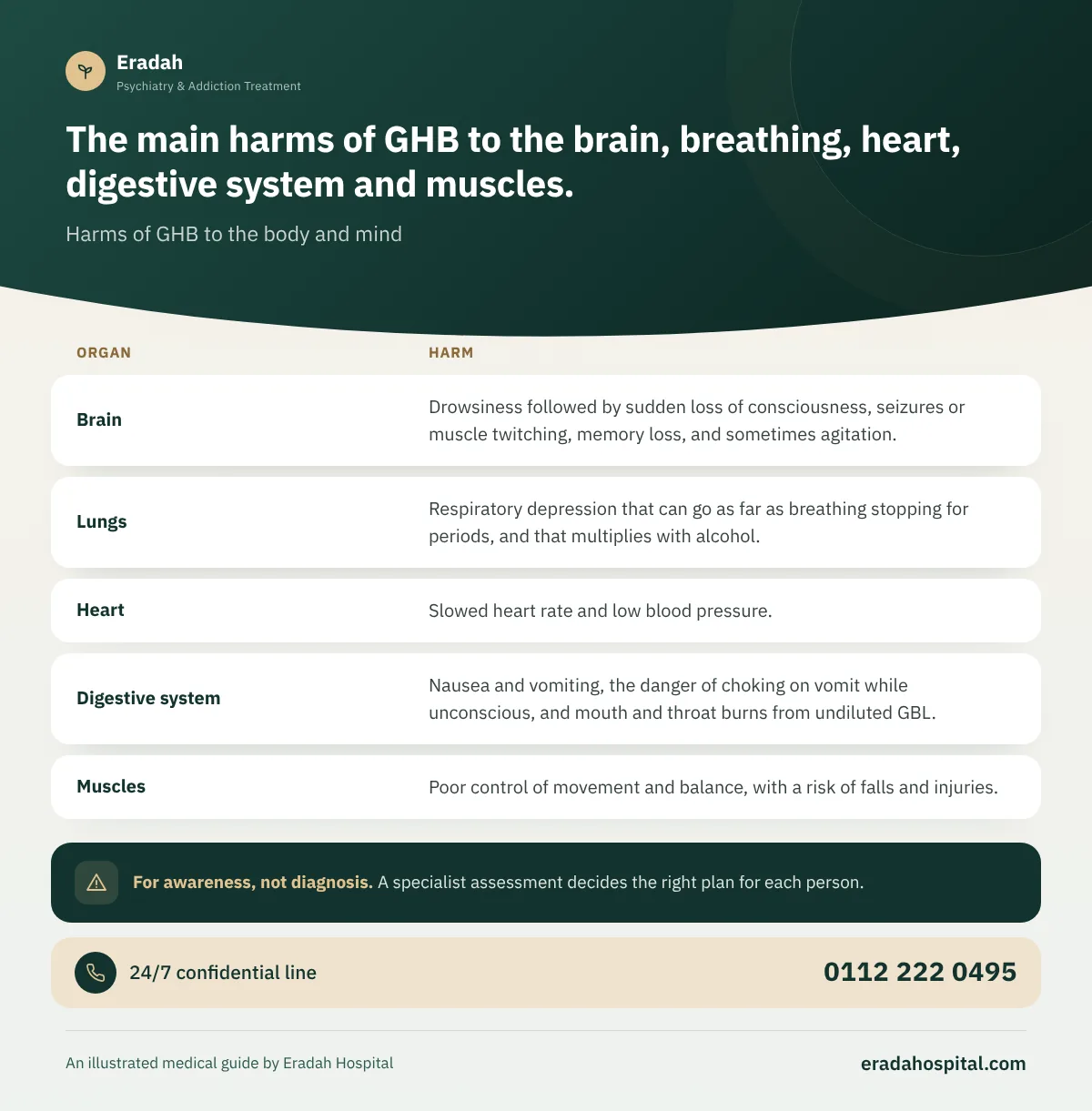
Sources: NIDA, the DEA, the StatPearls review on GHB intoxication, and FRANK.
Mixing GHB with alcohol: why is it deadly?
Alcohol and GHB both depress the nervous system, and when they are combined their effect on the breathing centers multiplies. The DEA confirms that alcohol intensifies the effect of GHB, leading to respiratory depression and possibly coma. The same applies to sedatives such as Xanax and Rohypnol pills, and to opioids.
Harms of GBL and bottles of unknown strength
FRANK notes that GBL is used industrially in stain and rust removers and paint strippers, that its taste and smell are strongly chemical, and that if GHB and GBL are not diluted they can burn the mouth and throat when swallowed. It adds that the strength of the liquid varies from one bottle to another, and that there is no reliable evidence on the purity of GBL in circulation.
Memory loss and exposure to harm
The review by Felmlee and colleagues notes that GHB is popularly known as the "date rape drug" because of the memory loss, drowsiness and reduced inhibition it causes, and NIDA states that it has been used in sexual assaults. FRANK points out that how easily it causes loss of consciousness has linked it to assaults. The harm here is not limited to the body; the experience can leave a deep psychological mark that needs specialist support, such as treatment for post-traumatic stress disorder (PTSD) when needed.
Addiction and withdrawal: the most serious harms of regular use
The DEA confirms that continued use of GHB products can lead to addiction, and that chronic use causes a withdrawal marked by insomnia, anxiety, tremor, a raised pulse and blood pressure, and sometimes psychotic thoughts. StatPearls notes that severe withdrawal can be life-threatening and last up to 15 days. In a review of records from a hospital in Sydney, Australia, signs of delirium appeared in 16% of admissions for GHB withdrawal treatment.
That is why someone who uses GHB regularly should not stop suddenly at home, but needs detox under medical supervision, usually within a treatment facility.
Psychological harms
FRANK notes that GHB can cause short-term confusion and disorientation, and that the effects of repeated use on the brain are still not precisely known. With dependence, anxiety, insomnia and mood swings appear when the level of the substance in the body falls, and psychotic thoughts may appear during withdrawal according to the DEA, which calls for a psychological assessment.
Do the harms of GHB go away?
Many acute harms resolve if the person reaches the hospital in time, and psychological symptoms and sleep improve gradually after safe cessation and treatment. Injuries that occur while unconscious, prolonged oxygen deprivation, or harm done to the person while they were helpless can leave lasting effects. That is why the most important step is to ask for help early.
Danger signs after GHB use: call an ambulance (123) immediately
- Loss of consciousness or deep sleep from which the person cannot be woken by calling or touch
- Slow or weak breathing, or breathing that stops for periods
- Seizures or sudden muscle tremors
- Vomiting while drowsy or with reduced awareness, or a cold body and slow pulse
- Severe agitation, confusion or hallucinations after stopping regular use
Call ambulance (123) immediately. If the person is unconscious but breathing, place them on their side so they do not choke on vomit. Stay with them and do not leave them alone to “sleep it off.” Do not give them food, drink or any medicine, and tell the paramedics everything you know about what they took and when.
Call the ambulance 123