What is ecstasy?
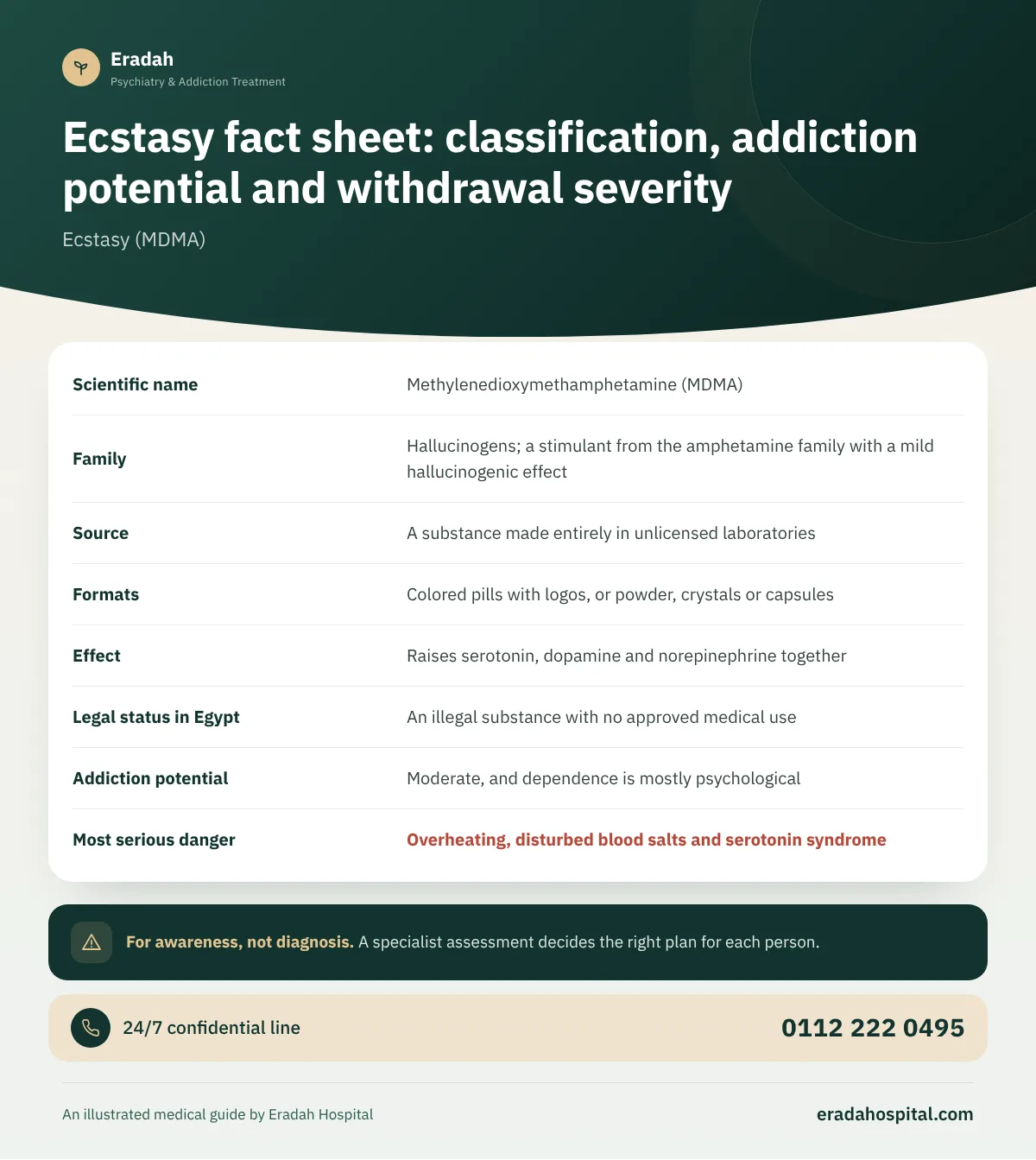
Ecstasy is a common name for methylenedioxymethamphetamine, known by the abbreviation MDMA, and in some countries called “molly.” It is made entirely in laboratories and is not extracted from a plant.
The German company Merck first made this substance in 1912 during chemical research, but it was never marketed as a medicine. Decades later it spread at parties and nightlife gatherings, and its name became tied to loud-music culture, until it was placed internationally in Schedule I of the 1971 United Nations Convention on Psychotropic Substances.
Many references classify it as a stimulant with a hallucinogenic effect. Chemically it belongs to the amphetamine family, like shabu and Captagon, but it differs from them in its strong effect on serotonin, which gives it its distinctive emotional character and explains many of its risks.
Forms and names of ecstasy
Ecstasy appears in more than one form, and the big problem is that the form never tells you what is really inside:
The best-known form, in bright colors with printed logos that suggest a trustworthy “product,” but in reality the contents are unknown.
Sometimes promoted as “pure,” but lab tests often find many other substances in it.
They hide their contents completely, and it is hard for anyone to know what is inside or how strong it is.
How does ecstasy affect the brain and body?
Ecstasy acts on three neurotransmitters at the same time. It pushes nerve cells to release their stored supply and blocks its reuptake, so the chemicals build up in the synapses:
| Neurotransmitter | Effect during use | What happens after the effect wears off |
|---|---|---|
| Serotonin | A feeling of closeness and empathy, open emotions and altered perception | Depleted stores, so sadness, anxiety and poor sleep appear for days |
| Dopamine | Euphoria, energy and a sense of reward | Sluggishness, flatness and a desire to repeat the use |
| Norepinephrine | Faster heartbeat and higher blood pressure and temperature | Marked physical exhaustion |
The effect usually begins in under an hour and lasts a few hours, followed by what is known as the “comedown.” The substance also affects the centers that regulate body temperature and raises a hormone that makes the body hold on to water. These two points are the key to understanding its most dangerous complications.
The closeness and warmth that ecstasy gives are borrowed from the brain’s own reserves, and are paid back later as sadness, exhaustion and anxiety.
Does ecstasy have a medical use? What about MDMA-assisted therapy?
Ecstasy has no approved medical use in Egypt. However, scientific research is studying the use of pure MDMA within structured psychotherapy sessions for post-traumatic stress disorder (PTSD), under strict medical supervision, and the US Food and Drug Administration gave this pathway “breakthrough therapy” status to speed up its study.
Even so, the same agency declined to approve it in 2024 and asked for further studies because of questions about safety and how the trials were conducted. In most countries this treatment is still in research, and it has nothing to do with street pills of unknown composition taken at parties without any supervision.
Common myths about ecstasy
| The myth | The truth |
|---|---|
| “A mild party drug that does no harm” | It can cause overheating, low sodium and serotonin syndrome, any of which can be fatal. |
| “It does not cause addiction” | Its addiction potential is moderate, and some people who use it develop tolerance, cravings and psychological dependence. |
| “A pill with a familiar look is guaranteed” | The logo and shape are easily copied, and the real contents are completely unknown. |
| “If it is used in therapy research, it must be safe” | Research uses a pure substance under strict supervision, and the treatment has not yet been approved. |
Correcting these ideas with young people in a calm tone and with accurate information works far better than exaggerated scare tactics, which quickly lose their trust.
The legal status of ecstasy in Egypt
Ecstasy is illegal in Egypt. Drug Control Law No. 182 of 1960 and its amendments criminalize its possession and dealing, and it is also placed internationally in Schedule I of the Convention on Psychotropic Substances. The Fund for Drug Control and Treatment of Addiction offers free, confidential treatment through hotline 16023, alongside specialized centers.
This is general educational information and not legal advice.
Ecstasy compared with similar substances
Many people confuse ecstasy with other stimulants and hallucinogens. This general comparison helps clarify the differences:
| Point of comparison | Ecstasy | Crystal meth (shabu) | LSD |
|---|---|---|---|
| Family | A stimulant from the amphetamine family with a hallucinogenic effect | A strong stimulant from the amphetamine family | A pure hallucinogen |
| Most prominent effect | A feeling of closeness and empathy, with energy | Intense alertness and energy for many hours | Profound change in perception and vision |
| Addiction potential | Moderate | Very high | Low |
| Most serious complications | Overheating and disturbed blood salts | Psychosis and strain on the heart | Panic, accidents and the return of hallucinations |
Because ecstasy pills are so often adulterated with methamphetamine or cathinones, a person may be exposed to the dangers of shabu while thinking they are taking something else. Also read about shabu and LSD.
Ecstasy guide: everything you need to know
We have gathered everything about ecstasy into 6 pages, each answering one question in detail. Choose what you are looking for:
Harms of ecstasy
From overheating, dehydration and dangerously low sodium to serotonin syndrome, then depression and memory problems with repeated use.
Causes of ecstasy addiction
Why does experimenting at parties become a repeated pattern? The role of the substance, social anxiety, depression and the environment.
Symptoms of ecstasy addiction
The physical and behavioral signs during and after use, such as dilated pupils, jaw clenching and mood swings after parties.
Ecstasy withdrawal symptoms
Mostly psychological withdrawal: depression, exhaustion, anxiety and difficulty concentrating, and when it becomes dangerous enough to need help.
Treatment of ecstasy addiction
Assessment, cognitive behavioral therapy, treatment of accompanying depression and anxiety, relapse prevention, and when residential treatment is needed.
How long ecstasy stays in the body
Roughly how long it remains in urine, blood, saliva and hair, and the difference between a screening test and a confirmatory test.
Ecstasy in numbers
Sources: the US National Institute on Drug Abuse (NIDA), and the European Union Drugs Agency (EUDA).
Found out your child is using ecstasy? Start here
Many young people consider ecstasy a “safe party drug” that does not cause addiction, and that belief is itself part of the problem. These practical steps can help you:
- Stay calm first, and do not start the conversation while they are under the influence or on the comedown day afterward.
- Learn the facts about the substance and its risks so that what you say is convincing rather than just frightening.
- Ask about the parties and friends with curiosity rather than accusation, and listen more than you talk.
- Watch their mood in the days after parties; deep sadness afterward deserves attention.
- Learn the emergency signs, such as high temperature, confusion and seizures, and the ambulance number, 123.
- Ask for specialized family counseling, even if they refuse to admit there is a problem.
Emergency signs with ecstasy: call an ambulance (123) immediately
- Very high body temperature with extremely hot skin, or sweating that stops despite the heat
- Confusion, severe agitation, frightening hallucinations or loss of awareness of where they are
- Seizures, loss of consciousness or sudden collapse
- Severe headache with repeated vomiting and confusion, especially after drinking large amounts of water
- Very rapid heartbeat, chest pain or stiff muscles
Call an ambulance at 123 immediately, move the person to a cool, well-ventilated place, loosen their clothing and cool their body with a damp cloth, and do not force them to drink large amounts of water. If they lose consciousness but are breathing, place them on their side in the recovery position, stay with them, and tell the paramedics everything they took.
Call the ambulance 123