What is GABA?
GABA is short for its scientific name, gamma-aminobutyric acid, and it is the most widespread inhibitory neurotransmitter in the central nervous system. Its basic job is to reduce a nerve cell’s response to signals, stopping it from becoming overactive.
Picture the brain as a car: if glutamate is the gas pedal that pushes cells to work, GABA is the brakes that stop them from racing out of control. A car cannot run safely with a gas pedal alone, nor move with the brakes pressed all the time; it runs on the balance between them.
A large share of the brain’s synapses use GABA, and the cells that release it are found in the cortex, cerebellum, basal ganglia, brainstem and spinal cord. That is why its effect reaches from thinking and emotions to movement and breathing.
How is GABA made in the body?
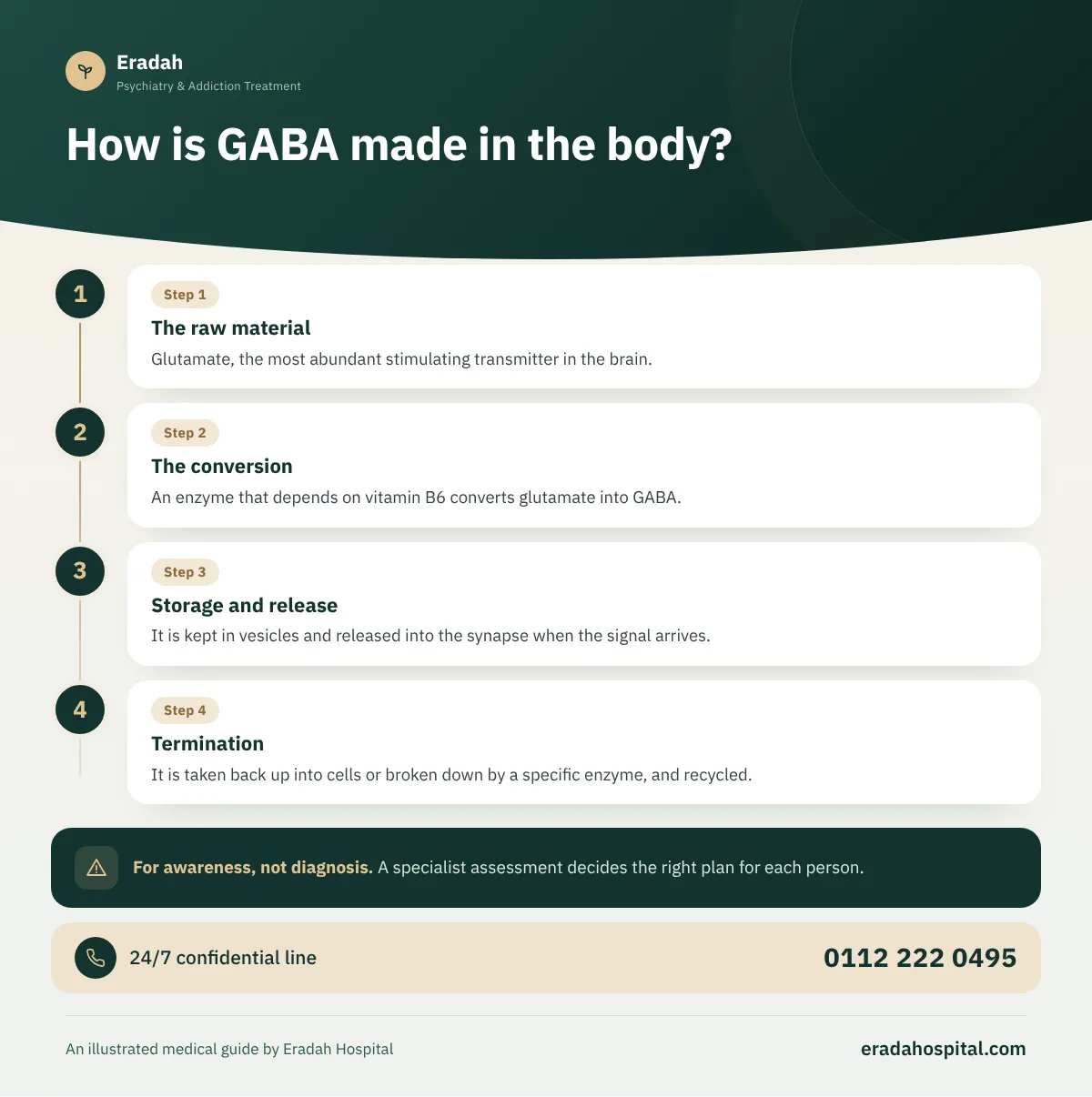
The neat irony is that calming GABA is made from the stimulating glutamate itself. An enzyme called glutamic acid decarboxylase converts glutamate into GABA, and this enzyme needs vitamin B6 as a helper. GABA is then stored in vesicles inside the tip of the nerve cell until the moment of its release.
- Step 1The raw material
Glutamate, the most abundant stimulating transmitter in the brain.
- Step 2The conversion
An enzyme that depends on vitamin B6 converts glutamate into GABA.
- Step 3Storage and release
It is kept in vesicles and released into the synapse when the signal arrives.
- Step 4Termination
It is taken back up into cells or broken down by a specific enzyme, and recycled.
Because vitamin B6 is essential for this step, severe deficiency, or a rare inherited problem using it in newborns, can cause seizures that do not respond to the usual epilepsy medicines and improve when the vitamin is given under medical supervision. This is a clear example of how important GABA is in preventing seizures.
How does GABA act on its receptors?
| Receptor | How they work | Speed | Substances that act on it |
|---|---|---|---|
| GABA-A receptor | A channel that opens to let chloride ions into the cell, making it less excitable | Very fast (fractions of a second) | Benzodiazepines, barbiturates, alcohol, “Z-drug” sleep medicines, and some anesthetic drugs |
| GABA-B receptor | A receptor linked to internal proteins that opens potassium channels and reduces calcium entry | Slower and longer-lasting | The muscle relaxant baclofen, and GHB |
The A receptor in particular is built from multiple subunits, and each combination sits in a different part of the brain and has a different sensitivity to medicines. This is why sedatives differ in their effects: some mainly calm, some mainly induce sleep, and some mainly prevent seizures.
What does GABA do in the body and brain?
Protects the brain from excessive electrical activity that shows up as seizures.
Eases the response of fear and stress circuits, which is why sedatives act on it.
Helps with falling asleep and staying asleep, and many sleep medicines act on it.
Regulates control of movement and eases stiffness and spasms in the spinal cord.
Fine-tunes the timing of cell signals, helping with focus and filtering information.
Helps set the breathing rate, which is why substances that act on it suppress breathing when taken in excess.
GABA also plays a role in brain development in fetuses and children. Outside the nervous system it has roles still under study in the pancreas, gut and immune system, but they are not the focus here.
Why is the balance between GABA and glutamate the basis of brain stability?
A healthy brain does not need “more GABA” but a precise balance. Tipping toward glutamate leads to anxiety, insomnia, overexcitability and seizures, while tipping toward GABA through sedating substances leads to drowsiness, slow thinking and poor coordination, and at the extreme, coma and suppressed breathing.
| The situation | What happens in the brain | Examples |
|---|---|---|
| Normal balance | Controlled activity that adapts to the situation | Calm with alertness, and natural sleep |
| Excess inhibition | Too much GABA effect caused by outside substances | Extreme drowsiness, slurred speech and slow breathing with alcohol or sedatives |
| Excess excitation | Weakened GABA effect or increased glutamate effect | Anxiety, tremor, insomnia and seizures, as in alcohol and sedative withdrawal |
This scale is the key to understanding why withdrawal is dangerous: a brain used to an outside sedative lowers the sensitivity of its GABA system and raises glutamate activity to compensate, so if the sedative suddenly disappears, only the stimulating side is left. We explain this in detail on the page GABA and addiction.
Which medicines act on the GABA system?
Medicine targets the GABA system to treat epilepsy, anxiety, insomnia, muscle spasms and anesthesia. This is an overview of the classes, with no doses, and all of them are prescribed and monitored under medical supervision:
| Category | Their relationship to GABA | Medical use | Warning |
|---|---|---|---|
| Benzodiazepines such as Xanax, Rivotril and Valium | Strengthen GABA’s effect at the A receptor | Anxiety, seizures and alcohol withdrawal | Dependence and dangerous withdrawal with long-term use |
| “Z-drug” sleeping medicines | Act on the A receptor in a more targeted way | Short-term insomnia | May cause dependence and behaviors during sleep |
| Some epilepsy medications | Increase available GABA or slow its breakdown | Epilepsy and some other conditions | Must not be stopped suddenly |
| Baclofen | Acts on the B receptor | Muscle spasms and stiffness | Stopping suddenly can be dangerous |
| Pregabalin and gabapentin | Similar to GABA in structure but do not bind its receptors; they act on calcium channels | Nerve pain and epilepsy, and anxiety in some countries | Widely misused in Egypt, and dangerous with opioids |
Can the GABA level in the body be measured?
The honest answer: there is no routine blood or urine test that measures GABA in the brain. GABA in the blood does not reflect what happens at the synapses. In research, scientists measure it with a special MRI technique called “spectroscopy,” a research tool that is not used to diagnose anxiety or insomnia in individuals.
A doctor may order highly specialized tests in rare cases, such as inherited metabolic diseases in children, or antibodies against the enzyme that makes GABA when a rare autoimmune neurological disease is suspected. But a commercial “GABA deficiency test” to explain everyday stress has no scientific basis.
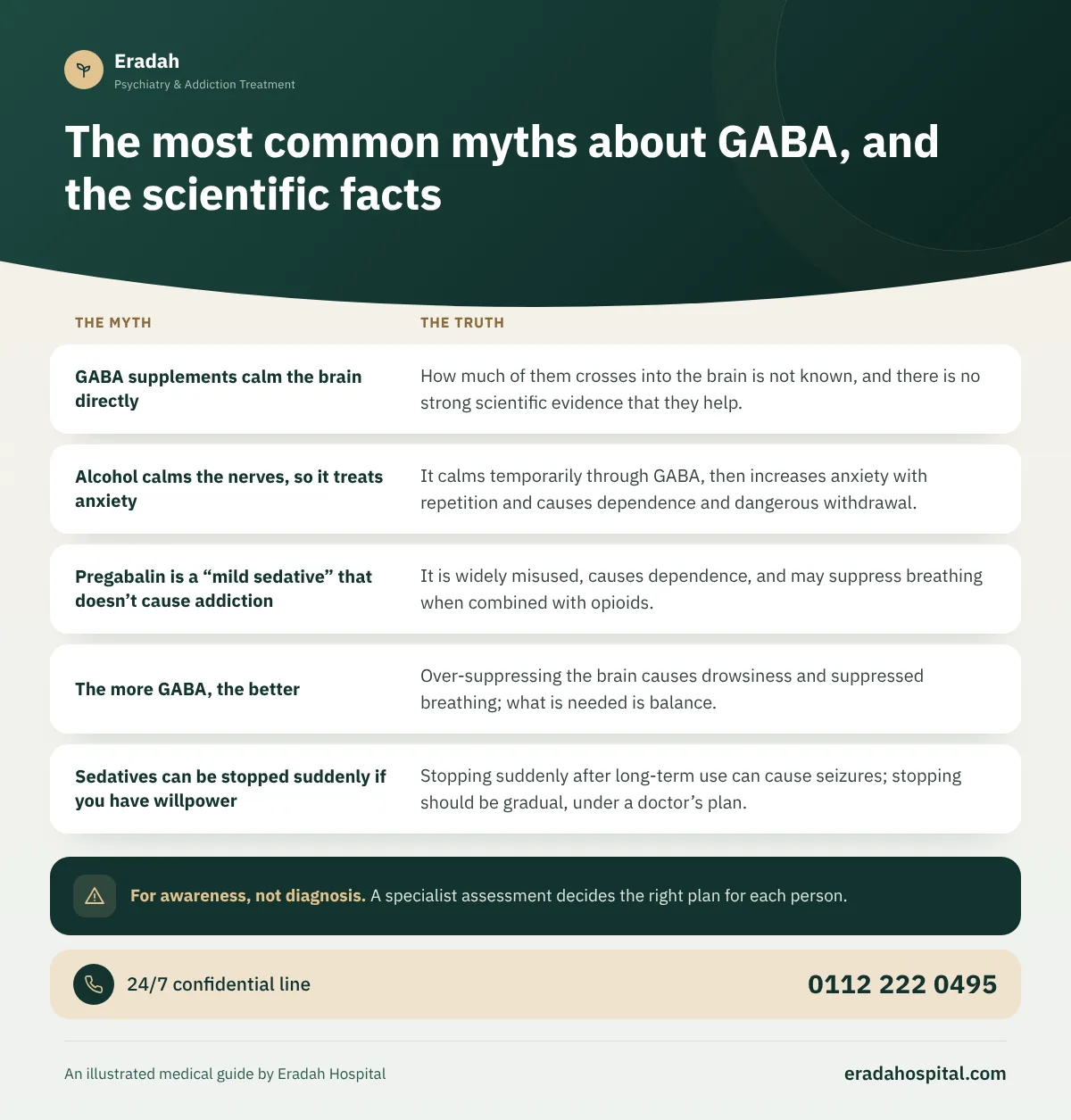
Common myths about GABA, and the facts
| The myth | The truth |
|---|---|
| GABA supplements calm the brain directly | How much of them crosses into the brain is not known, and there is no strong scientific evidence that they help. |
| Alcohol calms the nerves, so it treats anxiety | It calms temporarily through GABA, then increases anxiety with repetition and causes dependence and dangerous withdrawal. |
| Pregabalin is a “mild sedative” that doesn’t cause addiction | It is widely misused, causes dependence, and may suppress breathing when combined with opioids. |
| The more GABA, the better | Over-suppressing the brain causes drowsiness and suppressed breathing; what is needed is balance. |
| Sedatives can be stopped suddenly if you have willpower | Stopping suddenly after long-term use can cause seizures; stopping should be gradual, under a doctor’s plan. |
GABA guide: everything you need to know
We have gathered everything about GABA into 3 pages, each answering one question in detail. Choose what you are looking for:
GABA deficiency: symptoms and causes
The signs linked to weak GABA activity, such as anxiety, insomnia, stiffness and seizures, its causes from rare inherited diseases to alcohol and sedative withdrawal, whether there is a test, and when to see a doctor.
Ways to increase GABA naturally
What research says about exercise, yoga, sleep, breathing and meditation, the truth about foods and supplements, with an honest rating of the strength of the evidence and why you should not treat anxiety with sedatives on your own.
GABA and addiction
How alcohol, benzodiazepines, pregabalin and GHB act on the GABA system, why their withdrawal causes seizures that can be fatal, and why medical supervision is needed.
Seizures or delirium after stopping alcohol or sedatives? Call an ambulance (123) immediately
- A seizure or loss of consciousness a few days after stopping alcohol, sedatives or pregabalin
- Severe confusion or not knowing where they are or who people are, or hallucinations, with tremor, sweating and fever
- A very fast heartbeat or high blood pressure with agitation that does not settle
- Extreme drowsiness and difficulty waking, or slow, shallow breathing after mixing sedatives, alcohol or opioids
- Bluish lips or nails, or vomiting with reduced consciousness
Call an ambulance (123) immediately. During a seizure, move hard objects away from the person, do not put anything in their mouth and do not try to restrain them. After it ends, place them on their side and stay with them. Do not give them alcohol or a sedative “to calm them down,” keep the medicine packaging, and tell the doctor frankly everything they were taking and when they stopped.
Ambulance 123 Mental health support line 16328