Why do alcohol withdrawal symptoms happen?
With continued drinking, the brain adapts to the presence of sedating alcohol: it reduces the sensitivity of its calming systems and increases the activity of its stimulating systems to keep its balance. When drinking stops suddenly, the brain is left “accelerating” with no brakes, and symptoms of nervous-system overactivity appear, such as shaking, anxiety, and a fast pulse, which can reach seizures and delirium.
Alcohol withdrawal timeline
Timing varies from person to person, but medical references paint a general picture like this:
- Within 6 to 24 hoursEarly symptoms
Hand tremors, anxiety and tension, sweating, headache, nausea, insomnia, and a fast heartbeat. They may begin even before the blood alcohol level reaches zero.
- Within 12 to 48 hoursAlcoholic hallucinations
The patient may see or hear things that are not there while remaining conscious and aware of where he is. They usually disappear within a few days.
- Within 8 to 48 hoursWithdrawal seizures
Generalized seizures that can occur even without other severe symptoms. They are a danger sign that calls for an ambulance.
- Within 48 to 96 hoursDelirium tremens
Severe confusion and disorientation to time and place, hallucinations, fever, heavy sweating, a fast pulse, and high blood pressure. In some cases it may be delayed to a week or more.
- Weeks to monthsThe prolonged phase
Anxiety, sleep disturbance, mood swings, and cravings to drink that may continue for weeks or longer after the acute phase ends.
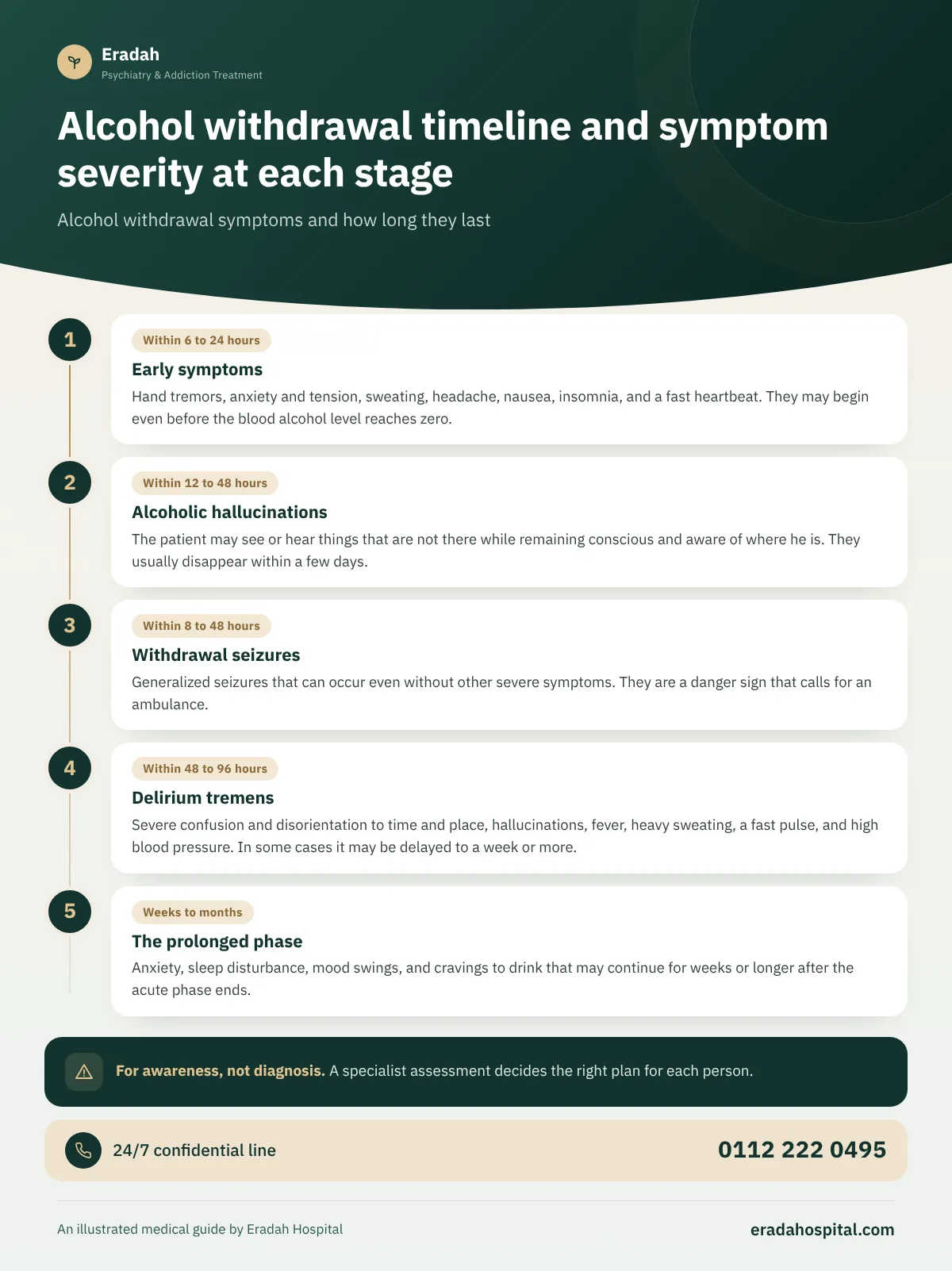
These times are approximate according to medical references, and vary with how long and how heavily the person drank, their health, and previous withdrawal episodes.
Alcohol withdrawal symptoms in detail
| Level | Common symptoms | Level of risk |
|---|---|---|
| Mild | Shaking, anxiety, sweating, headache, nausea, insomnia, loss of appetite | Troublesome and needs a medical assessment |
| Moderate | Clear tremor, fast pulse, high blood pressure, brief hallucinations, vomiting | Needs close medical follow-up |
| Severe | Seizures, confusion, hallucinations, fever, delirium tremens | An emergency that requires hospital care |
What is delirium tremens, and why is it dangerous?
Delirium tremens is the most severe form of alcohol withdrawal. It affects a small share of patients, which medical references estimate at about 3% to 5% of those who go through withdrawal. It shows up as acute confusion, not knowing where or when you are, frightening hallucinations, severe tremor, fever, and disturbances in pulse and blood pressure.
Death from it was historically high, but it has fallen to about 1% with prompt diagnosis and treatment in hospital, according to a StatPearls review. This shows that the danger is real and that early medical care is what saves lives.
Who is most at risk of severe withdrawal?
- People who have been drinking heavily every day for months or years.
- People who have had previous withdrawal episodes, especially if seizures or delirium occurred before.
- Older adults and people with liver or heart disease.
- People who use sedatives or other substances along with alcohol.
- People with malnutrition or vitamin and electrolyte deficiencies.
Why shouldn’t you stop drinking alone at home?
Because seizures and delirium can happen suddenly and without enough warning, and because the family cannot monitor vital signs or give medication at the right time. Under medical supervision:
The team uses validated scales to rate the severity of withdrawal and tracks it around the clock.
The doctor prescribes suitable sedative medication to prevent seizures and delirium, and tapers it gradually according to a plan.
Thiamine is given early to protect the brain from Wernicke encephalopathy, along with replacement of fluids and electrolytes.
Continuous monitoring prevents falls and injuries, and allows immediate action in any emergency.
Outpatient detox with daily follow-up may suit some mild cases, depending on the doctor’s assessment, but the decision is entirely a medical one. The full treatment plan after withdrawal is explained on the page on alcohol addiction treatment.
Prolonged withdrawal: do symptoms end after a week?
The acute phase usually ends within about a week, but some patients suffer for weeks or months from insomnia, anxiety, mood swings, poor concentration, and cravings to drink. This phase is among the times of highest relapse risk, which is why psychological support and follow-up continue after detox ends, and some medications help ease these symptoms.
Does withdrawal affect other health conditions?
Yes. The rise in pulse and blood pressure during withdrawal adds to the load on the heart, vomiting and sweating cause dehydration and electrolyte disturbance, and liver disease, diabetes, or infections may worsen during this period. That is why the medical team reviews the full physical condition and does not limit itself to monitoring withdrawal symptoms.
Why does withdrawal get worse each time?
Doctors observe that repeated withdrawal episodes without treatment can make later episodes more severe, a phenomenon known as kindling. So repeated attempts to stop on your own followed by a return to drinking are not without cost, and it is better for the next attempt to be under specialist supervision.
How can the family support a patient going through alcohol withdrawal?
- Do not encourage him to stop suddenly on his own; go with him to a medical assessment.
- Save the ambulance number (123) and learn the danger signs in advance.
- Provide a calm environment, comfortable lighting, and reassuring contact after the acute phase passes.
- Accept his mood swings in the first weeks without confrontation, while keeping clear boundaries.
- Encourage him to continue the treatment program after detox ends.
Signs of alcohol poisoning and withdrawal danger: call the ambulance on 123 immediately
- Severe confusion, difficulty staying awake, or being unable to be roused
- Vomiting while semi-conscious, with a risk of choking
- Seizures, whether during drinking or in the first days after stopping
- Very slow or irregular breathing, or pauses between breaths
- Cold, bluish or pale skin, and a drop in body temperature
- Delirium, severe tremor and hallucinations days after stopping drinking
Call the ambulance on 123 and do not leave the person alone. If they lose consciousness, place them on their side so they do not choke on vomit, and do not give them coffee, put them under cold water or force them to walk; these are myths that do not stop the poisoning and may make it worse, because the alcohol in the stomach keeps reaching the blood.
Call the ambulance 123