"I found out I'm pregnant, and I'm afraid to tell the doctor I'm taking something." This fear is understandable, but it is the most dangerous part of the story. A pregnant woman who hides what she takes deprives herself and her baby of care that could change the whole outcome. Drugs and pregnancy is a subject that needs frankness and compassion together.
How do drugs affect pregnancy and the fetus?
The US National Institute on Drug Abuse explains that many substances cross the placenta easily, so what a pregnant woman takes reaches the fetus as well. The institute estimates that about 5% of pregnant women use one or more addictive substances, and that the effect varies with the substance, the amount, how long it was used, how well the mother's body breaks it down, and whether the baby was born on time or early.
Among the effects the institute lists for some substances, such as cannabis, cocaine, and crystal meth (shabu), are birth defects, low birth weight, premature birth, smaller head circumference, and an increased risk of sudden infant death. It notes that babies whose mothers drank alcohol and smoked after the first trimester face about a 12-fold higher risk of sudden death than other babies.
Drugs, pregnancy, and the risk of stillbirth
The institute presents figures from a study published in 2013 on the risk of stillbirth:
- Smoking tobacco: a risk 1.8 to 2.8 times higher, rising with heavier smoking.
- Cannabis: a risk 2.3 times higher.
- Any stimulants, cannabis, or opioid painkillers: a risk 2.2 times higher.
- Secondhand smoke: a risk 2.1 times higher.
The effect of each substance on pregnancy
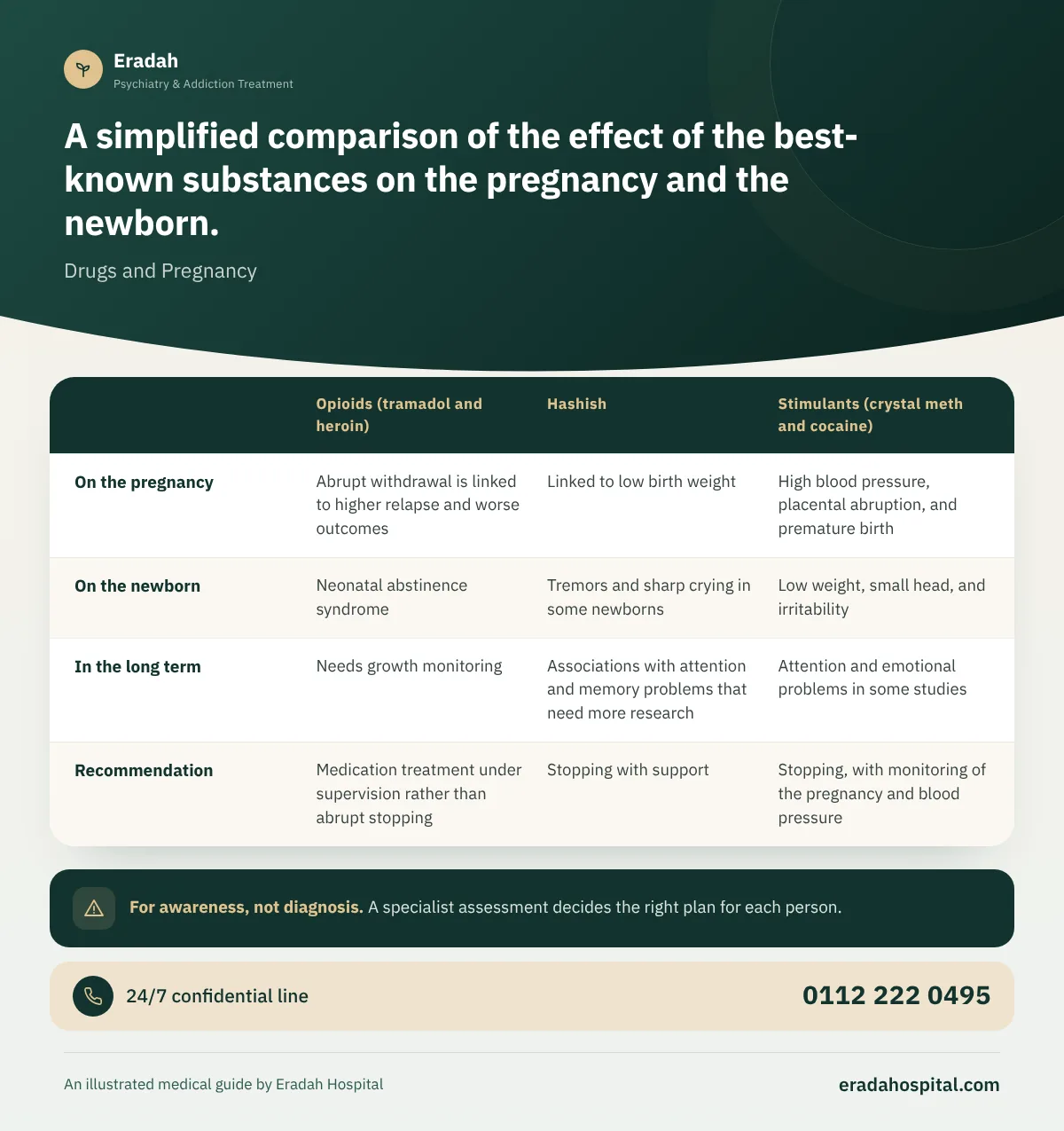
| Opioids (tramadol and heroin) | Hashish | Stimulants (crystal meth and cocaine) | |
|---|---|---|---|
| On the pregnancy | Abrupt withdrawal is linked to higher relapse and worse outcomes | Linked to low birth weight | High blood pressure, placental abruption, and premature birth |
| On the newborn | Neonatal abstinence syndrome | Tremors and sharp crying in some newborns | Low weight, small head, and irritability |
| In the long term | Needs growth monitoring | Associations with attention and memory problems that need more research | Attention and emotional problems in some studies |
| Recommendation | Medication treatment under supervision rather than abrupt stopping | Stopping with support | Stopping, with monitoring of the pregnancy and blood pressure |
As for alcohol, the US National Institute on Alcohol Abuse and Alcoholism says that pregnant women and those who might be pregnant should avoid it completely. The National Institute on Drug Abuse warns against any vaping product during pregnancy, whatever its substance, citing the US Food and Drug Administration.
Neonatal abstinence syndrome: drug withdrawal in the newborn
When the mother becomes accustomed to a substance such as opioids, the fetus's body becomes accustomed to it too, and when the baby is born it is cut off suddenly. According to the National Institute on Drug Abuse, symptoms may appear right at birth or up to 14 days later, and include persistent sharp crying, tremors, poor feeding, vomiting and diarrhea, sneezing and stuffy nose, little sleep, and slow weight gain, and they can reach seizures.
The syndrome is not limited to opioids; the institute notes that alcohol, barbiturates, benzodiazepines, and caffeine can also cause withdrawal symptoms in the newborn. A StatPearls review explains that the baby is monitored in the hospital and treated first with supportive care, and with medication when needed.
Opioids during pregnancy: why is stopping suddenly not advised?
Stopping immediately may seem the obvious ethical solution, but the American College of Obstetricians and Gynecologists, in its Committee Opinion No. 711, recommends medication treatment with opioid agonists as the recommended treatment for a pregnant woman with opioid use disorder, and as preferable to supervised withdrawal, because withdrawal is linked to high relapse rates that lead to worse outcomes. The right medicine and its dose are determined by the doctor, and in heroin withdrawal you can find why stopping suddenly is not advised during pregnancy.
Drugs and breastfeeding
The National Institute on Drug Abuse states that THC can reach breast milk and accumulate in it with regular use, so cannabis is not advised during breastfeeding. It varies between medicines: some are compatible with breastfeeding and some have an unknown effect, and the decision belongs to the pediatrician and the treating doctor together.
How can a pregnant woman get help?
- Tell your follow-up doctor the whole truth; she needs it for your safety.
- Ask for an assessment from a psychiatrist or addiction doctor, especially if you take opioids or sedatives.
- Call the hotline of the Fund for Drug Control and Treatment of Addiction on 16023; its services are free and confidential.
- After delivery, monitor your mental health closely; the early period is hard, and postpartum depression may appear.
Eradah's residential program is for men only, but the first consultation is free and confidential for women too, and the team helps you find the place suited to your situation. You can find more in the guide to addiction in women.