What is postpartum depression?
Everyone congratulates you and expects you to be at the height of happiness, while you feel emptiness, sadness and guilt you don't understand, and you are afraid to say it out loud. What you are going through has a well-known medical name: postpartum depression. It is common, and it can be treated.
It is an episode of depression that appears during pregnancy or in the weeks and months after birth, which is why the US National Institute of Mental Health calls it “perinatal depression,” and it notes that most episodes begin within 4 to 8 weeks after delivery. In the American DSM-5-TR classification it is not a separate illness but major depression “with peripartum onset,” as the page on types of depression explains.
Most importantly, the mother is not responsible for it; the Institute itself stresses that it does not happen because of anything you did or did not do, but results from an interplay of genetic, hormonal, psychological and social factors during one of the hardest times of life, physically and emotionally.
Is postpartum depression common?
Estimates vary between studies depending on how it is measured and the period studied. No unified, current Egyptian figures are available, but perinatal depression is seen in every society.
What is the difference between the baby blues, postpartum depression and psychosis?
This is the most important information on the page, because confusing the three conditions delays treatment or causes needless panic:
| Baby blues of the first days | Postpartum depression | Postpartum psychosis | |
|---|---|---|---|
| How common | Most mothers | More than 1 in 10 | Rare: about 1 in 1,000 |
| The start | Two or three days after birth | Any time in the first year | Usually within the first two weeks |
| Situation | Crying, mood swings and sensitivity | Persistent sadness, loss of pleasure, guilt and exhaustion | Hallucinations, strange ideas, confusion or mania |
| Duration | Improves within a week or two | Lasts for months and may be longer without treatment | Worsens quickly |
| What is needed | Support, rest and follow-up | Specialist assessment and treatment | Emergency and hospital immediately |
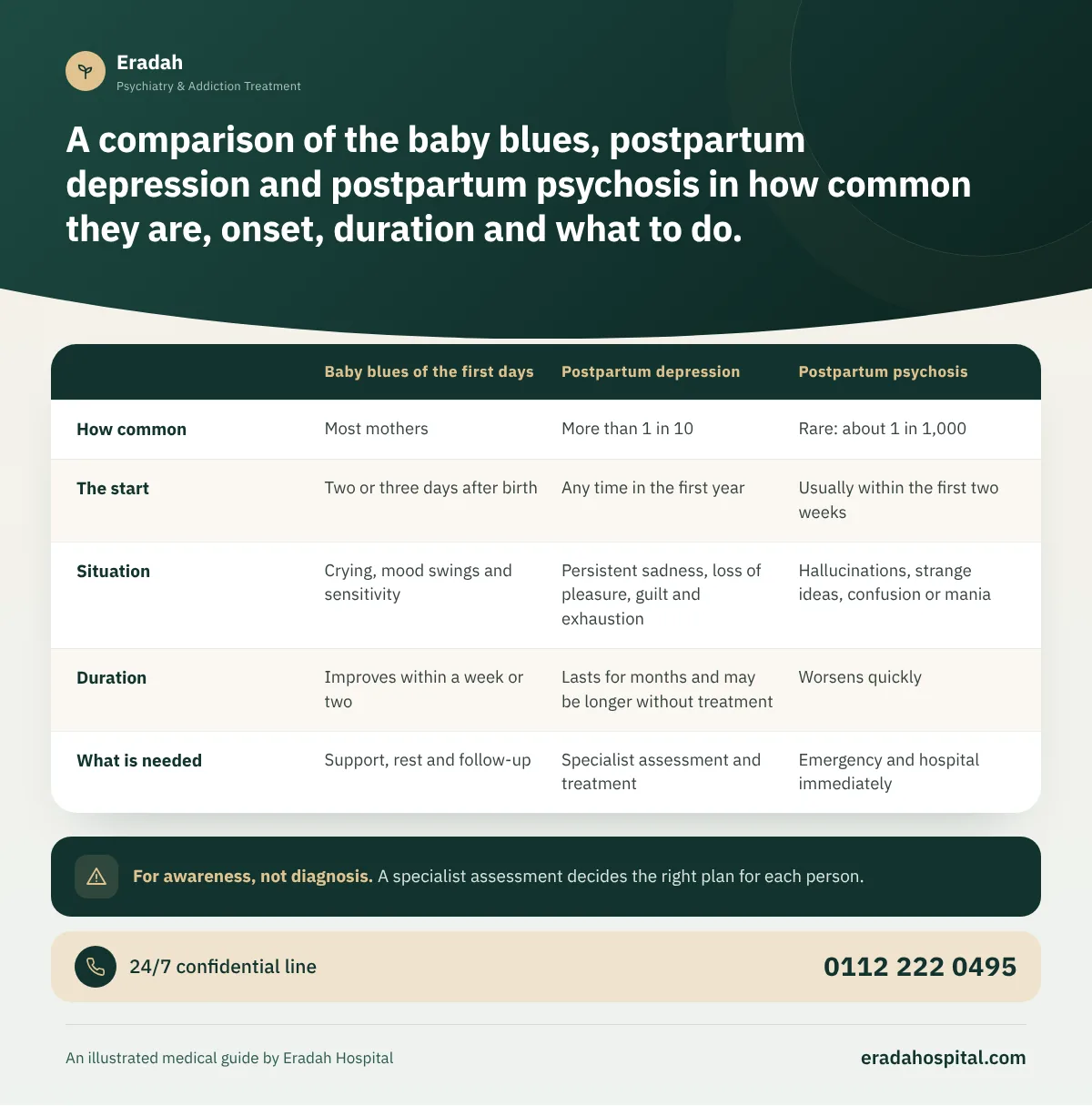
The simple rule on which the American institute and the British health service agree: anything that lasts more than two weeks or gets worse is no longer the “baby blues” and deserves assessment.
How does a mother feel on the inside?
Many mothers don't describe what they feel as “sadness” but as detachment: you do every task, nursing, changing and rocking, but you don't feel the joy you expected, and then you blame yourself for it. You may have repeated frightening thoughts that something bad will happen to the baby, or a feeling that you are a “failed mother” and that someone else would have cared for him better.
What are the symptoms of postpartum depression in brief?
The main ones are sadness or emptiness most of the day, loss of pleasure, exhaustion beyond what lack of sleep explains, difficulty sleeping even when the baby sleeps, feeling guilty or like a bad mother, difficulty bonding with the baby, excessive worry about him, and sometimes thoughts of self-harm. Full details, how it shows up in fathers, and the screening tool used worldwide are in Postpartum depression symptoms.
Why does postpartum depression happen?
There is no single cause, but an interplay of the sharp drop in estrogen and progesterone after birth, sleep deprivation, a previous history of depression, anxiety or bipolar disorder, and weak support, conflict, stress, and difficulties with the birth or the baby's illness. The details, risk factors and ways to prevent it are in Causes of postpartum depression.
Can fathers get postpartum depression?
Yes. An analysis published in the Journal of the American Medical Association in 2010 pooled data from 43 studies covering more than 28,000 participants and found that about 10.4% of fathers experienced depression from pregnancy through the end of the first year, that the rate was higher between the third and sixth month after birth, and that a father's depression is linked to the mother's. In men it often shows up as excessive irritability, withdrawal, or burying oneself in work rather than visible sadness.
How does a mother's depression affect the baby and the family?
The US National Institute of Mental Health notes that treating perinatal depression is essential for the health of both mother and baby, because the disorder can affect both. The Cleveland Clinic states that untreated depression can make bonding with the baby harder and may be linked to problems with the baby's sleep, feeding and later language and social development. We don't say this to add to your guilt; we say it because seeking treatment is the best thing you can do for your baby.
Common myths about postpartum depression
| The myth | The truth |
|---|---|
| “Every woman gives birth and none of them gets depressed” | Postpartum depression is common and affects more than one mother in ten |
| “If she loved her baby she would be happy” | Depression is an illness, not a measure of a mother's love, and many women with it love their babies deeply |
| “It will go away by itself when the baby grows up” | Some cases may improve on their own, but it can last months or longer, and improvement is more likely with treatment |
| “Treatment means stopping breastfeeding” | There are treatment options compatible with breastfeeding, and the decision is made with the doctor for each mother individually |
| “Men don't get this” | About 10% of fathers experience perinatal depression |
Can postpartum depression be treated?
Yes. The UK National Health Service notes that it usually improves within 3 to 6 months but may last longer, and that the chances of improvement are greater with treatment. Treatment includes psychotherapy such as cognitive behavioral therapy and interpersonal therapy, antidepressants chosen by the doctor to suit breastfeeding, and newer medications designed for it in some countries. Details without doses are in Postpartum depression treatment.
When do you need urgent help?
- Sadness, emptiness or exhaustion lasting more than two weeks after birth.
- A growing inability to care for yourself or your baby.
- Repeated thoughts that your family would be better off without you, or thoughts of harming yourself.
- Hallucinations, strange ideas, confusion, or going without sleep for days with excess activity.
The last two items are an emergency: ambulance 123 or the nearest emergency department immediately; do not wait for your follow-up appointment. If thoughts of death are present, the page on suicidal thoughts explains how to ask for help right now.
How can the family support the mother after birth?
- Ask how she is doing, not only about the baby.
- Share the night feeds or the baby's care so she can sleep for stretches.
- Avoid phrases like “you should be happy” or “you're being spoiled.”
- Help around the house and with cooking without waiting to be asked.
- Encourage her to be assessed if symptoms last more than two weeks, and go with her.
- Do not leave her alone if thoughts of harm or psychotic symptoms appear.
Postpartum depression guide: everything you need to know
We have gathered everything about postpartum depression into 3 pages, each answering one question in detail. Choose what you are looking for:
Postpartum depression symptoms and signs
Learn about the psychological and physical symptoms of postpartum depression, symptoms related to the baby and frightening thoughts, when it begins, how it shows up in fathers, and urgent warning signs.
Causes of postpartum depression
What causes postpartum depression? The role of falling hormones, lack of sleep, a history of depression or bipolar disorder, weak support and birth difficulties, who is most at risk, and whether it can be prevented.
Postpartum depression treatment
How is postpartum depression treated? Cognitive and interpersonal therapy, antidepressants and breastfeeding, newer medications such as zuranolone, recovery time, the family's role, and urgent situations.
Hallucinations or thoughts of harming yourself or the baby after birth? Get help now
- Hearing or seeing things that aren't there, or strange ideas and unrealistic suspicions.
- Severe confusion, or going without sleep for days with unusual excess activity or talking.
- Talk of death or that the family is “better off without me,” or thoughts of self-harm.
- Thoughts or intent to harm the baby, or a complete inability to care for the baby or herself.
- Refusing food and drink, or a severe collapse in the ability to move and speak.
Do not leave the mother alone, and do not leave the baby in her sole care until she has been assessed. Talk to her calmly, without blame or threats, remove medications and dangerous objects, and call an ambulance on 123 or go to the nearest emergency department immediately, because postpartum psychosis is an emergency treated in hospital. You can also call the mental health support line 16328, available around the clock.
Ambulance 123 Mental health support line 16328