What are the main symptoms of antisocial personality disorder?
The American manual DSM-5 describes the disorder as a pervasive pattern of disregard for and violation of the rights of others since age 15. What distinguishes the disorder is that the behavior repeats at home, at work and in the street over years, with difficulty learning from consequences, rather than being a single wrongful act.
Symptoms can look different from one person to another. Some people with the disorder are mostly violent and impulsive, while others are mostly deceitful and quietly exploit others financially. This is why diagnosis relies on the whole picture rather than on a single trait.
What are the seven traits that diagnosis relies on?
Diagnosis needs at least three of the following traits, presented here in simplified form to aid understanding, not for self-diagnosis:
- Failure to follow laws and norms repeatedly, leading to legal accountability or arrest.
- Repeated lying and deceit, using false names, or exploiting others for benefit or pleasure.
- Impulsivity and failure to plan ahead.
- Irritability and aggression, with repeated fights or assaults.
- Recklessness with the safety of oneself or others.
- Persistent irresponsibility, such as leaving jobs for no reason or not meeting financial obligations.
- Lack of remorse: indifference to, or justification of, hurting or stealing from others.
What are the signs of conduct disorder in childhood and adolescence?
| Area | Examples |
|---|---|
| Aggression toward people and animals | Bullying and threatening, starting fights, cruelty to animals or to younger children |
| Destruction of property | Deliberately damaging other people's property |
| Deceitfulness or theft | Lying for gain, stealing from home or shops |
| Serious rule violations | Repeatedly running away from home at night or skipping school at a young age |
What worries doctors in particular are the so-called “callous-unemotional traits”: a child who does not seem affected when they hurt others, and who does not care about punishment or other people's feelings. These traits deserve early assessment, because they respond better to intervention at a young age.
What do emotions and relationships look like?
- Reduced empathy for other people's pain, or understanding it intellectually without feeling it.
- Quick boredom and a constant search for excitement.
- Superficial relationships, or ones based on benefit, with difficulty making an emotional commitment.
- May seem charming and confident at first, with exploitation showing later.
- Blaming others or “circumstances” when problems occur.
Not all of these traits are present in everyone with the disorder, and their severity varies a great deal. Some people with the disorder do feel sadness or depression, especially after major losses, and these moments can open the door to asking for help.
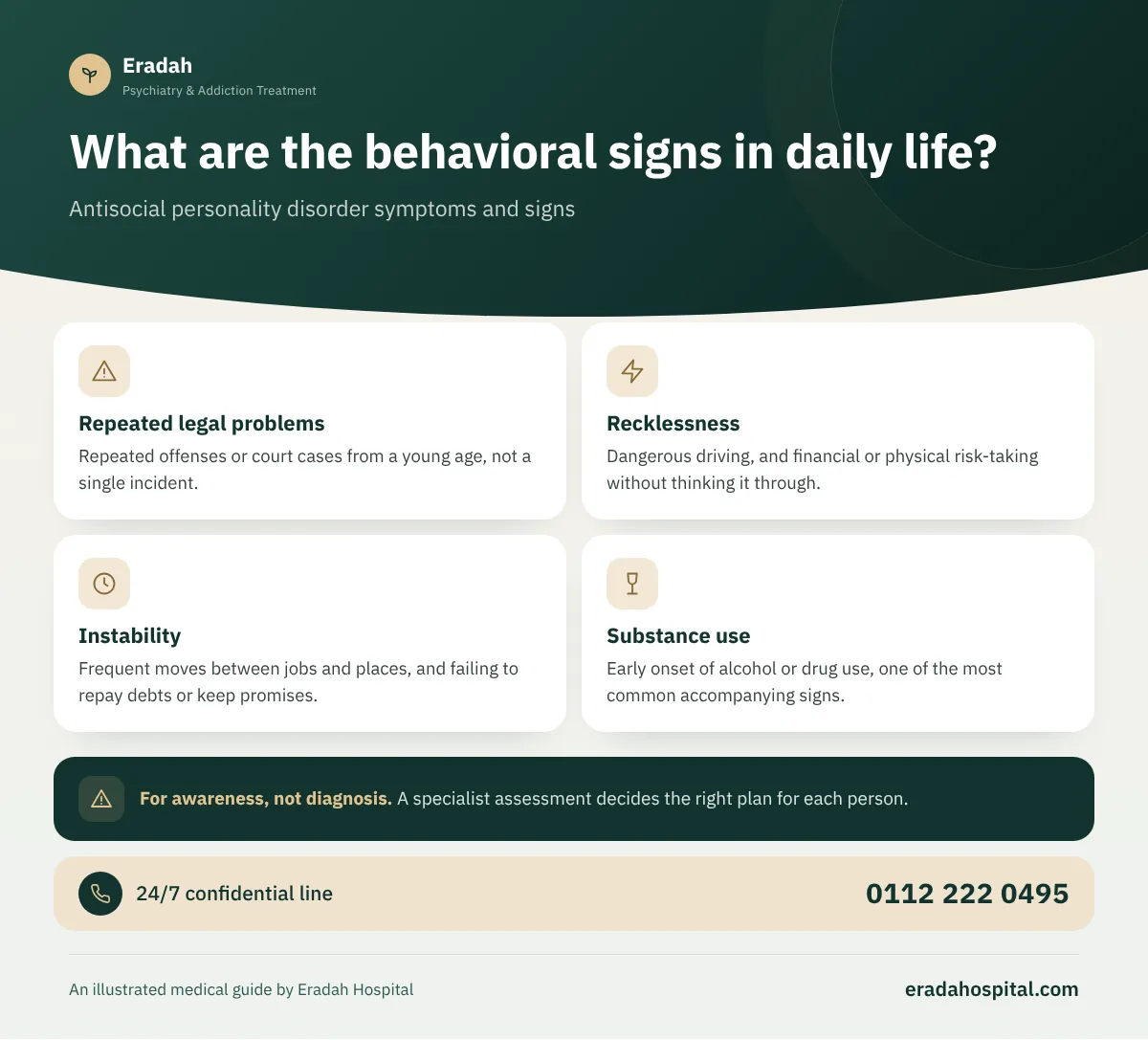
What are the behavioral signs in daily life?
Repeated offenses or court cases from a young age, not a single incident.
Dangerous driving, and financial or physical risk-taking without thinking it through.
Frequent moves between jobs and places, and failing to repay debts or keep promises.
Early onset of alcohol or drug use, one of the most common accompanying signs.
What is the difference between the mild and severe forms?
The disorder varies greatly in severity. In the milder form, lying, avoiding responsibility, impulsivity and job-hopping may predominate, with some attachment to the family and sometimes the ability to work. In the severe form, violence and serious legal problems recur, lack of remorse is clear, and this is often accompanied by addiction to multiple substances.
Severity is not fixed. It increases with substance use, unemployment and delinquent peers, and often lessens with stopping substances, settling into a job and advancing age. That is why the doctor pays attention to the current level of risk and not only to the diagnosis, and asks about past violence, substance use and whether there are children in the home.
Does the picture differ between men, women and adolescents?
| Category | What may show up more | Note |
|---|---|---|
| Men | Physical aggression, legal problems, recklessness | They are diagnosed several times more often. |
| Women | Deceit, exploitation in relationships, severe neglect of responsibilities | May be diagnosed with other conditions, or the diagnosis may be missed. |
| Teenagers | Signs of conduct disorder, early substance use, skipping school | They are not diagnosed with the disorder before 18; they are assessed for conduct disorder. |
| After age 40 | Violence and lawbreaking decline in some people | Difficulty in relationships and reduced empathy may remain. |
What do the symptoms look like from inside the home?
A family may notice a son who lies easily even when there is no obvious benefit, takes money or things without permission, makes promises and does not keep them, gets violently angry when refused, and does not seem affected by his mother's sadness or his father's loss. Over time the family learns to “walk on eggshells” to avoid his outbursts.
When talking with him, choose a calm time, avoid long lectures and general accusations, and focus on a specific behavior and a realistic consequence. Do not put yourself in a physical confrontation. If he uses substances, talking about treatment for substance use may be an easier way in than talking about “personality.”
Questions to reflect on: is an assessment needed?
- Have there been repeated problems with the law or school since childhood or adolescence?
- Does the person repeatedly resort to lying or fraud?
- Do fights or assaults keep happening?
- Do they seem indifferent to those who are hurt by their actions?
- Do they recklessly put themselves or others in danger?
- Do they use alcohol or drugs regularly?
Risk of violence or self-harm? Get help now
- An explicit threat to harm a family member or others, or violence that has already begun
- Severe agitation and aggression, especially under the influence of alcohol or drugs
- Recklessness that endangers their life or the lives of others, such as driving under the influence
- Talk of wanting to die or of severe hopelessness after a crisis or major loss
- Immediate danger to children or older people in the home
Your safety and the children's safety come first: do not get into an argument or a physical confrontation, move to a safe place, and call the police on 122 if violence is threatened or the ambulance on 123 if someone is injured or life is in danger. If the danger is to the person themselves, stay close if it is safe to do so, and call the mental health support line 16328 or go to the nearest emergency department.
Ambulance 123 Mental health support line 16328