Can antisocial personality disorder be treated?
Scientific reviews acknowledge that there is no standard treatment protocol for this disorder, and that the evidence for the effectiveness of treatments in adults is limited and the results modest. But “limited” does not mean “nonexistent”: structured programs and treatment of addiction and co-occurring disorders clearly reduce harm in many people.
The realistic goal of treatment is to reduce violence, offending behavior and substance use, improve problem-solving and anger control, and build a more stable life. It helps that some behaviors naturally decline with age, and treatment builds on this trend.
What are group cognitive behavioral programs?
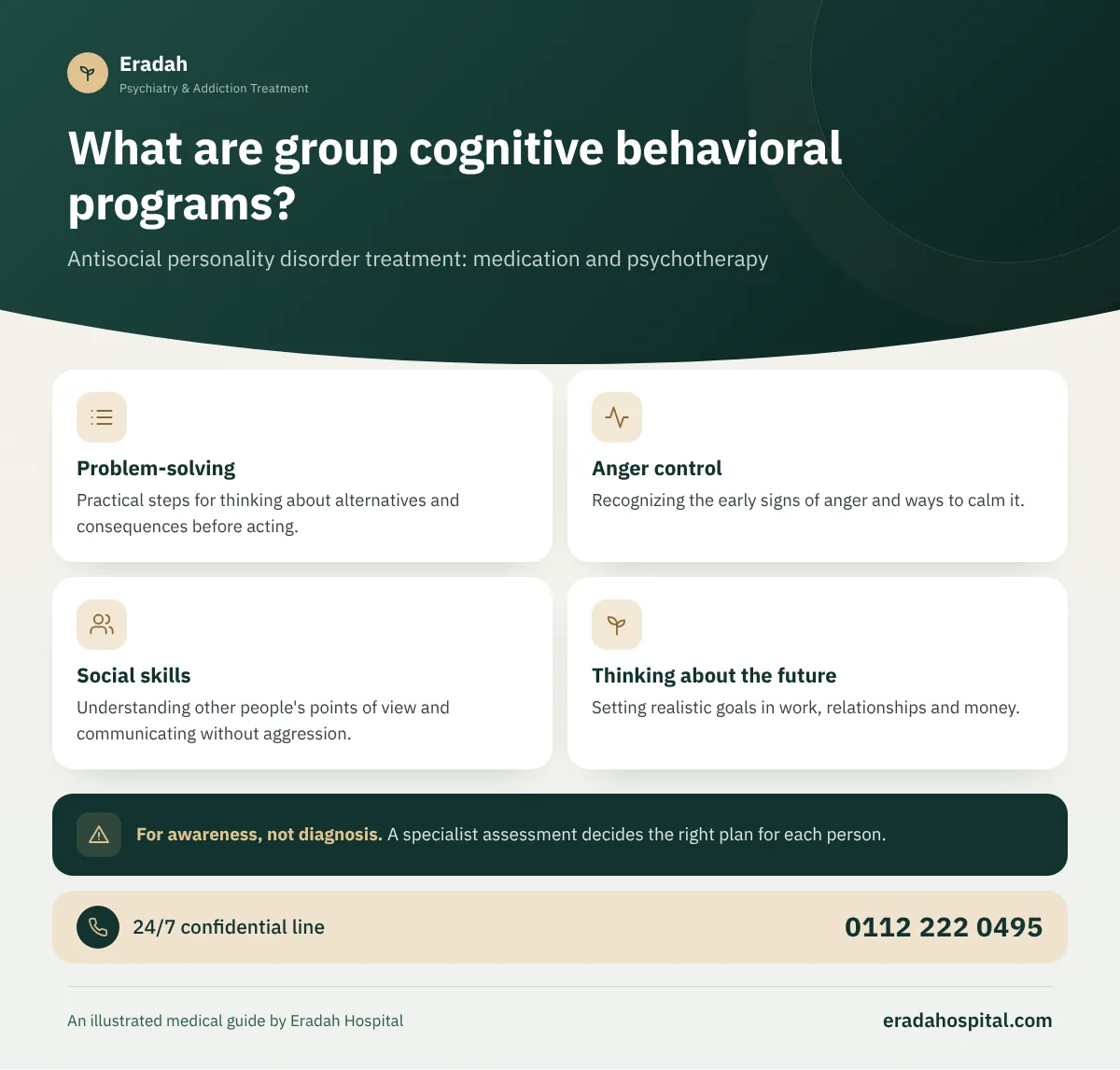
NICE guideline CG77 recommends group cognitive behavioral interventions for adults, especially to reduce lawbreaking behavior. Among the best known are the “Reasoning and Rehabilitation” programs used in prisons and probation services, and the guidelines recommend extending their length and adding booster sessions for people who pose a higher risk.
Practical steps for thinking about alternatives and consequences before acting.
Recognizing the early signs of anger and ways to calm it.
Understanding other people's points of view and communicating without aggression.
Setting realistic goals in work, relationships and money.
The guidelines also advise that methods should be positive and motivating rather than punitive, because reinforcement-based approaches are more successful with this group, and that staff be trained to work without negative preconceptions about the patient.
How are at-risk children and adolescents treated?
Since the disorder begins with conduct disorder, the most important treatment is early prevention. NICE recommends parent training programs for at-risk families, and cognitive problem-solving skills training for older children, which teaches the child steps for solving relationship problems through structured tasks and role-play.
| Intervention | For whom | The idea |
|---|---|---|
| Parent training programs | Families of children with behavior problems | Clear rules, reinforcing good behavior, calm and consistent consequences |
| Cognitive problem-solving skills training | Older children | Learning steps for thinking before acting, and role-play |
| Multisystemic therapy | Adolescents with severe problems | Working with the family, school and peers at the same time |
| Treating co-occurring ADHD | Children diagnosed with it | Reducing the impulsivity that feeds behavior problems |
Are there medications to treat antisocial personality disorder?
NICE guidelines do not recommend using medication routinely to treat the disorder itself, but to treat co-occurring disorders such as depression and anxiety according to their own guidelines. In selected cases the doctor may use medication for severe aggression, such as some mood stabilizers or antipsychotics, carefully weighing the benefits against the side effects.
If there is co-occurring attention-deficit/hyperactivity disorder, the doctor chooses the appropriate treatment while taking the risk of misuse into account, and may prefer non-stimulant options or formulations less prone to misuse, with close follow-up.
Why is treating co-occurring disorders a priority?
Addiction, depression and ADHD increase violence and impulsivity and disrupt any other treatment. Treating them is where quick results are most achievable: stopping alcohol or drugs alone greatly reduces fights, accidents and legal problems. That is why NICE states that substance use should be assessed in everyone being evaluated for the disorder. Details are on the antisocial personality and addiction page.
What is the role of therapeutic communities and specialist care?
Therapeutic communities are structured environments where participants live together, share responsibilities and receive feedback from the group, and they are used in some prisons and addiction programs. For people who pose a very high risk, NICE recommends much longer cognitive behavioral programs with close follow-up, alongside treatment of co-occurring disorders.
What approaches do not work or may cause harm?
Approaches based on humiliation, harshness or “breaking” the person, physical punishment and harsh confrontations do not change behavior in the long term and may increase aggression and rebellion. Preaching or repeated promises without a plan are not enough either, nor is prison alone without rehabilitation programs.
Likewise, irregular, unstructured sessions, or a focus only on “insight” and talking about the past, rarely help with this disorder. What helps more is a clear long-term framework, firm rules, reinforcement of positive behavior, and practical skills that can be applied the same day.
How can we increase the chances that the patient stays in treatment?
- Linking treatment to goals the person cares about: avoiding prison, keeping a job, or seeing their children.
- Clear rules and predictable consequences, without humiliation or harsh punishment.
- Starting with addiction treatment if present, because it often motivates the person to ask for help.
- Involving the family with the patient's consent, and introducing them to support groups.
- A collaborative team that communicates regularly to avoid splitting and manipulation among therapists.
How can the family support treatment without being harmed?
The family can support treatment by encouraging it and tying financial help or housing to commitment to it, with clear limits and no tolerance for violence or substance use in the home. Families also need psychological support of their own, because exhaustion sometimes leads to being too lenient or to a complete break, and both can do harm.
Choosing a hospital for antisocial personality disorder treatment
Most people with antisocial personality disorder do not come to treatment willingly; they are pushed by an exhausted family, a legal problem or an addiction that has gone out of control. That is why the criteria for choosing a place differ here: you need a team that is not fooled by surface charm, does not respond to aggression with harshness, and starts with what can really be changed, which is substance use and impulsivity. Ask any facility:
- Do you start with addiction treatment, if present, as the fastest way to reduce violence and problems?
- Do you offer a structured group program for problem-solving and impulse control, rather than occasional talk sessions?
- Do you have written rules for handling violence and threats inside the facility, applied without humiliation?
- Do team members communicate regularly so that their differences of opinion cannot be exploited?
- Do you offer family support that helps them set limits without cutting ties?
At Eradah, the dual diagnosis program treats addiction and the co-occurring disorder in a single plan, psychologists work through individual and group therapy, and a doctor and nursing staff are present around the clock. The family program gives relatives a space to regain their balance. We do not promise to change a personality in weeks; the realistic goal is to reduce harm and build commitment.
Treating antisocial personality disorder at Eradah
At Eradah we begin with a comprehensive psychological assessment covering substance use, depression, ADHD and the level of risk, then build an individual plan combining addiction treatment, cognitive behavioral programs for problem-solving and anger control, and treatment of co-occurring disorders when needed, along with family guidance and a plan to protect family members. We treat every patient with respect, without prejudgment, and in complete confidentiality.