What is the link between antisocial personality and addiction?
Scientific reviews show that substance use disorders are among the most common conditions accompanying antisocial personality, and that a notable share of patients in alcohol and drug treatment programs meet the criteria for this disorder. That means addiction treatment centers are among the most important places where it is discovered.
This pairing is not a coincidence; the very traits that characterize the disorder, such as impulsivity, sensation seeking and disregard for consequences, are among the strongest risk factors for addiction. Research also points to a shared genetic predisposition between the two.
Why do the disorder and addiction go together so strongly?
Quick boredom and the need for strong sensations make substances attractive.
Health and legal warnings do not deter them as they deter others.
Early involvement with peers who use substances and break the law.
Shared genes and traits that raise the risk of both together.
Substance use usually starts early, in adolescence, alongside signs of conduct disorder. The earlier use begins, the greater the risk of dependence and of effects on the development of the brain's inhibition and planning regions, which increases impulsivity even more in a closed circle.
There is also “self-medication”; some people with the disorder live with constant tension, distress and anger, or heavy boredom, and use substances to ease it. And with untreated ADHD in some of them, stimulants may be used in an attempt to focus, or sedatives to calm tension, which deepens dependence.
Which substances are most common with antisocial personality?
| Substance | The particular risk with this disorder |
|---|---|
| Alcohol | Raises aggression, fighting and reckless driving, and is linked to domestic violence |
| Stimulants such as crystal meth (shabu), cocaine and Captagon | Agitation, suspicion and violence, and may cause psychosis |
| Hashish and Strox | Strox in particular may cause agitation and unpredictable behavior |
| Opioids such as heroin and tramadol | Severe dependence, overdose, and legal problems from funding use |
| Sedatives such as Rivotril | May increase impulsivity in some, and a major risk when mixed with alcohol or opioids |
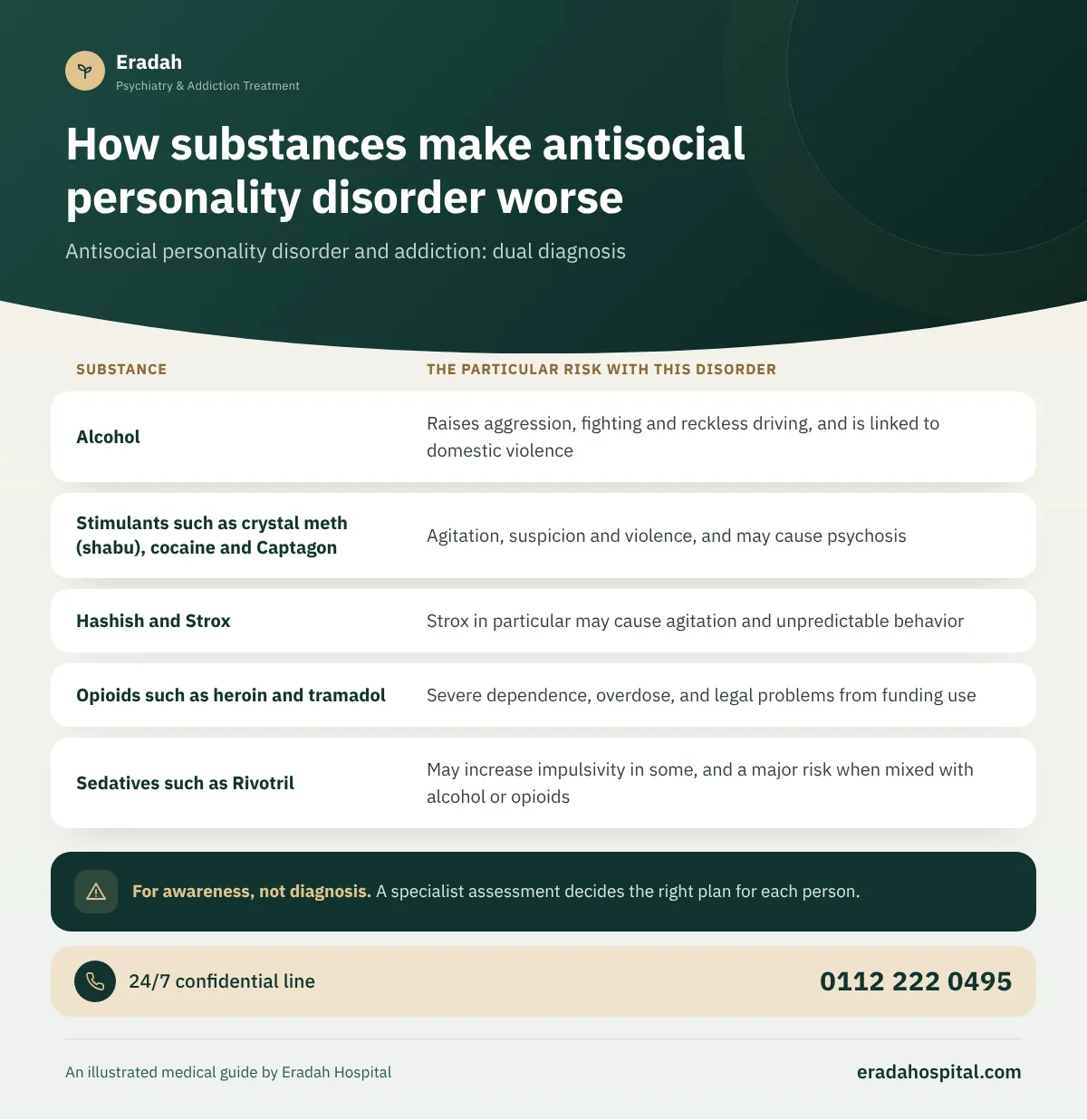
Using more than one substance is very common in this group, which multiplies the danger to life and complicates the safe detox stage.
How does substance use increase the risk of the disorder?
- More violence: alcohol and stimulants weaken inhibitions and increase aggression.
- More offenses: the need to fund use leads to theft and fraud.
- Accidents and injuries: driving under the influence and recklessness.
- Infectious diseases and overdoses: especially with opioids and injecting use.
- Deteriorating relationships: losing the family's trust and support, which are among the most important factors in recovery.
On the other hand, addiction can make a person without the disorder look as if they have it; lying and stealing to fund use may disappear with recovery. That is why the doctor assesses the history from childhood, and confirms that the pattern existed before substance use began and outside periods of use.
What warning signs should the family watch for?
- Money or valuables repeatedly disappearing from the home.
- Violence or threats that increase with drinking or after substance use.
- Legal problems linked to drugs or driving under the influence.
- New friends tied to substance use, and long unexplained absences from home.
- Using more than one substance at the same time.
When you notice these signs, the priority is the family's safety. Then you can talk to the person at a calm time, without empty threats, about treatment and about the realistic consequences the family will stick to.
How is an appropriate dual treatment designed?
- AssessmentA full picture
Assessing substance use, co-occurring disorders and the level of risk to self and others.
- Safe withdrawalUnder medical supervision
Especially with alcohol, sedatives and opioids, in a structured setting if needed.
- The treatment programRules and reinforcement
Group cognitive behavioral programs, and problem-solving and anger-control skills, along with addiction treatment.
- Follow-upRelapse prevention
Extended follow-up, support with work and housing, and a plan for risk situations.
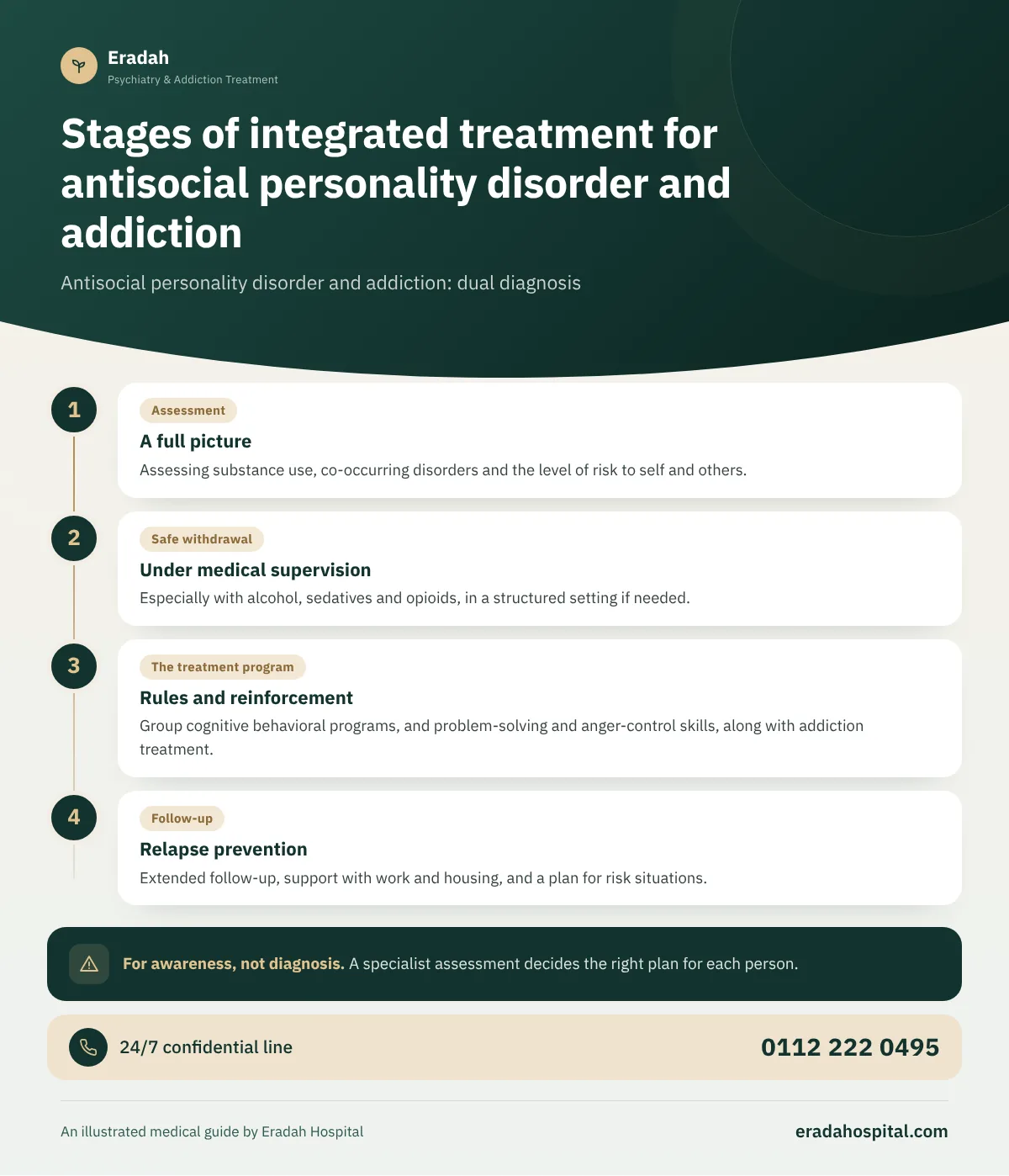
NICE guidelines advise assessing substance use in everyone being assessed for the disorder, and referring to specialist services when needed, with coordination between teams so the patient does not fall between two services. The guidelines also note that positive, motivating approaches are more successful than punitive ones with this group.
Why do programs with rules and reinforcement work with this group?
People with this disorder learn more from reward than from punishment. That is why some programs use “contingency management,” or conditional reinforcement, where the patient receives tangible rewards or privileges in return for negative test results and attending. This approach is among the most effective in treating stimulant addiction in general.
How does the family deal with a son who has both the disorder and addiction?
- Do not fund substance use in any form, and do not pay drug debts.
- Do not keep money or sedative medication where it is easy to reach.
- Tie any support to commitment to treatment, clearly and in writing if possible.
- Do not stay in a confrontation with a person under the influence; step away and ask for help if there is danger.
- Seek psychological support for yourself and the other family members, especially children.
At Eradah, the dual diagnosis program combines safe detox, addiction treatment, behavioral programs for problem solving and anger control, and treatment of co-occurring disorders, with family guidance and a plan to protect them. You can see the page on treatment of antisocial personality disorder for details.
Risk of violence or self-harm? Get help now
- An explicit threat to harm a family member or others, or violence that has already begun
- Severe agitation and aggression, especially under the influence of alcohol or drugs
- Recklessness that endangers their life or the lives of others, such as driving under the influence
- Talk of wanting to die or of severe hopelessness after a crisis or major loss
- Immediate danger to children or older people in the home
Your safety and the children's safety come first: do not get into an argument or a physical confrontation, move to a safe place, and call the police on 122 if violence is threatened or the ambulance on 123 if someone is injured or life is in danger. If the danger is to the person themselves, stay close if it is safe to do so, and call the mental health support line 16328 or go to the nearest emergency department.
Ambulance 123 Mental health support line 16328