Does the disorder have a single cause?
No. The UK's National Health Service says personality disorders result from a mix of inherited genes and early environmental influences, such as a painful childhood experience like abuse or neglect. In this disorder specifically, the interaction between the two appears clearer than in any other personality disorder.
Understanding the causes does not justify harming others nor excuse a person from responsibility, but it helps with early prevention and with designing realistic treatment. It also helps the family free itself from excessive blame of itself or of the child.
Is antisocial personality disorder hereditary?
Twin studies estimate that about 50% of the variation in the likelihood of developing it is due to genetic factors. What is inherited are traits such as impulsivity, sensation seeking, a weak fear response and difficulty controlling anger, not “criminality” itself, and in certain environments these traits can lead to antisocial behavior.
One of the best-known examples of gene-environment interaction is research on a gene called MAOA; children who carry a certain version of it and are abused in childhood were found to be more prone to antisocial behavior, while the same effect barely appears in those who were not abused. A gene alone does not create the disorder.
What is the role of the brain and nervous system?
Responsible for inhibition and planning; weaker functioning is linked to impulsivity and difficulty thinking about consequences.
A weaker response to fear and to expressions of pain on other people's faces may explain reduced empathy.
Some studies point to a lower heart rate and skin response to fear, so the person seeks stimulation.
The role of serotonin in impulsivity and aggression is being studied.
Factors that affect brain development may also contribute, such as exposure to alcohol or drugs during pregnancy, head injuries in childhood, or developmental disorders such as untreated ADHD. These factors raise the likelihood but do not settle it.
What is the role of childhood abuse and neglect?
Physical abuse, neglect, witnessing violence between parents, and harsh or erratic parenting that punishes severely one time and ignores the next are among the strongest risk factors. A child in this environment may learn that the world is a hostile place, that aggression is a means of survival, and that other people's feelings do not matter because their own feelings mattered to no one.
The disorder is also linked to having a parent with addiction or who breaks the law, where the cause is heredity, lack of supervision and the role-model example together. Separation from caregivers and moving between homes or institutions contribute to weak secure attachment.
How does the disorder develop from childhood to adulthood?
- Early childhoodA difficult temperament and risk factors
Impulsivity and difficulty self-soothing, in a harsh or neglectful environment.
- SchoolBehavior problems
Aggression, defiance and rejection by peers, and falling behind in school.
- AdolescenceConduct disorder
Theft, running away and assaults, early substance use, and joining delinquent peers.
- After 18A fixed pattern
If the pattern continues, the disorder is diagnosed; about 40% of boys and 25% of girls with conduct disorder reach this stage.
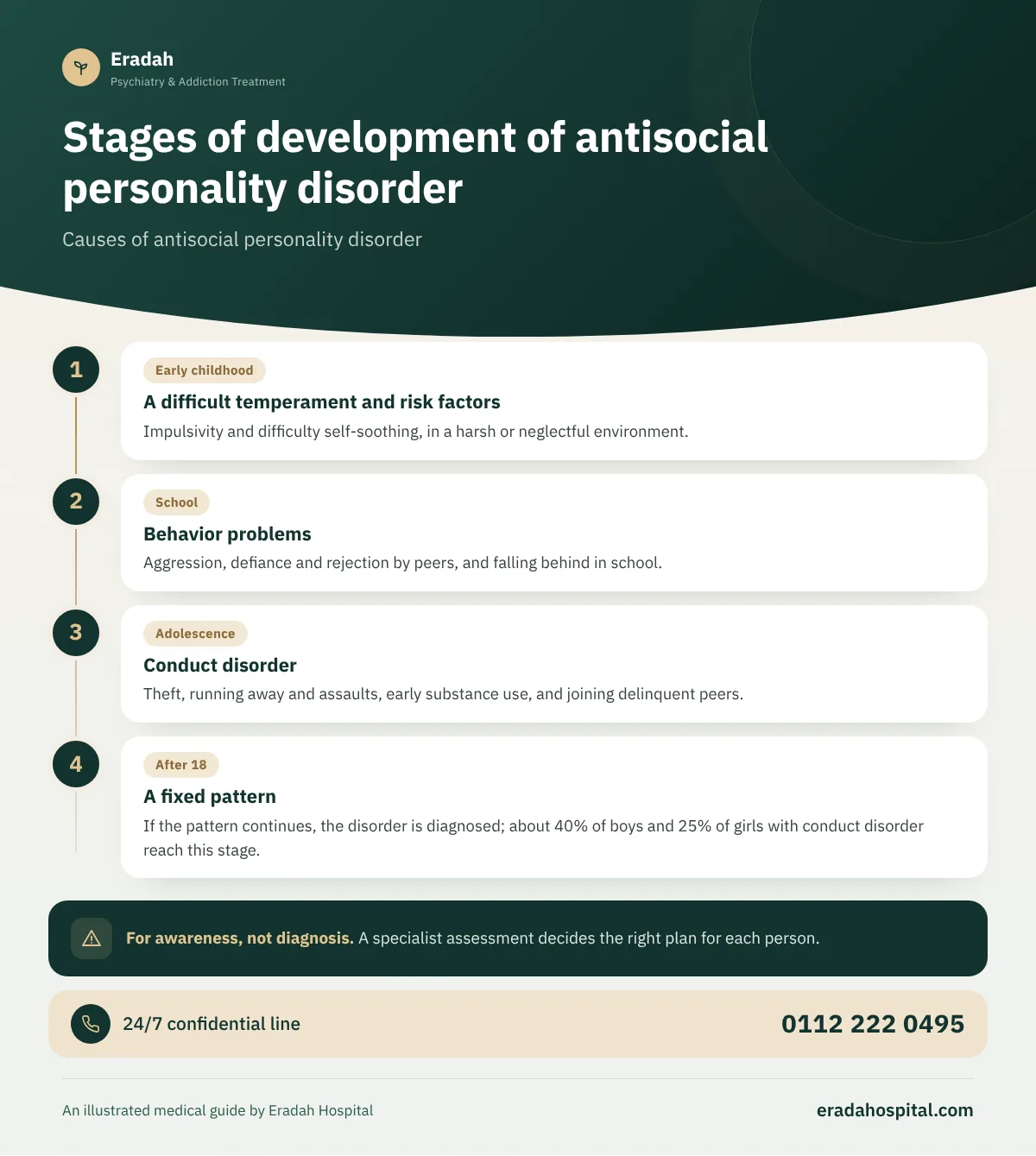
Each stage on this path is an opportunity to intervene, and the earlier the intervention, the better its chance. That is why international guidelines focus on parent training and problem-solving programs for children.
Do environment and society play a role?
Severe poverty, neighborhoods where violence and drugs are widespread, dropping out of school, and the company of peers who break the law all raise the likelihood of antisocial behavior in children and teenagers who are already at risk. But they do not explain the disorder on their own; most people living in these conditions do not develop it.
What is the difference between causes and triggers of behavior?
Causes build a predisposition over years: heredity, temperament and a difficult childhood. Triggers are what set off aggressive or law-breaking behavior at a particular moment in a person who already has the predisposition, such as substance use, feeling humiliated, rejection, needing money, or being with peers who encourage breaking rules.
This distinction is useful to the family; the situation that came before an outburst is not the “cause of the illness,” and does not mean the family is responsible for it. But knowing the triggers helps with a protection plan, such as avoiding heated arguments with a person under the influence of a substance, and keeping money out of their reach.
What are the risk factors and protective factors?
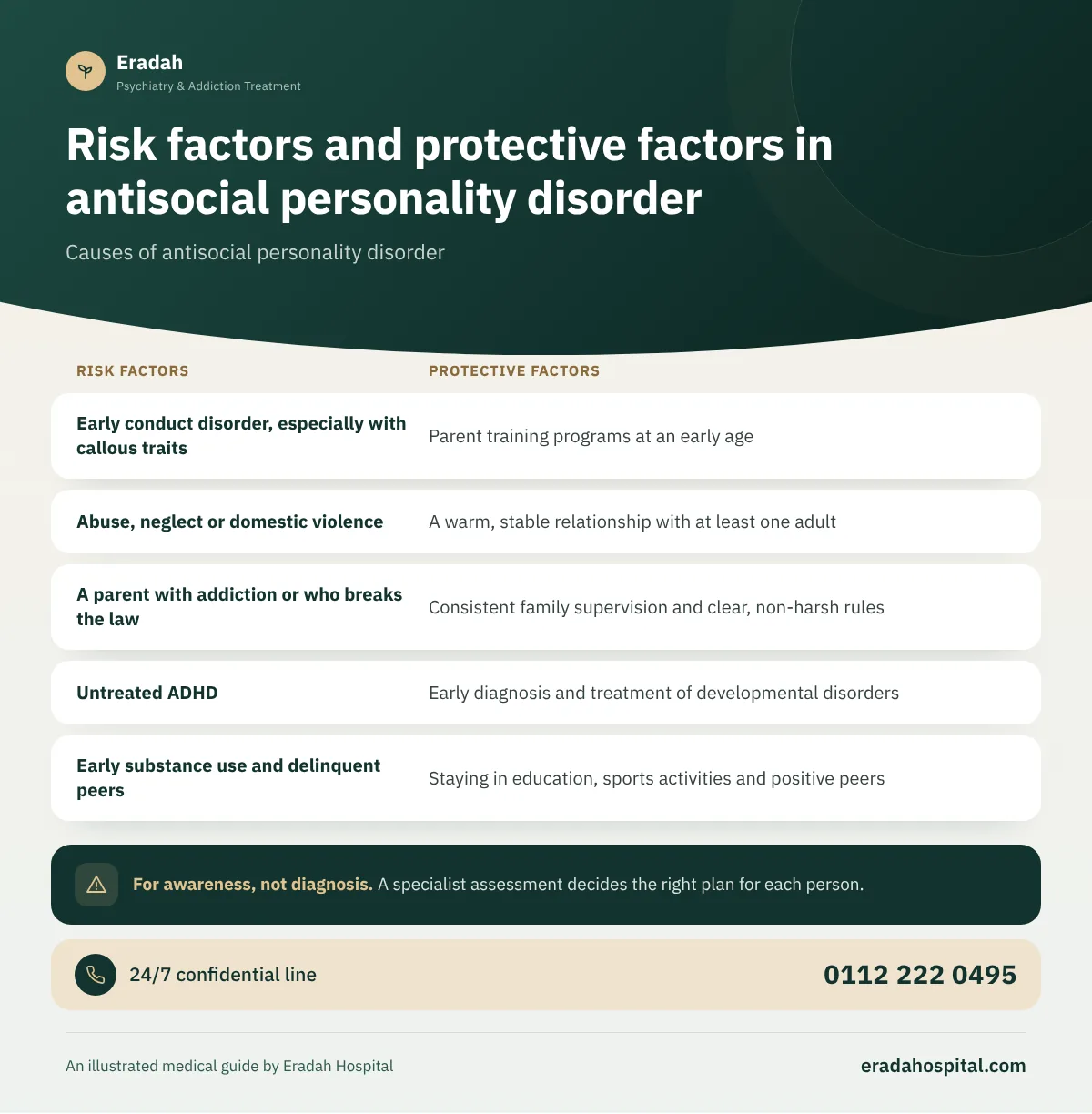
| Risk factors | Protective factors |
|---|---|
| Early conduct disorder, especially with callous traits | Parent training programs at an early age |
| Abuse, neglect or domestic violence | A warm, stable relationship with at least one adult |
| A parent with addiction or who breaks the law | Consistent family supervision and clear, non-harsh rules |
| Untreated ADHD | Early diagnosis and treatment of developmental disorders |
| Early substance use and delinquent peers | Staying in education, sports activities and positive peers |
Myths about the causes of antisocial personality
- “Born evil”: heredity gives a predisposition to traits, not a fixed moral destiny.
- “Spoiling is the cause”: research links the disorder more to harshness, neglect and inconsistency, not to pampering.
- “Beating will fix him”: harsh physical punishment is itself a risk factor, and increases aggression.
- “Video games are the cause”: there is no evidence that they cause the disorder, although violent content is unsuitable for children.