What is a highly sensitive person?
"Since I was little they've been telling me I'm too sensitive. One small word stays in my head for two days." If this sentence sounds like you, you are not alone. There is a real scientific difference between people in how much they are affected by the world around them, and understanding it greatly eases self-blame.
The psychologist Elaine Aron described this trait in the 1990s and called people who have it "highly sensitive persons." Researchers today define it as sensory processing sensitivity: a tendency to process information and stimuli more deeply, to be affected by emotions, to notice fine details, and to become overwhelmed quickly in crowded environments. A scientific review published in 2019 in Neuroscience and Biobehavioral Reviews described it as a trait that is common and partly heritable, not a mental disorder.
Traits of a highly sensitive person
- You are strongly affected by loud sounds, bright lights, smells and crowds.
- You notice small details that others pass over without noticing.
- You pick up the mood of those around you quickly and are affected by their sadness or tension.
- You need time alone after a busy day to regain your calm.
- You are deeply moved by music, art and touching situations.
- You think for a long time before deciding and get tense when rushed.
- You are hurt by criticism or a harsh word more than others are.
- You find it hard to work when someone is watching you.
What does science say about the highly sensitive person?
In a study published in 2018 in the journal Translational Psychiatry with 906 adults, three groups emerged: 31% high in sensitivity, 40% medium, and 29% low. The researchers likened the groups to orchids, tulips and dandelions. In other words, sensitivity is a continuum, not a sharp divide between "sensitive" and "not sensitive."
In a functional brain imaging study published in Brain and Behavior in 2014, higher sensitivity scores were linked to greater activity in brain regions responsible for awareness, empathy and integrating sensory information when viewing other people's faces showing different emotions. But it was a small study of 18 people, so its results are an indication, not a final verdict.
Is high sensitivity an advantage or a burden?
The 2019 review concluded that high sensitivity increases the risk of stress-related problems when the environment is harsh, but lets the person benefit more from supportive environments and positive experiences. The same person may wilt in a home full of shouting and flourish in a quiet place that values them.
The ability to understand other people's feelings and support them.
Noticing mistakes and details that others miss.
Deeper enjoyment of art, nature and relationships.
Crowds, noise and back-to-back appointments drain you.
A harsh word stays for days and feeds overthinking.
In stressful environments, exhaustion may turn into anxiety.
The difference between the highly sensitive person and anxiety disorders
| The highly sensitive person | Anxiety disorders | Introverted temperament | |
|---|---|---|---|
| Classification | A natural personality trait | A diagnosable mental disorder | A natural personality trait |
| The core | Depth of processing and being affected by stimuli | Persistent fear and anxiety that are hard to control | A preference for quiet and recharging by being alone |
| Suffering | Mostly in crowded or harsh environments | Persistent across many situations | Not necessarily any suffering |
| Does it need treatment? | No, rather skills and organizing the environment | Yes, psychotherapy and sometimes medication | No |
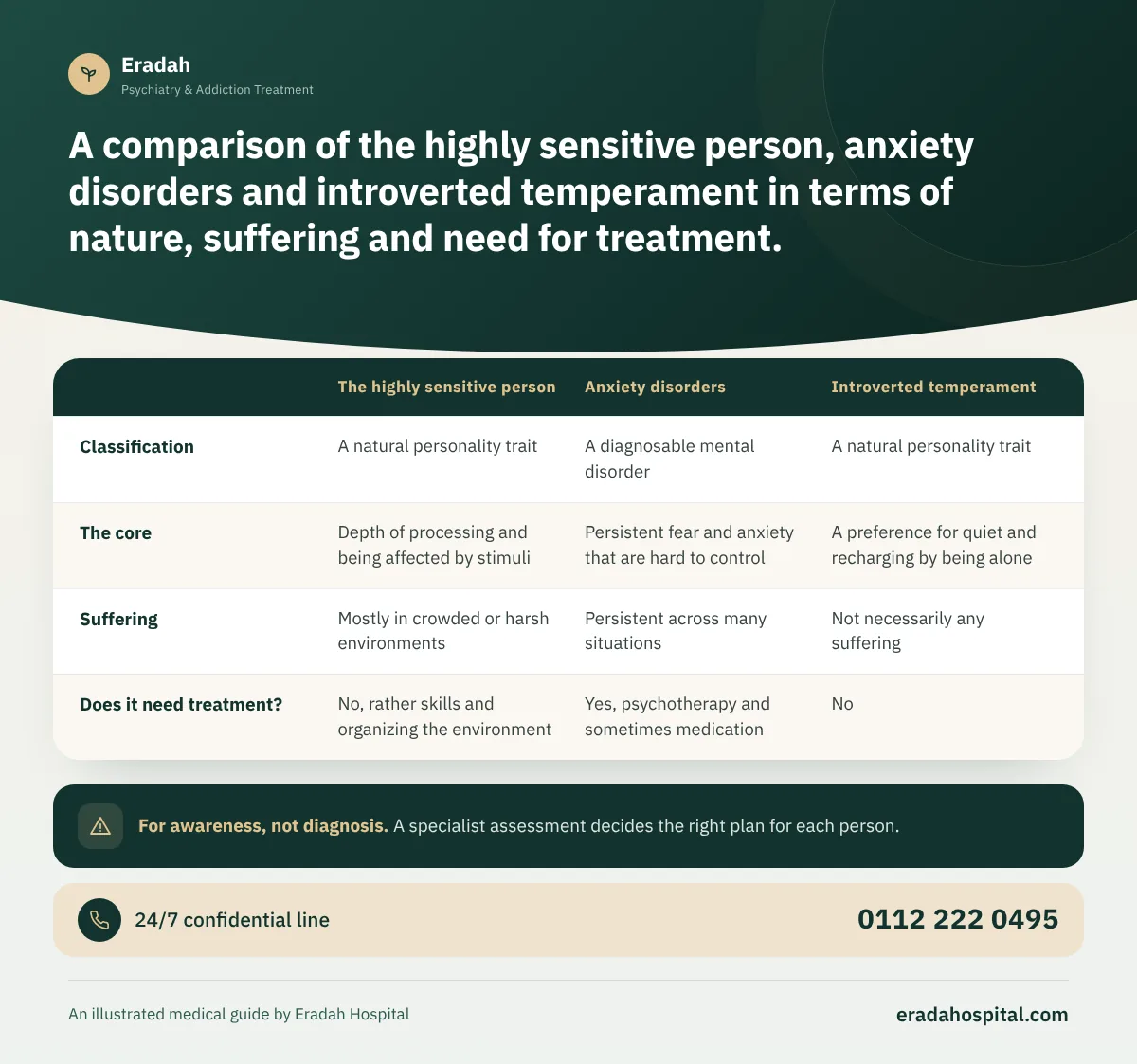
Sensitivity can occur together with generalized anxiety disorder or social phobia in the same person, but sensitivity alone does not mean illness. What decides it is how much suffering there is and how far it disrupts life.
How do you cope with your high sensitivity?
- Know your triggers: for a week, record what drains you and what soothes you.
- Plan short quiet breaks between tasks and crowded appointments.
- Use earplugs or noise-canceling headphones in noisy places.
- Say "no" to some commitments without feeling guilty.
- Separate criticism of your work from your worth as a person.
- Sleep well and move every day, because exhaustion multiplies sensitivity.
- Choose relationships and a work environment that value your calm and your precision.
The highly sensitive person at work and in relationships
At work, a sensitive person excels at tasks that need precision and empathy, and struggles in noisy open-plan offices and relentless deadlines. Negotiating for time to concentrate or a quieter place is not a luxury. In relationships, it helps to explain to a partner or family that the need to be alone is not a rejection of them, and to agree on a calm way to discuss disagreements instead of shouting.
When does a highly sensitive person need help?
Ask for a psychological assessment if sadness or anxiety continues for weeks, if you start avoiding work and people, if your sleep is disturbed, or if thoughts of hopelessness appear. This may be depression or an anxiety disorder, which respond well to cognitive behavioral therapy. You can start with a confidential consultation in Eradah's outpatient clinics.
Exhaustion has turned into hopelessness or suicidal thoughts? Get help now
- Sadness or anxiety lasting weeks, with avoidance of work and people
- Repeated panic attacks or severe sleeplessness that does not improve
- Talk of hopelessness or death, or of being a burden on others
- Increasing reliance on alcohol, sedatives or hashish to calm down
Do not leave the person alone. Ask calmly what they are feeling and listen without calling their feelings exaggerated or "being spoiled"; asking about suicidal thoughts does not plant them, it opens the door to help. Call the ambulance on 123 or take them to the nearest emergency room if they are in danger, or call the mental health support line 16328 around the clock, and keep medications and things they could use to harm themselves out of their reach.
Ambulance 123 Mental health support line 16328