What is caffeine?
“Without my morning cup, I’m not myself.” Millions of people say this every day, and it is in fact an accurate description of physical dependence on the best-known stimulant humans have ever used. Caffeine is a nervous system stimulant found naturally in coffee beans, tea leaves, cocoa and kola nuts, and added to soft drinks, energy drinks and some supplements and medications.
A scientific review published in 2013 describes it as the most widely used psychoactive substance in the world. According to the European Food Safety Authority (EFSA), coffee is the main source of caffeine for adults in most European surveys, accounting for between 40% and 94% of their total intake, while chocolate, tea and cola lead the sources for children.
Does caffeine have medical uses?
Yes. Caffeine citrate is an approved medication given in hospitals under close monitoring to treat pauses in breathing (apnea) in premature infants. The MedlinePlus medical encyclopedia also notes that caffeine is an ingredient in some over-the-counter painkillers, cold medicines and diet pills, so a person may take “hidden” caffeine without realizing it, and it is worth reading the label before counting your daily amount.
How does caffeine affect the brain and body?
Over the course of the day, a chemical called adenosine builds up in the brain, and the more of it there is, the more tired and sleepy you feel. Caffeine resembles it in structure, so it occupies its receptors and stops it from working. The feeling of tiredness disappears for a while, and dopamine and adrenaline activity increases indirectly. With daily use the brain adapts to its presence, so the person needs more for the same effect and feels doubly tired when it is absent.
- On attention: EFSA says moderate amounts increase alertness and reduce sleepiness.
- On the heart: it may speed up the pulse, especially in large amounts.
- On the kidneys: a mild diuretic, as MedlinePlus notes.
- On sleep: EFSA notes that as little as 100 mg close to bedtime may affect sleep duration and pattern in some adults.
How much caffeine is in your drink?
About 80 mg of caffeine.
About 90 mg of caffeine.
About 50 mg of caffeine.
About 40 mg of caffeine.
About 80 mg, and large cans may contain several times that.
About 25 mg, and much less in milk chocolate.
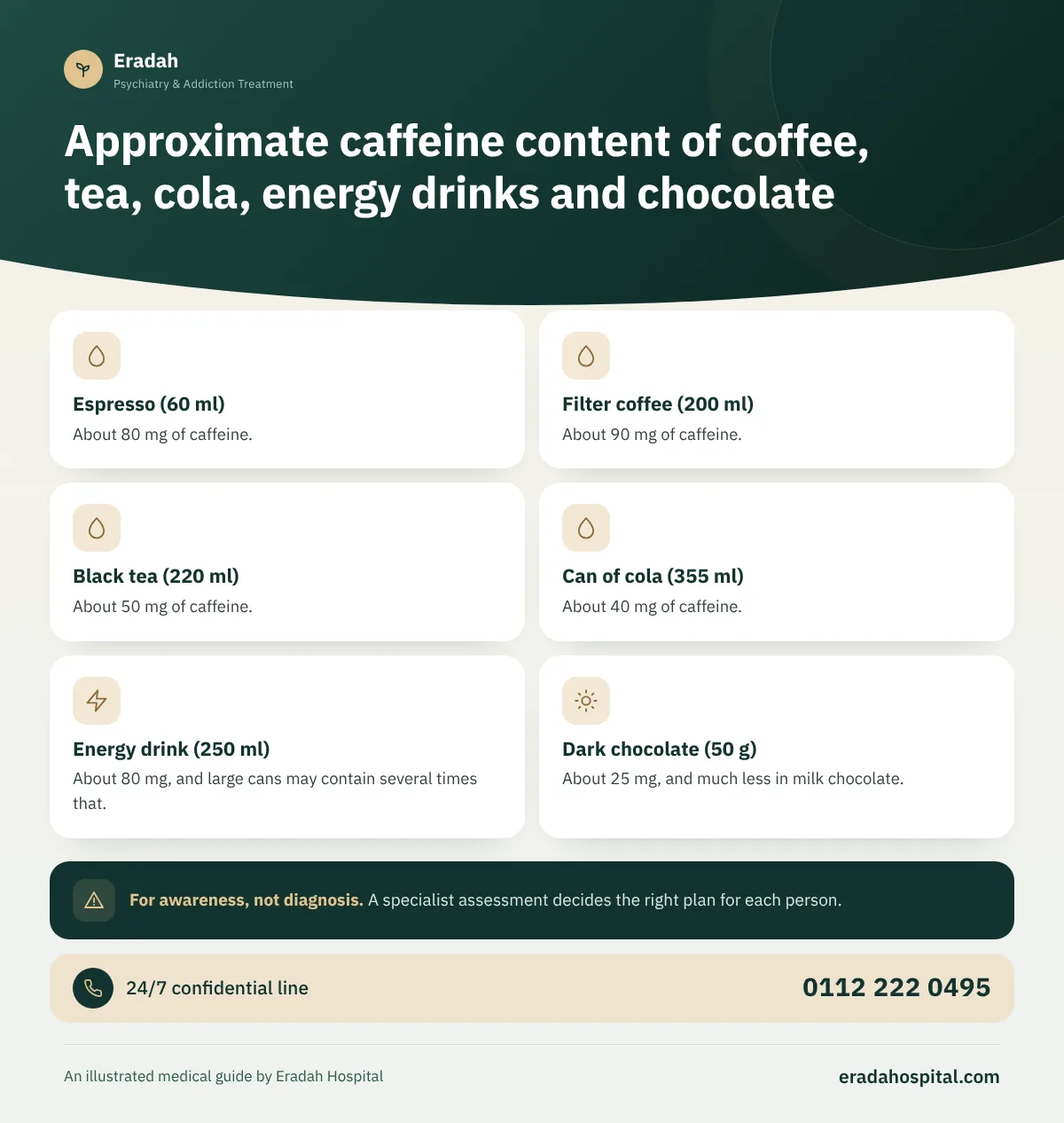
These are approximate figures published by EFSA, and the actual amount varies with the type of coffee bean, the preparation method and the size of the cup. The US Food and Drug Administration notes that energy drinks generally contain between 54 and 328 mg per container of roughly 473 ml, so a single large can may approach half the daily limit or exceed it.
How much caffeine is safe per day?
| Category | Approximate limit | Source |
|---|---|---|
| Most healthy adults | Up to 400 mg a day, spread through the day | FDA and EFSA |
| A single dose for an adult | Up to 200 mg raises no safety concern | EFSA |
| Pregnant and breastfeeding women | Up to 200 mg a day | EFSA and NHS |
| Children and teenagers | There are no specific US guidelines, and the American Academy of Pediatrics advises avoiding it, especially energy drinks | MedlinePlus |
Is coffee addiction real?
The DSM-5 diagnostic manual formally recognizes a diagnosis of caffeine withdrawal, while it lists caffeine use disorder among the conditions that need further research, as a review published in 2014 explains. Another review notes that the World Health Organization and some specialists recognize caffeine dependence as a clinical disorder. In practical terms, most coffee drinkers have dependence, not destructive addiction; they need it to function normally, but few lose control and continue despite clear harm.
Caffeine compared with other stimulants
| Point of comparison | Caffeine | Khat | Amphetamine |
|---|---|---|---|
| How they work | Blocks adenosine receptors | Releases dopamine and norepinephrine | Releases dopamine and norepinephrine strongly |
| Legal status | Legal in food | Prohibited in Egypt | A controlled medication |
| Addiction potential | Low, and physical dependence is common | Moderate, with psychological dependence | High |
| Main risk | Poisoning from concentrated products | Blood pressure and mouth lesions | Heart problems, psychosis and addiction |
Caffeine is a real stimulant, but it differs in mechanism and strength from khat and amphetamine, so it should not be lumped in with them, nor should it be considered risk-free.
Caffeine and the law: legal, but not without limits
Caffeine is a legitimate food ingredient sold freely. But the US Food and Drug Administration warns against pure or concentrated caffeine products, and estimates that consuming about 1,200 mg quickly, which is less than half a teaspoon of pure powder, can cause toxic effects such as seizures, and that these products can cause serious health consequences, up to and including death.
Caffeine in numbers
Sources: the US Food and Drug Administration (FDA), the official prescribing information for caffeine citrate, and the Juliano and Griffiths review on caffeine withdrawal (2004).
Caffeine in brief: harms, symptoms, withdrawal and how long it stays
- Harms: excess steals sleep and increases anxiety and palpitations, and concentrated products can cause dangerous poisoning. Details are in harms of caffeine.
- Symptoms: a headache when a cup is late, gradually increasing amounts, and failed attempts to cut down. Read about coffee addiction symptoms.
- Withdrawal: headache, sluggishness and low mood that begin within a day and fade within days. See caffeine withdrawal symptoms.
- How long it stays: half of it remains in the blood for about five hours, which is why an afternoon cup affects your sleep. Details are in how long caffeine stays in the body.
Caffeine during addiction recovery
Many people recovering from drug use notice that they drink a lot of coffee, tea and energy drinks, as if the brain were looking for a replacement stimulant. Moderate coffee is not a problem in itself, but overdoing it feeds insomnia and anxiety, two of the best-known triggers of relapse. That is why treatment programs pay attention to managing stimulants and sleep as part of the daily routine, especially for those who used stimulants.
Caffeine guide: everything you need to know
We have gathered everything about caffeine into 4 pages, each answering one question in detail. Choose what you are looking for:
Harms of caffeine to the body and mind
What are the harms of caffeine and too much coffee? Its effect on sleep, anxiety, the heart, the stomach and pregnancy, the danger of energy drinks and concentrated powders, and the symptoms of caffeine poisoning and when it becomes dangerous.
Coffee and caffeine addiction symptoms
How do you know if you are addicted to coffee? Symptoms of coffee addiction and caffeine dependence, signs of overuse, hidden sources of caffeine, diagnostic criteria, and when you need a doctor.
Caffeine withdrawal symptoms and how long they last
When do caffeine withdrawal symptoms begin and how long do they last? The headache from quitting coffee, sluggishness and low mood, a withdrawal timeline, and a practical plan to cut caffeine gradually without headaches.
How long caffeine stays in the body
How long does caffeine stay in the body? Caffeine’s half-life and when the effect of coffee wears off, why it differs from person to person, when to have your last cup in order to sleep well, and whether it shows up in tests.
Tips for families: children, teenagers and energy drinks
- Don’t let energy drinks replace late-night studying or sleep.
- Read the label: some large cans contain a lot of caffeine and other stimulants.
- Be careful about mixing them with alcohol or any stimulants or diet pills.
- Do not keep concentrated caffeine tablets or powders within children’s reach.
- If severe palpitations, repeated vomiting or a seizure appear after overuse, call the ambulance (123) immediately.
Danger signs after too much caffeine: call the ambulance (123) immediately
- Chest pain, or a very fast or irregular heartbeat
- Seizures or loss of consciousness
- Repeated vomiting with agitation, confusion or severe tremor
- Difficulty breathing or fainting
- Taking a large amount of concentrated caffeine tablets or powder, especially in a child or teenager
Call the ambulance on 123 immediately. If the person is unconscious but breathing, place them on their side so they don’t choke on vomit, stay with them and don’t leave them alone, don’t give them any stimulant drink or home remedy, and keep the product container or the tablets to show the paramedics.
Call the ambulance 123