What is health anxiety?
A mild headache turns in your mind into a brain tumor, a skipped heartbeat into an impending clot, a mole on your arm into cancer. You go to the doctor and he reassures you, you feel relieved for a day, and then the story starts again with another symptom. If this sounds familiar, you are not "a worrier" in the mocking sense. You have a recognized disorder that has treatment.
It used to be called "hypochondria," and the current diagnostic manual splits it into two forms: illness anxiety disorder, where physical symptoms are few or mild and the anxiety is the main problem, and somatic symptom disorder, where there are troublesome physical symptoms along with excessive preoccupation with them. In both, the preoccupation lasts six months or more, consumes time and energy, and affects work and relationships.
Symptoms of health anxiety
- Constant fear of having, or developing, a serious illness.
- Constantly monitoring the body: measuring blood pressure and pulse, feeling for lumps, checking the skin.
- Repeatedly searching for symptoms online.
- Visiting many doctors and requesting repeated tests and lab work.
- Not feeling reassured for long after normal results.
- Asking family for reassurance again and again: "Do you think this is normal?"
- In some patients, avoiding hospitals, news about diseases, or doctors.
- Fear that shifts from one illness to another.
Why does anxiety get worse the more you search?
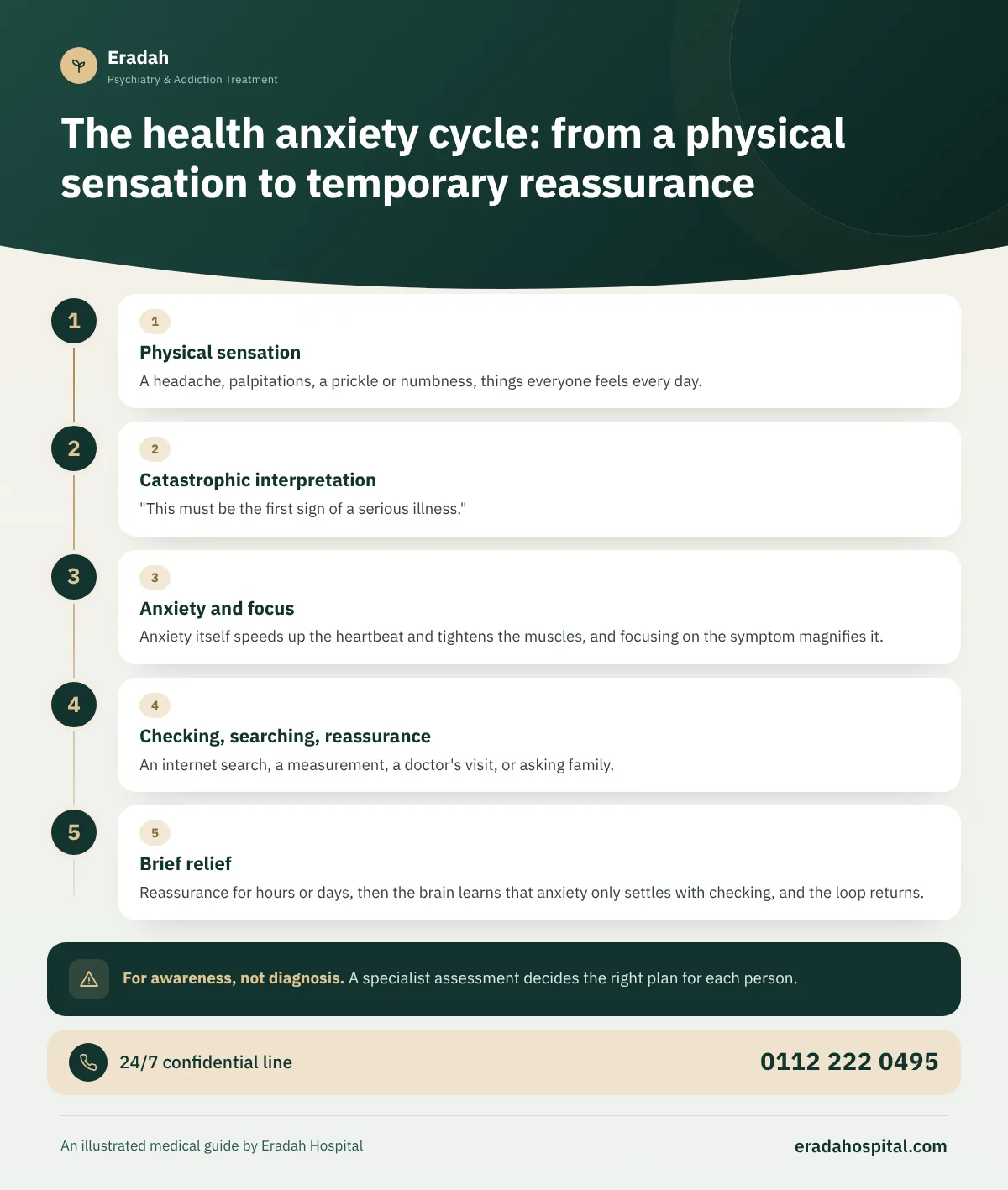
Health anxiety works as a loop that feeds itself, and every attempt to calm the anxiety in the usual way strengthens it in the long run:
- 1Physical sensation
A headache, palpitations, a prickle or numbness, things everyone feels every day.
- 2Catastrophic interpretation
"This must be the first sign of a serious illness."
- 3Anxiety and focus
Anxiety itself speeds up the heartbeat and tightens the muscles, and focusing on the symptom magnifies it.
- 4Checking, searching, reassurance
An internet search, a measurement, a doctor's visit, or asking family.
- 5Brief relief
Reassurance for hours or days, then the brain learns that anxiety only settles with checking, and the loop returns.
Causes of health anxiety
- Past experience: a serious illness in childhood, or losing someone close to a sudden illness.
- An anxious temperament: more common in people with generalized anxiety or panic.
- Periods of stress: symptoms increase during times of pressure and major change.
- Beliefs about the body: that health means the absence of any sensation, and that any symptom is a sign of danger.
- Heavy exposure to health news: as happened to many people during pandemics.
Health anxiety and obsessive-compulsive disorder
They are similar in intrusive thoughts and repeated checking, and they can occur together. But in obsessive-compulsive disorder (OCD) the fears are usually varied and come with specific rituals, whereas in health anxiety the subject is specifically health and illness, and the behavior is seeking medical certainty. The doctor makes the diagnosis, because the treatments are similar but differ in their details.
Treatment of health anxiety
Cognitive behavioral therapy has the strongest evidence. It teaches the patient to understand the anxiety cycle, adjust catastrophic interpretations of physical sensations, gradually cut down on checking, searching and asking for reassurance, and tolerate uncertainty. The doctor may prescribe an antidepressant from the selective serotonin reuptake inhibitor group when the anxiety is severe or comes with depression or obsessions. Sedatives do not treat health anxiety and carry a risk of dependence.
Steps that help from today
- Agree with one doctor you trust on fixed follow-up appointments instead of emergency visits.
- Set a time for searching online, then gradually reduce it until you stop.
- Cut down on measuring blood pressure and pulse and feeling your body, and record how often you do it.
- When a symptom comes, write down the other possible explanations that are not serious.
- Ask your family not to reassure you repeatedly, but to gently remind you of your plan.
- Stay active and sleep well, because exhaustion magnifies physical sensations.
A serious physical symptom or severe hopelessness? Do not wait
- Chest pain with shortness of breath or sweating, or chest pain that appears with exertion
- Unexplained bleeding, a persistent fever, or marked weight loss with no reason
- A new symptom that is clear or completely different from what you are used to
- Severe hopelessness about getting better, or talk that life has no meaning
- Thoughts of death or self-harm because of the fear of illness
Health anxiety does not mean every symptom is imagined; a new, serious symptom deserves the emergency room immediately: call the ambulance on 123 or go to the nearest hospital. If thoughts of death or self-harm appear, do not leave the person alone. Ask calmly, listen without blame, and call the ambulance (123) or the mental health support line 16328 (24 hours).
Ambulance 123 Mental health support line 16328