What is an introverted personality?
“I'm not upset, I just need to sit by myself for a bit.” Many people repeat this after a day crowded with people, and those around them respond with worry or blame. Most of the time, the person is simply an introvert, someone who recharges in quiet rather than in a crowd, and this is a difference in temperament, not a defect.
A Cleveland Clinic article explains that an introvert is someone who draws energy and a sense of satisfaction from internal sources: solitude, quiet and low-stimulation environments, while an extrovert draws energy from people and activity. At its core this is energy management and a personal preference, not ability or inability. That is why an introvert can speak in front of an audience and work in a team, but needs time afterward to regain their balance.
Personality is not a rigid mold; introversion and extroversion are the two ends of a spectrum, and in the middle are the so-called “ambiverts,” who combine traits from both ends. Mental Health America (MHA) notes that this trait may change with the move from youth to adulthood or after major life changes.
Traits of an introverted personality
Feels mentally drained after a big gathering and recovers energy in quiet.
Prefers a few close friends over many superficial acquaintances.
Is more comfortable in a deep conversation with one person than in group chatter.
Listens and observes first, then offers a considered opinion.
Leans toward reflection, reading, imagination and solitary activities.
Feels at ease in quiet places and needs time to get used to new places and faces.
Types of introverts
The Cleveland Clinic article describes four common patterns, and their definitions vary between personality tests:
- The social introvert: likes people but in small groups, such as a dinner at home with a few friends.
- The thinking introvert: absorbed in their inner world, with a lot of reflection and imagination.
- The anxious introvert: more cautious in social situations, and replays what happened in them.
- The restrained introvert: deliberate, thinking a great deal before speaking or acting.
The difference between introversion, shyness, social phobia and depression
| Introversion | Social phobia | Depression | |
|---|---|---|---|
| Reason for withdrawing | Comfort in quiet | Fear of being judged and evaluated by people | Loss of energy and pleasure |
| Feeling when alone | Comfortable and content | Temporary relief with regret | Persistent sadness or emptiness |
| Favorite activities | Enjoys them | Enjoys them away from people | Loses interest in them |
| Does it need treatment? | No | Yes, and it improves with treatment | Yes, and it improves with treatment |
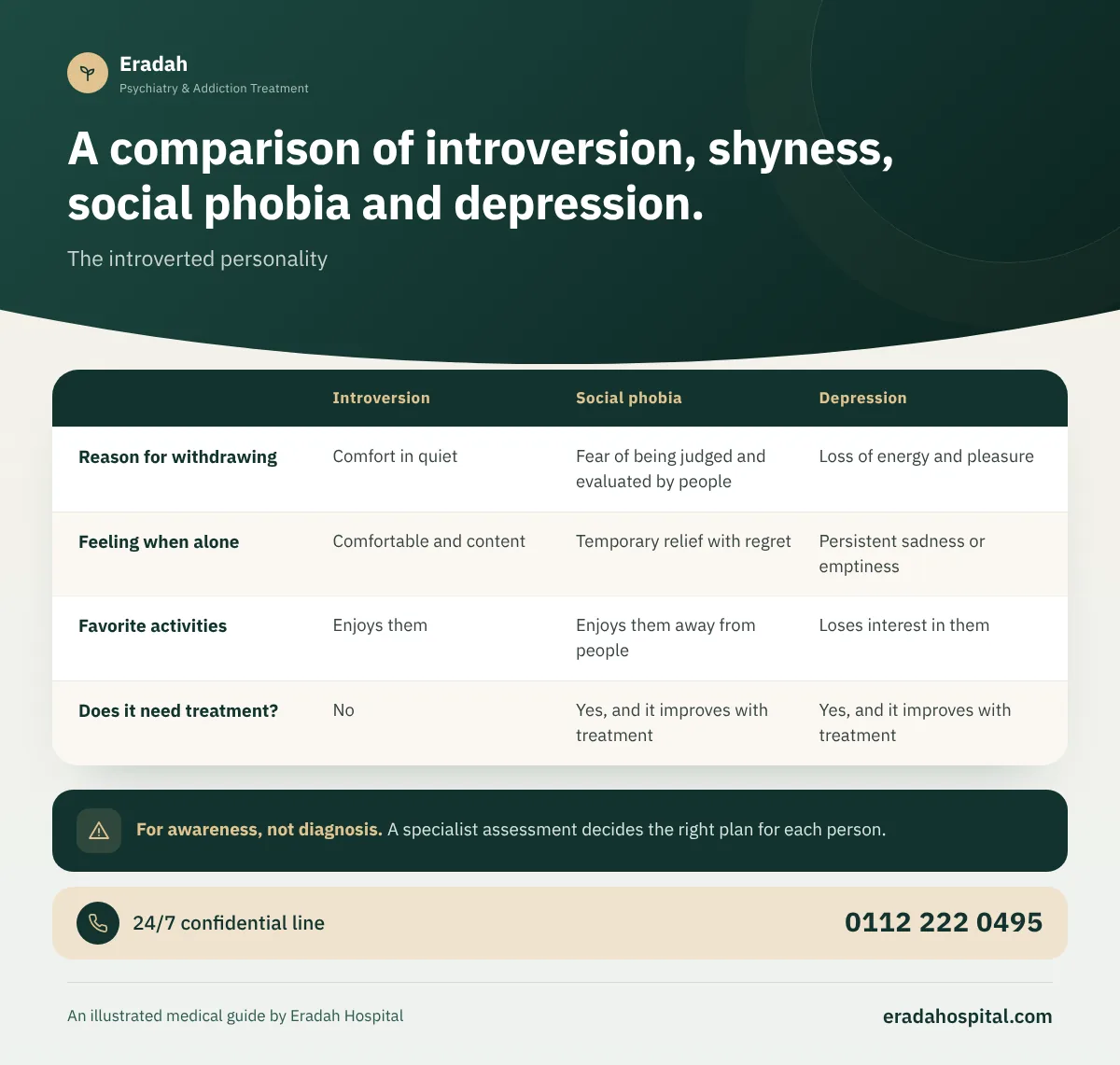
Shyness, on the other hand, is a feeling of tension and awkwardness in social situations, and a person can be shy and extroverted at the same time. MHA explains that the deciding question is: do I withdraw because I prefer to, or because I avoid people and fear them? If it is the latter and it keeps you from relationships you want, it may be social phobia. If the solitude comes with sadness and a longing for people, that is loneliness, not introversion. And if your mood has changed and you have lost pleasure and energy, look at the signs of depression.
Strengths of an introverted personality
MHA stresses that there is nothing wrong with being an introvert, and that it has clear strengths: the ability to concentrate and work independently, good listening, careful thought before decisions, and deep, steady relationships. The problem is not introversion itself, but the social pressure that demands everyone be equally sociable.
Tips for introverts and the people around them
- Know the limits of your energy, and plan quiet time after crowded events.
- Choose the events that really matter to you, and politely decline the rest.
- At work, ask for the meeting agenda in advance so you can prepare your ideas.
- For family: do not read their need for solitude as being upset or arrogant.
- Do not pressure an introverted child to become “social;” help them make one or two real friends.
When does an introverted personality need a consultation?
Introversion alone needs no treatment. But if it comes with fear that gets in the way of your studies or work, prolonged sadness, or you have started to rely on a substance or on screens to escape people, an assessment helps tell temperament from illness. You can begin with the depression test or book a consultation at the outpatient clinics.
Not introversion: withdrawal with hopelessness or suicidal thoughts? Get help now
- Sudden withdrawal from family and friends that was not part of their nature
- Giving up hobbies and favorite activities, with persistent sadness or emptiness
- Talking about hopelessness, that life is pointless, or that they are a burden
- Saying goodbye to loved ones or suddenly giving away treasured things
- Increased drinking or substance use to escape from people
Do not leave them alone. Ask calmly and openly about what they are going through, and listen without blame or mockery of their “isolation;” asking about suicidal thoughts does not plant them, it opens the door to help. Call an ambulance on 123 or take them to the nearest emergency room if they are in danger, or call the mental health support line 16328, available around the clock, and keep medication and anything they could use to harm themselves out of their reach.
Ambulance 123 Mental health support line 16328