What is compulsive shopping?
Compulsive shopping is a condition in which buying becomes a way to soothe feelings, not to meet a need. The person feels a strong drive to buy things they often do not need, gets a brief sense of relief or elation at the moment of purchase, and is then followed by guilt, shame or worry about the cost, so they return to buying to escape those feelings.
It is not new to psychiatry: the German physicians Emil Kraepelin and Eugen Bleuler described it in the early twentieth century as "buying mania" (Oniomania). But it has received greater research attention in recent decades, especially with the spread of credit cards and then online shopping, which never closes its doors, day or night.
What matters is that the purchases themselves are often not the goal; they frequently stay in their bags, are hidden, or are given to others. What is sought is the experience of buying: the searching, the excitement, the decision and the moment of payment, which temporarily ease sadness, stress or emptiness.
What is the difference between loving to shop and compulsive shopping?
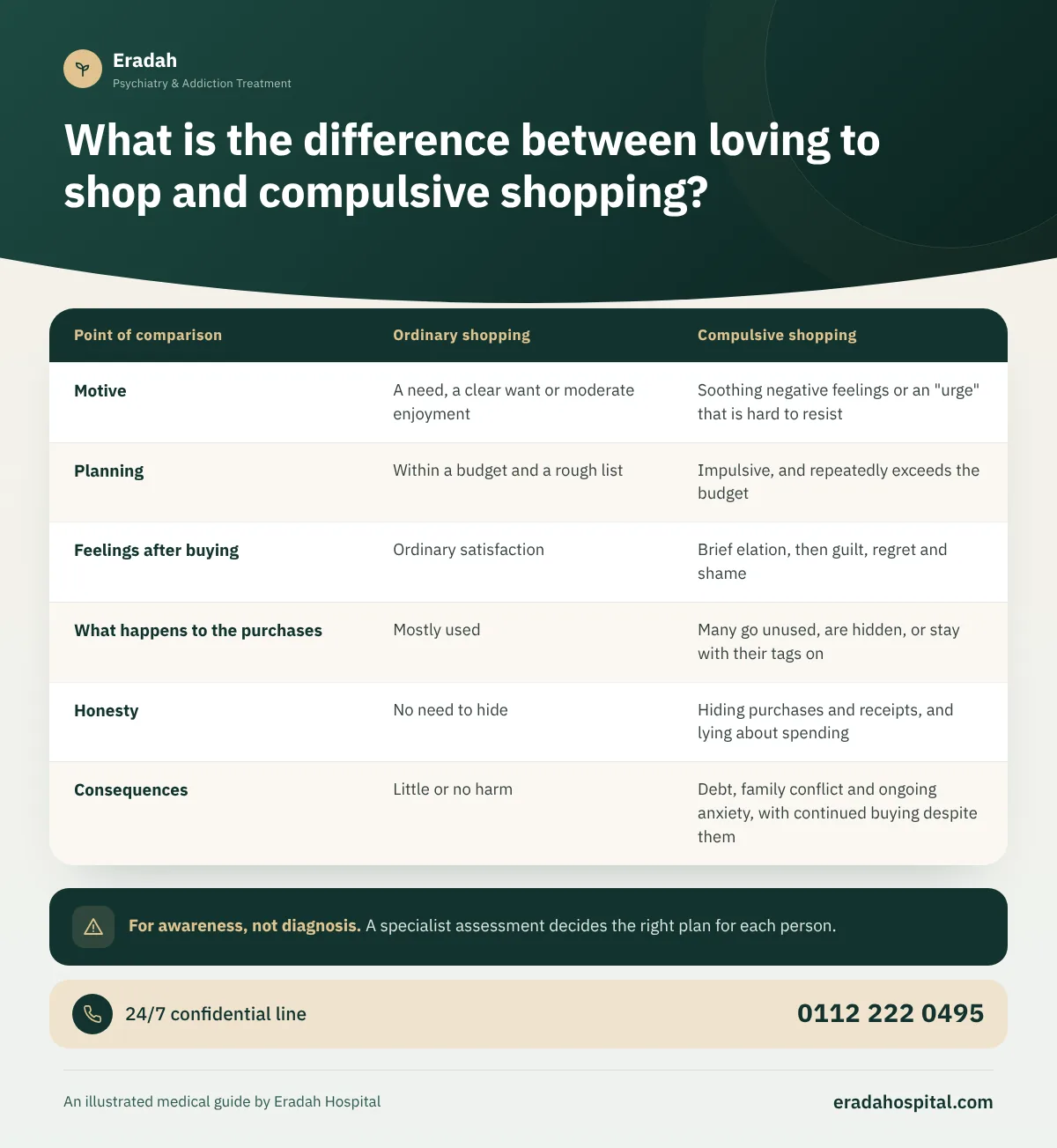
Loving to shop and enjoying sales is normal, and buying something nice after a hard day does not mean a disorder. The difference shows in control, motive and outcome:
| Point of comparison | Ordinary shopping | Compulsive shopping |
|---|---|---|
| Motive | A need, a clear want or moderate enjoyment | Soothing negative feelings or an "urge" that is hard to resist |
| Planning | Within a budget and a rough list | Impulsive, and repeatedly exceeds the budget |
| Feelings after buying | Ordinary satisfaction | Brief elation, then guilt, regret and shame |
| What happens to the purchases | Mostly used | Many go unused, are hidden, or stay with their tags on |
| Honesty | No need to hide | Hiding purchases and receipts, and lying about spending |
| Consequences | Little or no harm | Debt, family conflict and ongoing anxiety, with continued buying despite them |
Is compulsive shopping a recognized mental illness?
Its place in medical classifications is still debated, and the honest answer is as follows:
- The American DSM-5-TR: does not include it as a separate diagnosis so far.
- The International Classification of Diseases (ICD-11) from the World Health Organization: mentions compulsive buying-shopping disorder as an example within the category "other specified impulse control disorders" (code 6C7Y), meaning it is recognized as a clinical condition without having its own separate diagnosis with a dedicated code.
- The scientific debate: one group of researchers sees it as closer to behavioral addictions such as gambling disorder and calls for classifying it under "disorders due to addictive behaviors", while others see it as an impulse control disorder.
Whatever the label, the suffering is real, and a psychiatrist can assess and treat it, and often finds other conditions alongside it that need treatment, such as depression or anxiety.
Is compulsive shopping common?
Sources: the pooled analysis published in the journal Addiction in 2016, and the International Classification of Diseases (ICD-11). Estimates vary with the measures used, and no reliable published Egyptian figures are available so far.
The real figures are thought to be higher than those recorded, because many people do not see buying as a "medical" problem, because society praises and encourages shopping, and because shame prevents people from admitting debts.
Who is most at risk of compulsive shopping?
It often begins in late adolescence and the early twenties, with the first financial independence or the first payment card.
Compulsive shopping is often linked to these conditions, and buying is used as a way to soothe feelings.
When possessions become a way to improve one's image in one's own eyes and in others'.
Buying with one click, saved card details and personalized offers raise the risk.
It is commonly said to be "a women's problem", but it affects men too, though the nature of the purchases may differ.
Full details on the psychological and family factors and marketing methods are on the causes of compulsive shopping page.
What happens in the brain during a buying episode?
The person usually goes through a repeating cycle similar to addiction cycles: tension or negative feelings, then an urge and thoughts of buying, then buying and brief elation, then guilt and regret that bring the tension back again. The brain's reward circuit, and the dopamine system tied to anticipation and desire, play a role in cementing this cycle.
This is why many people describe the moment of searching and anticipation before buying as more enjoyable than owning the item itself, and the pleasure fades quickly once the order arrives. With repetition, the brain learns that buying is a "quick fix" for distress, so the urge grows stronger each time.
How does it differ from conditions that may resemble it?
| The situation | The key difference |
|---|---|
| A manic episode in bipolar disorder | Excessive spending comes in a specific period with excess energy, little sleep and general impulsivity, and needs a completely different treatment |
| Hoarding disorder | The core problem is difficulty discarding things and the accumulation of items, and it may occur together with compulsive buying |
| Gambling and betting addiction | The driver is the bet, the expectation of winning and chasing losses, not the experience of acquiring |
| Passing impulsive spending | Isolated occasions without repeated loss of control or ongoing harm |
That is why the psychiatrist asks about sleep, energy and mood during spending periods, because confusing compulsive shopping with a manic episode can lead to unsuitable treatment.
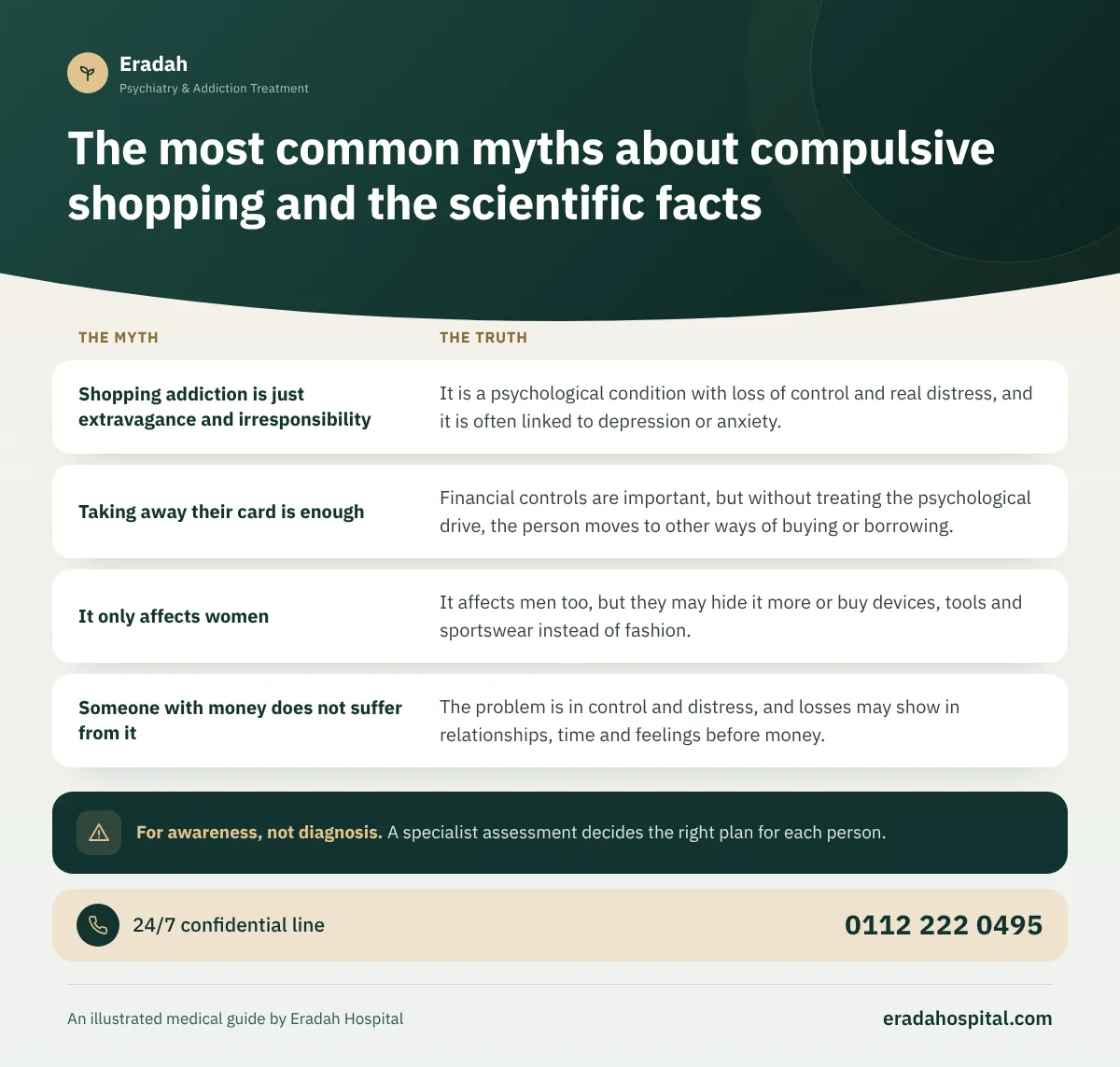
Common myths about shopping addiction and the facts
| The myth | The truth |
|---|---|
| Shopping addiction is just extravagance and irresponsibility | It is a psychological condition with loss of control and real distress, and it is often linked to depression or anxiety. |
| Taking away their card is enough | Financial controls are important, but without treating the psychological drive, the person moves to other ways of buying or borrowing. |
| It only affects women | It affects men too, but they may hide it more or buy devices, tools and sportswear instead of fashion. |
| Someone with money does not suffer from it | The problem is in control and distress, and losses may show in relationships, time and feelings before money. |
How can the family help someone with compulsive shopping?
Families usually discover the problem through debts, repeated parcels or hidden receipts, and the first reaction is anger and blame. This is understandable, but shame is one of the strongest drivers of compulsive shopping, and harsh blame can increase hiding. What helps more:
- Separate solving the urgent financial crisis from treating the behavior, and handle each calmly.
- Talk about the feelings behind the buying, not only the purchases.
- Agree on temporary financial controls that the person accepts, rather than imposing them in a humiliating way.
- Avoid paying off debts again and again without a treatment plan, because that may prolong the cycle.
- Encourage a specialist assessment, especially if sadness, anxiety or hopelessness appear.
Compulsive shopping guide: everything you need to know
We have gathered everything about compulsive shopping into 4 pages, each answering one question in detail. Choose what you are looking for:
Signs of compulsive shopping
Behavioral, psychological and financial signs, and how families notice them, with non-diagnostic self-assessment questions and how to start the conversation.
Causes of compulsive shopping
The role of emotions, depression, anxiety and self-esteem, marketing methods, online shopping and "buy now, pay later", and risk and protective factors.
Harms of compulsive shopping
Debt, legal problems, family conflict and the effect on mental health and children, and how complications can be avoided.
Treatment of compulsive shopping
Cognitive behavioral therapy, practical financial controls, treatment of co-occurring depression or anxiety, and when you need a specialist.
Debt crisis, hopelessness or suicidal thoughts? Get help now
- Talk of there being no way out of debt or of the family being "better off without him"
- A sudden collapse after debts or hidden purchases are exposed, with intense shame
- Withdrawing from people and not eating or sleeping for days
- Suddenly saying goodbye to family or putting affairs in order, or talking about death
- Increased use of alcohol, sedatives or other substances to bear the pressure
Stay with the person and listen without blaming them about money right now; debts can be dealt with later, but their life is the priority. Call an ambulance on 123 or take them to the nearest emergency room, or call the mental health support line 16328 (24 hours), and keep away from them medications and anything they could use to harm themselves.
Ambulance 123 Mental health support line 16328