Is social anxiety treatable?
Yes. Social anxiety is one of the mental health conditions with treatments proven by research, and most people who stick with them notice a real difference in their lives within months.
The British NICE guidelines recommend individual cognitive behavioral therapy as the first choice for adults, and place medication as an option for those who do not want psychological therapy or have not benefited enough from it, or as an addition to it. The doctor sets the plan after assessing the severity of the condition and any accompanying depression or substance use.
How does cognitive behavioral therapy work for social anxiety?
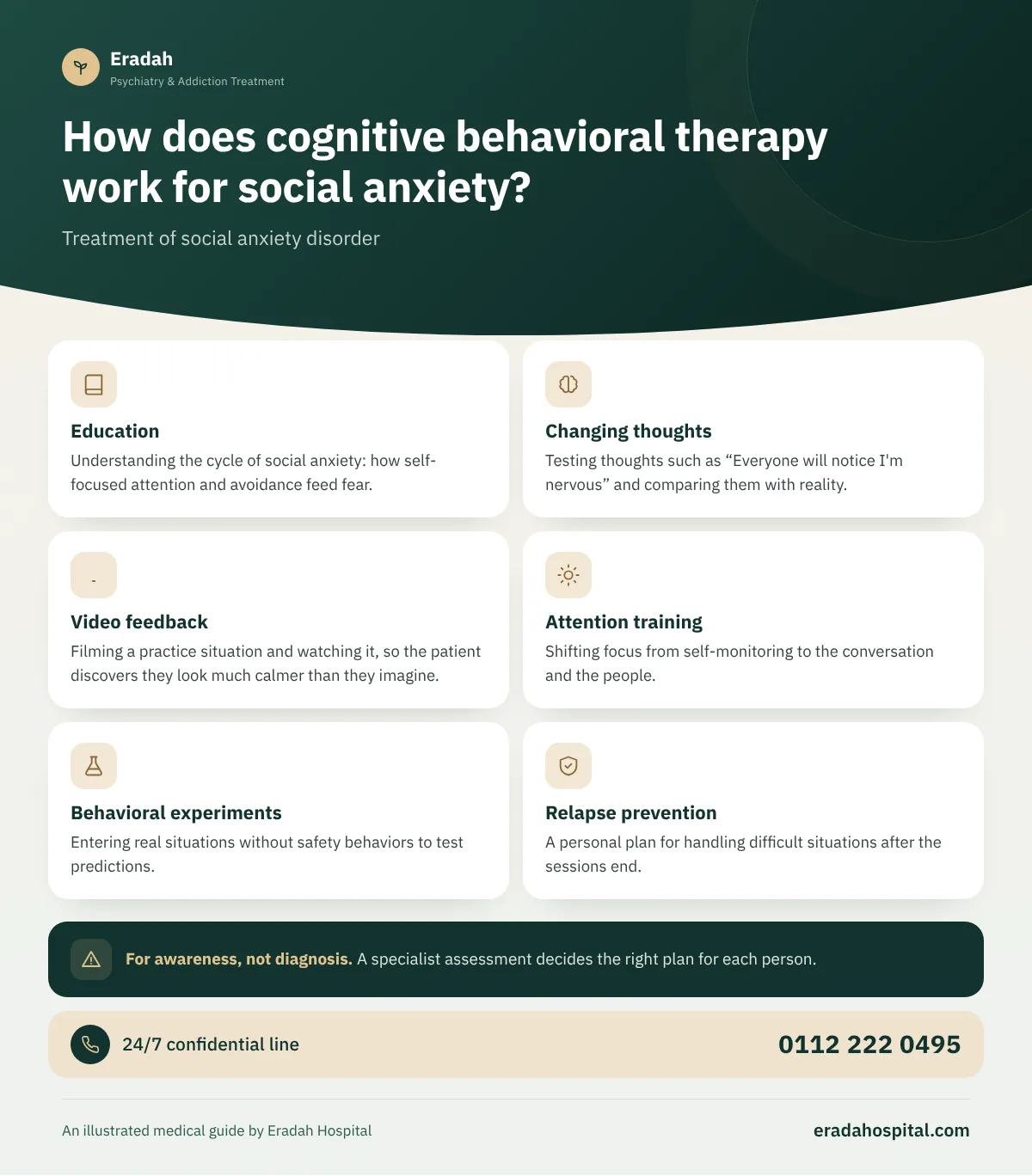
Cognitive behavioral therapy for social anxiety is a structured, time-limited program, different from “general talking”, and usually consists of weekly sessions over a few months. The two best-known established models are the Clark and Wells model and the Heimberg model, and their components include:
Understanding the cycle of social anxiety: how self-focused attention and avoidance feed fear.
Testing thoughts such as “Everyone will notice I'm nervous” and comparing them with reality.
Filming a practice situation and watching it, so the patient discovers they look much calmer than they imagine.
Shifting focus from self-monitoring to the conversation and the people.
Entering real situations without safety behaviors to test predictions.
A personal plan for handling difficult situations after the sessions end.
What is gradual exposure therapy and how is it applied?
Exposure is the heart of treatment: the patient faces the situations they fear step by step, and stays in them until their brain learns they are not dangerous. Together with the therapist, a “fear ladder” is built, starting with the easiest step:
| Level | The situation | Expected level of dread |
|---|---|---|
| 1 | Asking a security guard where a lecture hall is | Low |
| 2 | Answering a call from an unknown number | Low to moderate |
| 3 | Eating with two classmates in the college cafeteria | Moderate |
| 4 | Asking one question in a lecture | High |
| 5 | Giving a short presentation to a small group | Very high |
The patient is not asked to jump to the top of the ladder, nor forced into a situation they have not prepared for. Each step they get through becomes new evidence that weakens the fear, and this is what makes the effect of psychological therapy last longer than that of medication alone.
What other psychological therapies are helpful?
- Group therapy: small groups in which patients practice together. It is helpful, but the guidelines prefer individual therapy as a first choice.
- Social skills training: for those who need to learn skills such as starting a conversation or expressing an opinion.
- Acceptance and commitment therapy: helps people accept feelings of anxiety without letting them control behavior, and some therapists use it.
- Guided self-help: books and programs based on cognitive therapy under a specialist's supervision, for milder cases or as a starting point.
The British guidelines state that supportive therapy alone or mindfulness programs alone should not be relied on routinely to treat social anxiety, because they are less effective than specialized cognitive therapy.
What medicines are used to treat social anxiety?
The psychiatrist prescribes medicine according to each patient's condition. The main groups used are:
| Group | Examples | Role and notes |
|---|---|---|
| SSRI antidepressants | Escitalopram, sertraline | The first medication choice; their effect appears gradually over weeks |
| Alternatives from the SSRI and SNRI classes | Fluvoxamine, paroxetine, venlafaxine | When there is no response to the first choice or it is not tolerated |
| MAO inhibitors | Moclobemide, phenelzine | A later option under specialist supervision, and some require dietary and medication restrictions |
| Beta-blockers | Such as propranolol | May be used for performance anxiety only, to control shaking and palpitations; not suitable for some patients, such as those with asthma |
Why are sedatives not used as a main treatment for social anxiety?
The British guidelines state that benzodiazepines, anticonvulsants, antipsychotics or tricyclic antidepressants should not be used as routine treatment for social anxiety in adults. Sedatives give momentary relief but carry a risk of dependence, prevent the learning that happens during confrontation, and can become a bigger problem than the anxiety itself.
So if a patient has already started to depend on a sedative or alcohol, their doctor must be told openly, because the plan is different. Details are on the social anxiety and addiction page.
How long does social anxiety treatment take?
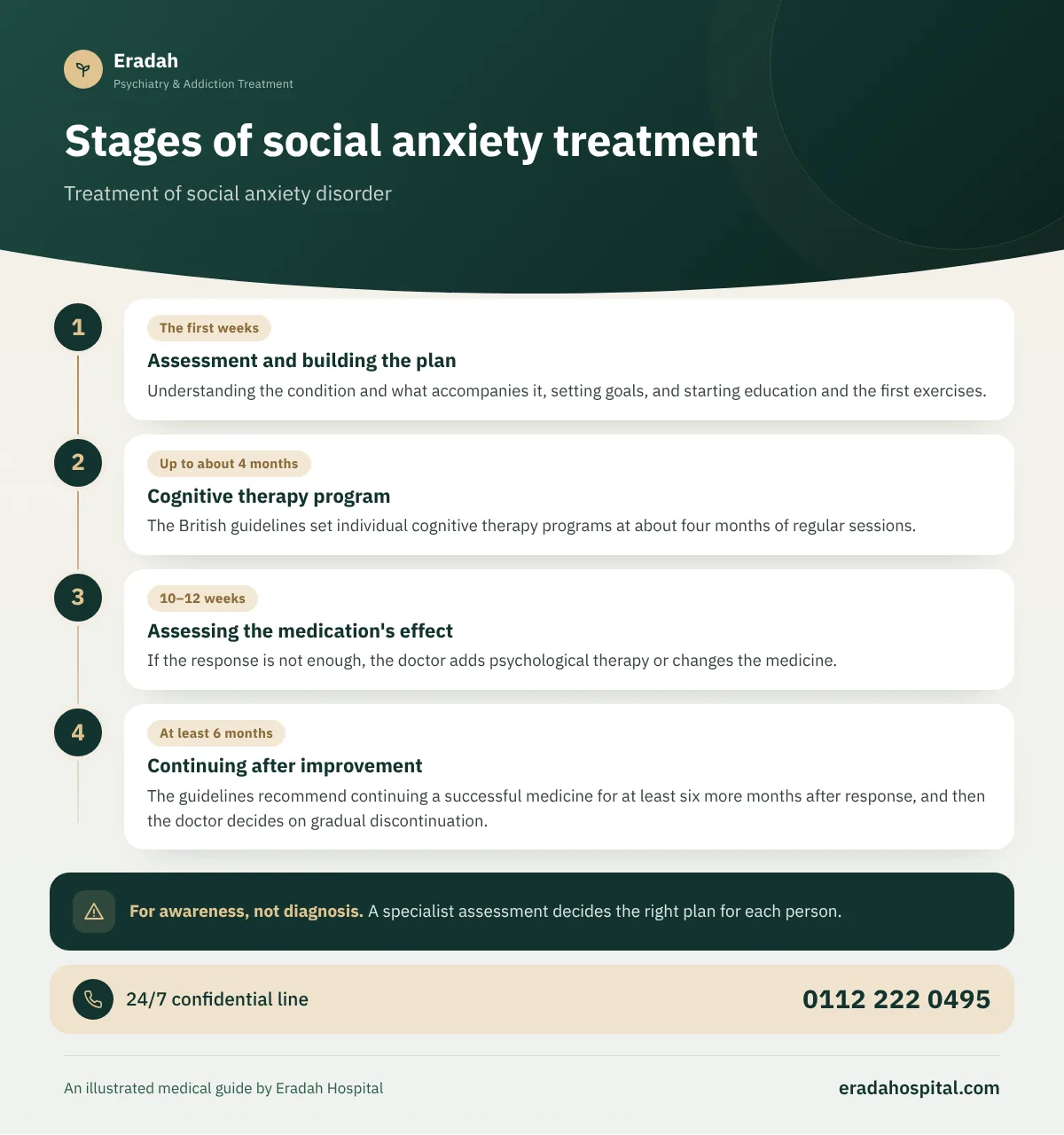
- The first weeksAssessment and building the plan
Understanding the condition and what accompanies it, setting goals, and starting education and the first exercises.
- Up to about 4 monthsCognitive therapy program
The British guidelines set individual cognitive therapy programs at about four months of regular sessions.
- 10–12 weeksAssessing the medication's effect
If the response is not enough, the doctor adds psychological therapy or changes the medicine.
- At least 6 monthsContinuing after improvement
The guidelines recommend continuing a successful medicine for at least six more months after response, and then the doctor decides on gradual discontinuation.
How is social anxiety treated in children and teenagers?
The foundation for young people is individual or group cognitive behavioral therapy suited to their age, with parents involved so they can help the child apply what they learn at home and at school. The British guidelines do not recommend routine use of medication for social anxiety at this stage, and the decision remains with the child psychiatrist in special cases.
A teenager in particular needs a therapist who respects their privacy and builds trust with them, and a family that works with the school to ease pressure without allowing complete avoidance.
What steps can help alongside treatment?
- Write down the situations that worry you and how anxious you feel in them, so you can notice improvement over time.
- Practice slow breathing before situations, without letting it become a way of escaping them.
- Break a big situation into small steps, and celebrate each step.
- While talking, focus on what the other person is saying, not on how you look and sound.
- Sleep well and cut back on stimulants such as coffee and energy drinks before difficult situations.
- Do not use alcohol or any substance to ease dread; it undoes what you are building in treatment.
How do you prevent social anxiety from coming back after improvement?
After treatment ends, practice remains the safeguard: keep entering situations instead of going back to avoidance, and notice early when old safety behaviors return. It is normal for some dread to come back during periods of stress or after a big change such as a new job. That is a signal to apply what you learned or to book a few short follow-up sessions, and it does not mean relapse.
How can the family help in treating social anxiety?
- Encourage them to keep up with sessions and exercises, and do not mock the training or rush results.
- Gradually stop doing social tasks on their behalf, by agreement with them and the therapist.
- Praise the courage of trying, even if the performance is not perfect.
- Do not make medication a subject of blame or stigma; it is a treatment like any other.
Choosing a hospital for social anxiety treatment
The irony of social anxiety is that seeking treatment is itself a frightening social situation: a phone call, a reception desk, a waiting room. So the most suitable place is one that lowers this first threshold, and then does not stop at calming the fear but trains the patient to face it. The hidden danger is being given a sedative that gives relief for weeks and then turns into a dependence that is hard to undo.
- It offers cognitive behavioral therapy designed for social anxiety, with real behavioral experiments outside the therapy room.
- It helps the patient see the safety behaviors they hide behind, and to drop them gradually.
- It does not make sedatives a main treatment, and asks openly about alcohol or pills used before situations.
- It offers group sessions for those who can manage them, since they are practice in their own right.
- It treats a teenager with privacy and works with their family without encouraging avoidance or forcing a harsh confrontation.
At Eradah, psychologists lead individual and group sessions, the doctor sets a medication plan when the patient needs one, and dependence on alcohol or sedatives, if it appears, is treated within the dual diagnosis program. If you fear that things have gone beyond anxiety into substance use, read about social anxiety and addiction.
Social anxiety treatment at Eradah
At Eradah, treatment begins with a comprehensive psychological assessment that determines the severity of the social anxiety and any accompanying depression or substance dependence. The psychiatrist and therapist then set a plan combining cognitive behavioral therapy, gradual exposure and medication when needed, with the family involved. All of this is done in complete confidentiality, and you can start with a first consultation by phone if attending is hard for you at the beginning.