What is kleptomania?
“I have money to buy what I want, but suddenly I feel I have to take it, and then I go home ashamed of myself.” This sentence sums up the struggle of many people with kleptomania: a real inner conflict they hide for years for fear of scandal, with no desire for money and no leaning toward crime.
Kleptomania is a disorder that psychiatry classifies among the impulse-control disorders, that is, conditions in which a person cannot resist a strong inner urge even though they know the act is wrong and harmful. Cleveland Clinic describes it as a medical condition that comes not from weak willpower or a flaw in morals, but from a problem in the brain's ability to restrain impulses.
It is an uncommon disorder: Cleveland Clinic estimates that it affects between 0.3% and 0.6% of the population, and that women are affected about three times as often as men.
Symptoms of kleptomania
- Repeated failure to resist the urge to steal items the person does not need for use or for their monetary value.
- Rising tension or anticipation just before stealing.
- Relief, pleasure or a “rush” at the moment of stealing.
- Guilt, shame or remorse once the moment has passed.
- Getting rid of the stolen items, giving them away, secretly returning them, or paying for them later.
- The theft usually happens spontaneously, without planning or accomplices.
- The theft is not driven by anger or revenge, and does not occur during psychosis or a manic episode.
Kleptomania or ordinary theft?
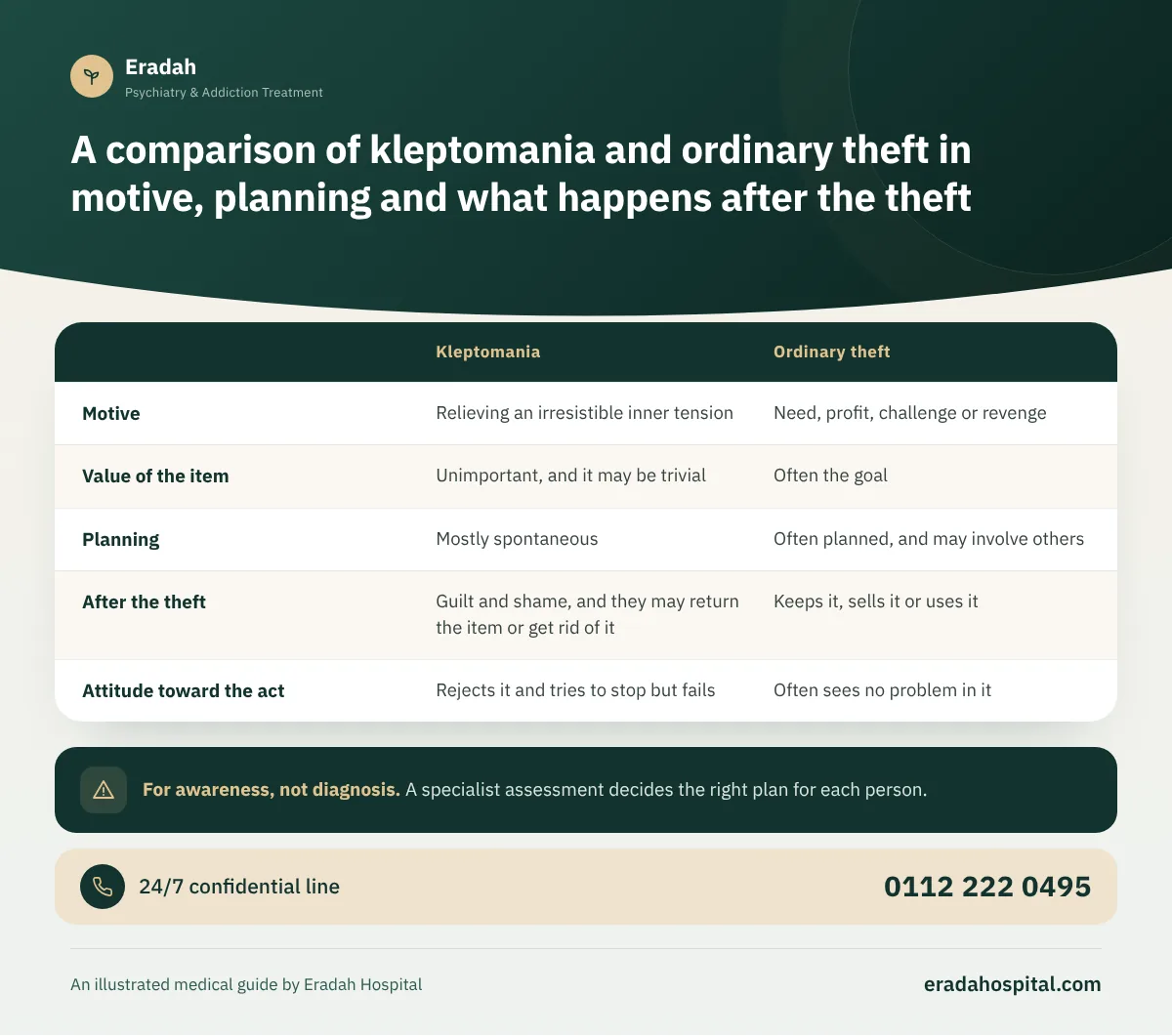
The most important question for families and those around them: is this an illness or a deviation? The difference lies in the motive for the act and what comes after it, not in the act itself. Cleveland Clinic notes that people with kleptomania make up no more than 4% to 5% of those arrested for shoplifting.
| Kleptomania | Ordinary theft | |
|---|---|---|
| Motive | Relieving an irresistible inner tension | Need, profit, challenge or revenge |
| Value of the item | Unimportant, and it may be trivial | Often the goal |
| Planning | Mostly spontaneous | Often planned, and may involve others |
| After the theft | Guilt and shame, and they may return the item or get rid of it | Keeps it, sells it or uses it |
| Attitude toward the act | Rejects it and tries to stop but fails | Often sees no problem in it |
Causes of kleptomania
The exact cause is unknown, but research points to several overlapping factors:
Differences in the brain regions responsible for restraining impulses and making decisions.
Differences in neurotransmitters, and rare cases have appeared after starting medications that affect them.
The quick relief after stealing teaches the brain to repeat it whenever tension rises.
Episodes often increase with stress, sadness or loneliness.
Anxiety, mood disorders and addiction are common in the families of people with it, with no conclusive evidence that it is hereditary.
Kleptomania is often linked to other disorders, such as depression, anxiety, obsessive-compulsive disorder and eating disorders, as well as substance use and various addictions, according to Cleveland Clinic. A study of 95 people seeking treatment, published in 2008, found that affected women were more likely to have eating disorders and to hoard stolen items, while men began stealing at a younger age.
Is kleptomania a legal excuse?
This is one of the most sensitive points. A person with the condition knows that stealing is wrong, so the diagnosis does not automatically exempt them from responsibility, and assessing that is up to the investigating authorities, the courts and specialist experts in each case. But the diagnosis changes something important: it explains the repetition, and shows that the real solution is treatment that prevents a return, not mere punishment. We provide general medical information here, not legal advice.
Treatment of kleptomania
There is no single standard treatment and research is limited, but there are options, and the doctor decides which suits each case:
- Cognitive behavioral therapy: helps in understanding the triggers of the urge, learning to deal with tension without stealing, and making practical plans for risky situations.
- Exposure and imagery techniques: the person practices facing the urge and imagining its consequences until its power weakens.
- Medication: in a double-blind trial in 2009 on 25 adults, the drug naltrexone reduced the urge to steal and the number of thefts compared with placebo. The doctor decides the medication and dose, and you should not start or stop any medication without a doctor.
- Treating accompanying disorders: such as depression and anxiety, and any alcohol or drug use as part of a dual diagnosis plan.
Treatment is usually delivered through outpatient treatment with regular sessions, along with practical helping steps, such as shopping with a trusted person, carrying a specific list, and avoiding crowded stores at times of stress.
If you discover that someone you love has kleptomania
- Remember that their confiding in you is a sign of trust; listen without mockery or threats.
- Separate rejecting the act from respecting the person.
- Help them book a confidential psychological assessment, and go with them if they want.
- Do not cover up the thefts and do not punish them on your own; make the solution a therapeutic one.
- Watch for signs of depression or hopelessness, and seek help immediately if they talk about harming themselves.
When should you ask for help?
If the stealing keeps recurring despite attempts to stop, or the urge occupies your thoughts, or it affects your work or relationships, it is time for an assessment. If thoughts of self-harm appear because of shame or fear, call the mental health support line 16328 or read the page on suicidal thoughts, and in immediate danger call an ambulance (123).
Shame that reaches despair? Get help now
- Talking about death or that the scandal cannot be endured
- Severe hopelessness after being arrested or the theft being discovered
- Complete withdrawal from family and work for fear of being judged
- Increased alcohol or drug use to bear the guilt
- Talking about self-harm
Their confiding in you is a sign of trust, so do not threaten or mock them, and do not leave them alone if they talk about death. Ask calmly and listen without blame. Call an ambulance on 123 or take them to the nearest emergency room, or call the mental health support line 16328 (24 hours), and keep medication and anything they could use to harm themselves out of their reach.
Ambulance 123 Mental health support line 16328