Why have we grouped these disorders into one family?
Medically, ADHD belongs to the neurodevelopmental disorders, while insomnia is classified among the sleep-wake disorders. But in addiction treatment clinics the two meet often, which is why we gave them their own family in the mental health guide.
The common thread is that each of these disorders causes an exhausting daily struggle, and the person looks for any quick way to ease it: a young person who is distracted and impulsive may find temporary calm in hashish or temporary focus in stimulants, and someone with insomnia may find quick sleep in alcohol or sedatives. In both cases the story begins with an attempt at “self-medication” and sometimes ends in a dependence that doubles the original problem.
This group also includes eating disorders, such as anorexia nervosa, bulimia nervosa and binge-eating disorder. These are serious disorders that affect body and mind together and may overlap with substance use, but they are treatable, and the earlier treatment starts the better.
The relationship runs in both directions: the disorder can lead to substance use, and substance use and withdrawal make insomnia and inattention worse, so the cycle goes round. Breaking this cycle is the essence of what we call dual diagnosis.
ADHD in this family
The US National Institutes of Health define it as a neurodevelopmental disorder marked by three features: inattention, such as difficulty concentrating and organizing; hyperactivity, such as fidgeting and talking a lot; and impulsivity, such as interrupting and difficulty waiting. Symptoms begin in childhood and usually continue into adolescence and adulthood.
Many adults were never diagnosed as children, so they spent years being called lazy, careless or “badly brought up,” while they actually had a real, treatable disorder. You will find the details in the guide to ADHD.
Full details are in the ADHD guide.
Chronic insomnia in this family
Everyone has difficult nights, especially under stress, and this is “acute insomnia,” which usually goes away when its cause does. Chronic insomnia, however, is defined by the US National Heart, Lung, and Blood Institute as difficulty sleeping that occurs three or more nights a week, lasts more than three months, and is not fully explained by another illness.
Chronic insomnia is more than “not sleeping enough”; it affects memory, concentration and mood, and is linked to a higher risk of high blood pressure, heart disease and diabetes. You will find the details in the guide to chronic insomnia.
Full details are in the chronic insomnia guide.
Types of other common disorders
Each disorder in this family has a full guide and its own pages. Here is a brief card for each:
Also known as: ADHD
A developmental disorder that begins in childhood and continues into adulthood for many people. It increases the risk of addiction if left untreated.
- Category
- Neurodevelopmental disorders
- How common
- One of the most common developmental disorders in children
- Typical onset
- Childhood; symptoms appear before age 12
- Link to addiction
Strong
When to seek help: if distractibility and impulsivity keep affecting school, work or relationships.
Chronic insomnia
InsomniaAlso known as: sleep disorder
Persistent difficulty falling or staying asleep for three months or more, and a common route into the misuse of sleeping pills.
- Category
- Sleep disorders
- How common
- Very common, and increasing with age
- Typical onset
- At any age, often after a period of stress
- Link to addiction
Strong
When to seek help: if trouble sleeping continues three nights a week for three months, or you have come to depend on a sleeping pill without a doctor.
Eating disorders
Eating disordersAlso known as: anorexia nervosa, bulimia nervosa
Serious disturbances in a person's relationship with food and body image, including anorexia nervosa, bulimia nervosa and binge eating episodes.
- Category
- Feeding and eating disorders
- How common
- About 18 million people worldwide (2023)
- Typical onset
- Usually adolescence and early adulthood, and may begin in childhood
- Link to addiction
Strong
When to seek help: if food, weight or body shape dominates your thoughts and life, and immediately if there is fainting, palpitations or thoughts about death.
Autism
Autism Spectrum Disorder (ASD)Also known as: autism spectrum disorder
A difference in brain development that affects communication, behavior and the senses. Early support makes a big difference.
- Category
- Neurodevelopmental disorder
- How common
- About 1 in 127 people worldwide
- Typical onset
- Usually in the first two years
- Link to addiction
Moderate
When to seek help: if a child loses skills they had gained, or has seizures or self-harm, or if a teenager or adult has thoughts about death.
Tourette syndrome
Tourette syndromeAlso known as: Tourette's disorder
Motor and vocal tics that begin in childhood, peak around age ten and often ease in adolescence.
- Category
- Neurodevelopmental disorder (tics)
- How common
- 3 to 9 per 1,000 children
- Typical onset
- Between 4 and 6 years
- Link to addiction
Weak
When to seek help: if tics interfere with school or cause pain, or are accompanied by anxiety, depression or substance use.
Hysteria
Functional neurological disorder (conversion disorder)Also known as: conversion disorder
Real neurological symptoms such as paralysis and seizures without structural damage, caused by a problem in the way the nervous system functions.
- Category
- Functional neurological disorder
- How common
- Among the most common conditions seen in neurology clinics
- Typical onset
- Late childhood to early adulthood
- Link to addiction
Weak
When to seek help: if weakness or a seizure appears for the first time, if symptoms interfere with life, or if depression accompanies them.
Depersonalization
Depersonalization-derealization disorderAlso known as: derealization
A persistent feeling of detachment from oneself or the world, with intact awareness that it is not real. It improves with treatment.
- Category
- Dissociative disorder
- How common
- About 1 to 2% as an ongoing disorder
- Typical onset
- Average age of onset 16
- Link to addiction
Moderate
When to seek help: if the feeling lasts for weeks or disrupts your life, began after substance use, or comes with depression.
Kleptomania
KleptomaniaAlso known as: compulsive stealing
An irresistible urge to steal things the person does not need, followed by guilt and shame. The motive is neither need nor profit.
- Category
- Impulse-control disorders
- How common
- Between 0.3% and 0.6% of people
- Typical onset
- Usually adolescence or early adulthood
- Link to addiction
Strong
When to seek help: if stealing keeps happening despite attempts to stop, and immediately if there are any thoughts of harming yourself.
Dissociative identity disorder
Dissociative Identity DisorderAlso known as: multiple personality disorder
Two or more distinct identities with gaps in memory, strongly linked to severe, repeated trauma in childhood.
- Category
- Dissociative disorders
- How common
- About 1.5% in one small study
- Typical onset
- Childhood; diagnosis is often delayed
- Link to addiction
Moderate
When to seek help: if memory gaps or “lost time” keep recurring, and immediately if there is any self-harm.
Psychosomatic disorders
Psychosomatic DisordersAlso known as: psychosomatic illnesses
Real physical symptoms and illnesses in which psychological stress plays a major part in their onset or worsening, such as irritable bowel syndrome.
- Category
- Interaction of mind and body
- How common
- Common, and not counted as a single category
- Typical onset
- Any age, increasing with stress
- Link to addiction
Moderate
When to seek help: if symptoms recur with stress and tests do not explain them, after physical causes have been ruled out first.
What is the difference between ADHD and chronic insomnia?
| Point of comparison | ADHD (attention-deficit/hyperactivity disorder) | Chronic insomnia |
|---|---|---|
| Medical classification | Neurodevelopmental disorder | A sleep-wake disorder |
| Typical onset | In childhood, and may be discovered late | At any age, and increases with stress and advancing age |
| Core of the problem | Concentration, organization and impulse control | Difficulty falling asleep or staying asleep |
| Most commonly misused substances | Hashish, stimulants and nicotine | Alcohol, sedatives and sleeping pills |
| First-line treatment | Behavioral therapy and school or work support, and medication determined by the doctor | Cognitive behavioral therapy for insomnia and regulating sleep habits |
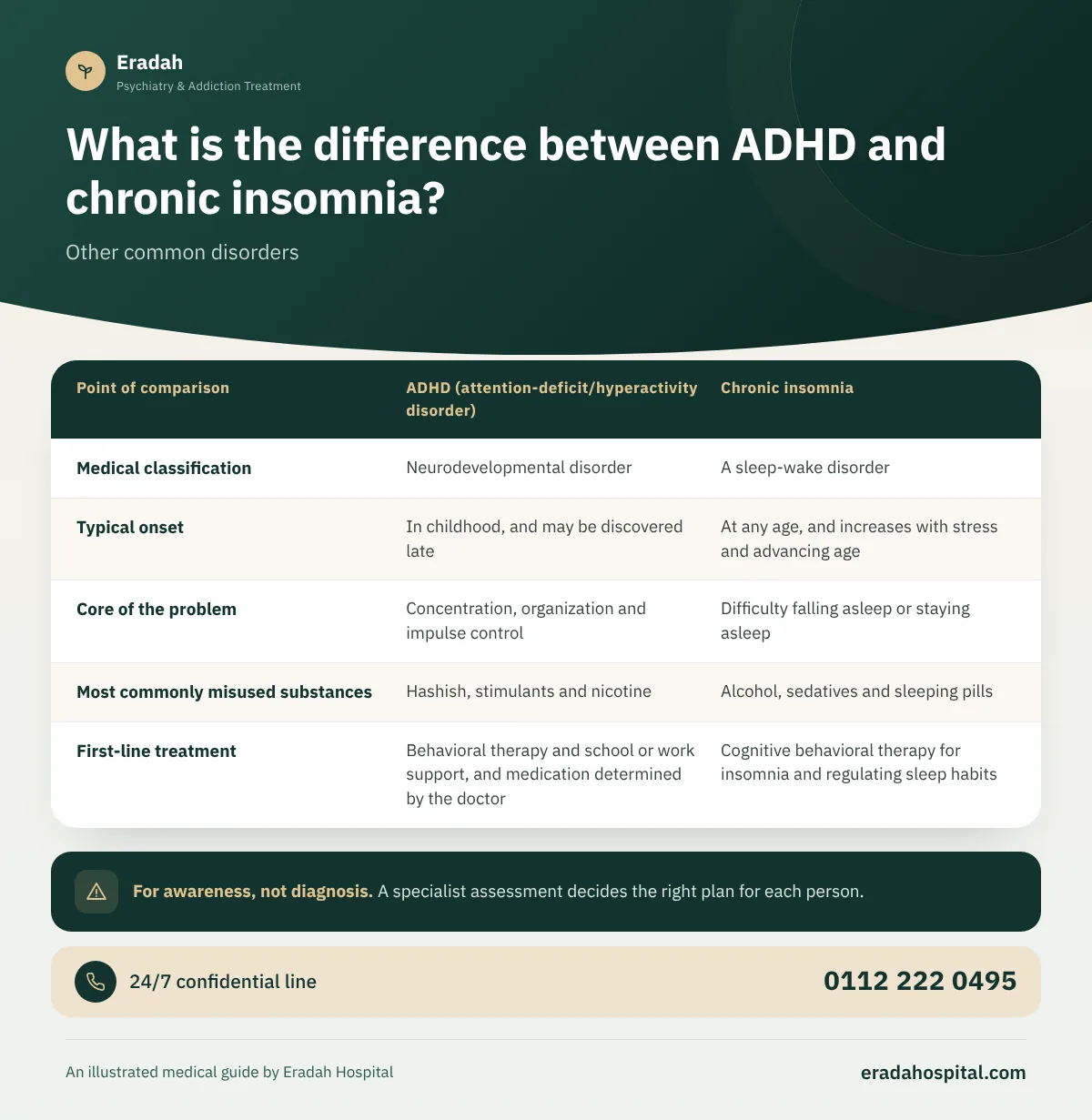
The two disorders sometimes overlap: many people with ADHD complain of sleep problems, and chronic lack of sleep alone can cause distraction and irritability that resemble ADHD symptoms. That is why the doctor always asks about sleep before judging attention.
How does each lead to addiction?
The US National Institute on Drug Abuse notes that many studies have documented a higher risk of substance use disorders in young people with ADHD who are untreated. Impulsivity, thrill-seeking and difficulty tolerating boredom make the first experience easier, and repeated school failure weakens self-confidence and adds stress.
Some young people misuse Ritalin or other stimulants without a prescription to concentrate or stay up late, or turn to hashish to “calm down.” With insomnia, the usual route is alcohol before bed, or sedatives such as Xanax and Rivotril, or pregabalin without medical follow-up.
- The startA real problem
Insomnia or distraction that wears the person out and affects their day.
- The quick fixA substance or medication without follow-up
Temporary relief that makes the brain associate relief with the substance.
- TolerabilityThe effect fades
The person needs more to get the same result.
- The reboundSymptoms return worse
Trying to stop causes worse insomnia, anxiety and distraction, so the person goes back to the substance.
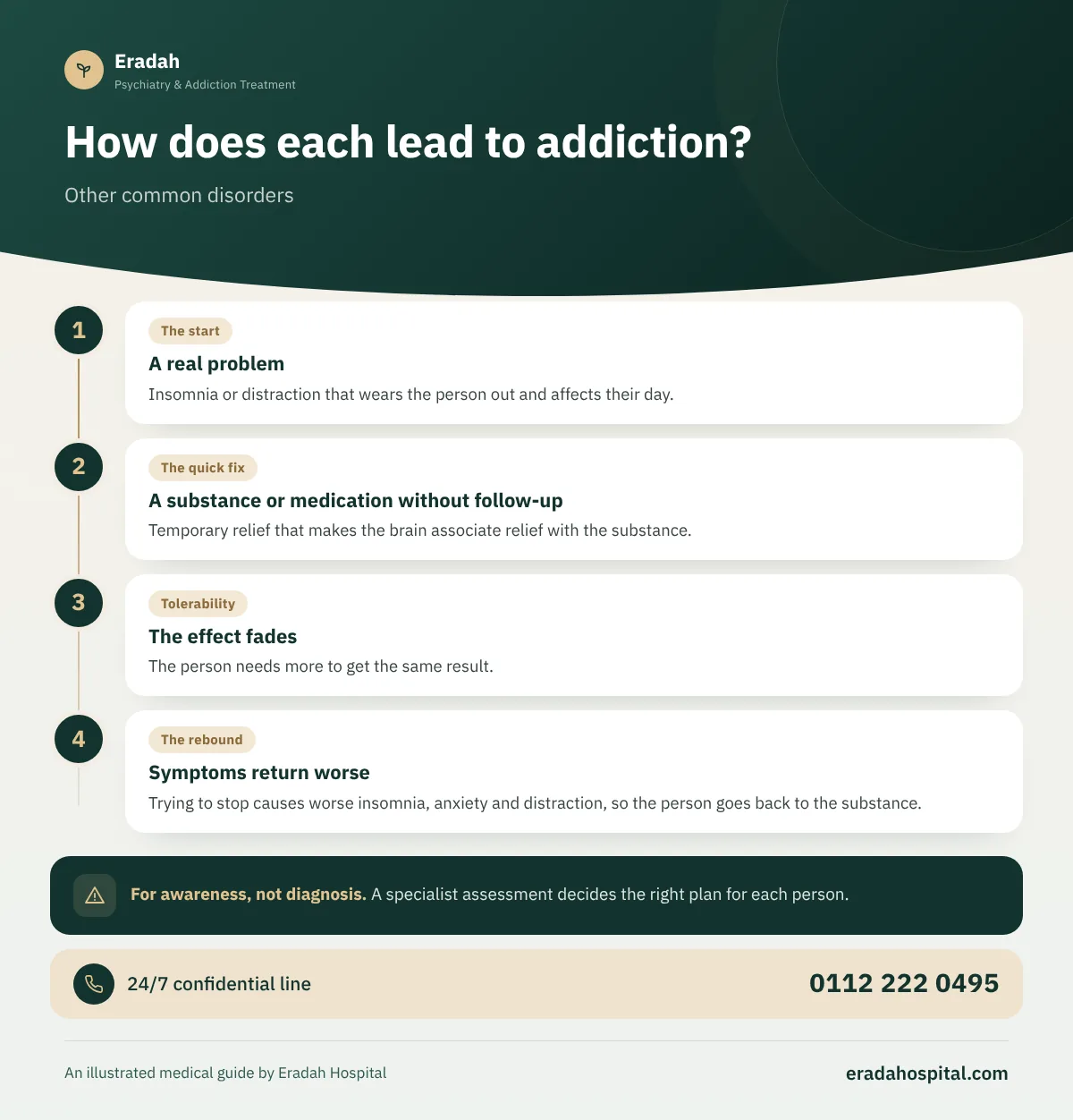
That is why we have given each disorder a page on its relationship with addiction: ADHD and addiction and chronic insomnia and addiction.
Are ADHD medications and sleeping pills “drugs”?
This question worries many families. Some ADHD medications, such as methylphenidates, are controlled drugs dispensed by prescription, as are many sleeping pills and sedatives. Using them under the supervision of a doctor who follows the case is completely different from taking them without a prescription, in larger amounts than prescribed, or for non-therapeutic purposes.
Can they be treated without relying on addictive substances?
Yes. For chronic insomnia, the American College of Physicians recommends cognitive behavioral therapy for insomnia as the first step for adults. It is a structured program that resets sleep habits and the anxious thoughts tied to sleep, with medication coming afterward when needed and for periods the doctor determines. For ADHD, treatment combines behavioral interventions, parent training and school support, and stimulant or non-stimulant medication chosen by the doctor according to the case and the history of substance use.
At Eradah we pay particular attention to people who have one of these disorders together with substance use, and we make one integrated plan that treats the addiction and the underlying disorder together. Details are in ADHD treatment and chronic insomnia treatment.
How can the family help their son or partner?
Families often treat ADHD as “naughtiness” or “carelessness,” and insomnia as “being spoiled” or “staying up by choice,” so they resort to blame and punishment. The result is usually more tension, and the person looking for a secret solution away from the family, which may be a substance or a medication taken from a friend.
- Treat the symptoms as a health problem that deserves assessment, not as a flaw in character.
- Help build a steady routine for sleep, waking, studying or work, with fewer screens at night.
- Keep an eye on medications in the home, and do not share your medication with anyone, however harmless it seems.
- Praise effort and small progress; repeated frustration is a main fuel for substance use.
- If you notice substance use or dependence on a sleeping pill, ask for an assessment that treats both together instead of focusing on only one.
When should you seek help from a psychiatrist?
- If trouble sleeping lasts for many weeks and begins to affect your work or mood.
- If you can no longer sleep without alcohol, a sedative or a sleeping pill taken without medical follow-up.
- If teachers or family notice persistent distraction and impulsivity in the child at home and at school alike.
- If you are an adult who has struggled since childhood with disorganization, forgetfulness, impulsivity and repeated unfinished starts.
- If any substance use appears, or use of other people’s medications to concentrate or sleep.
This list is for awareness and is not a diagnosis; an accurate diagnosis needs a specialist assessment.
Suicidal thoughts or danger to self? Get help now
- Talk of wanting to die or of being a burden on others
- Severe hopelessness after months of insomnia and exhaustion
- Saying goodbye to loved ones or giving away important belongings
- Mixing sleeping pills or sedatives with alcohol or other substances
- Severe drowsiness, difficulty rousing the person, or slow breathing after taking sleeping pills
- Agitation, severe suspicion, or not sleeping for days after using stimulants
Stay with the person and listen without blame, and keep medications and dangerous objects out of their reach in general. Call an ambulance (123) or go to the nearest emergency room, and you can call the mental health support line 16328, available around the clock. With severe drowsiness or slow breathing, place the person on their side until the ambulance arrives.
Ambulance 123 Mental health support line 16328