What are eating disorders?
Eating disorders are a group of mental illnesses in which food, and the thoughts about the body, weight and control that go with it, become the center of a person’s life and a source of suffering. From the outside it may look like an “eating problem,” but it is really a disturbance of feelings and thoughts that expresses itself through food.
The World Health Organization’s International Classification of Diseases (ICD-11) classifies them as feeding and eating disorders and defines them as abnormal eating or feeding behaviors that are not explained by another illness, do not suit the stage of development, and are not an accepted cultural practice. It distinguishes “eating disorders,” which are usually accompanied by preoccupation with weight and body shape, from “feeding disorders,” in which weight or shape is not the focus.
This group includes several diagnoses: anorexia nervosa, bulimia nervosa, binge eating disorder and avoidant/restrictive food intake disorder (ARFID), along with presentations that do not meet the criteria for a particular type but are no less serious. The differences between them are explained in detail on the page Types of eating disorders.
How common are eating disorders?
In the American surveys reported by the National Institute of Mental Health (NIMH), binge eating disorder was the most common among adults, followed by bulimia and then anorexia. These disorders usually begin in adolescence and early adulthood, although children, middle-aged people and older adults are not immune.
The real numbers are probably higher than those recorded; many people hide their struggle for years out of shame or denial. We do not have reliable published figures for Egypt, but psychiatrists observe that these disorders are not a “Western problem,” as is often claimed.
Who gets eating disorders?
The common picture of a very thin teenage girl is incomplete and misleading. According to NIMH, eating disorders affect all ages, backgrounds, body sizes and genders, and a person may look healthy while being seriously ill.
Eating disorders affect them too, but they are less likely to seek help and less likely to be diagnosed, and the disorder may hide behind an exaggerated focus on muscles or sport.
They may show different presentations such as extreme picky eating or fear of choking, which are features of avoidant/restrictive food intake disorder.
Many people with eating disorders have a weight in the usual range or above it, yet have a serious disorder that needs treatment.
The disorder may begin late, or return after years of improvement under heavy stress or life changes.
What do eating disorders feel like from the inside?
“I thought I was controlling my eating, then I discovered that eating was controlling everything: my day, my mood, my relationships, even my thoughts before sleep.” A phrase often heard from people in recovery, not a quote from a particular patient.
Many patients describe a relentless inner critic that ties a person’s worth to what they eat or to the shape of their body. At first the disorder may give a false sense of control, achievement or numbness from painful feelings, then gradually it becomes a prison that narrows every day.
That is why it is not enough to tell the patient “just eat” or “stop eating so much.” The problem lies in a cycle of anxiety, shame, control and loss of control, not in a lack of information about food, and that cycle needs understanding and specialized help.
What happens in the brain with eating disorders?
Research indicates that eating disorders are linked to differences in the brain circuits responsible for reward, anxiety, decision-making and sensing the body’s signals such as hunger and fullness. Large genetic studies have shown that anorexia nervosa has both psychiatric and metabolic roots, meaning it is a condition with a biological basis and not a “decision” the patient makes.
Importantly, malnutrition itself changes brain function: it increases rigid thinking, anxiety and preoccupation with food, which feeds the disorder. This is one reason early intervention matters, and why restoring regular nutrition is a core part of psychological recovery, not only physical recovery. The details are on the page Causes of eating disorders.
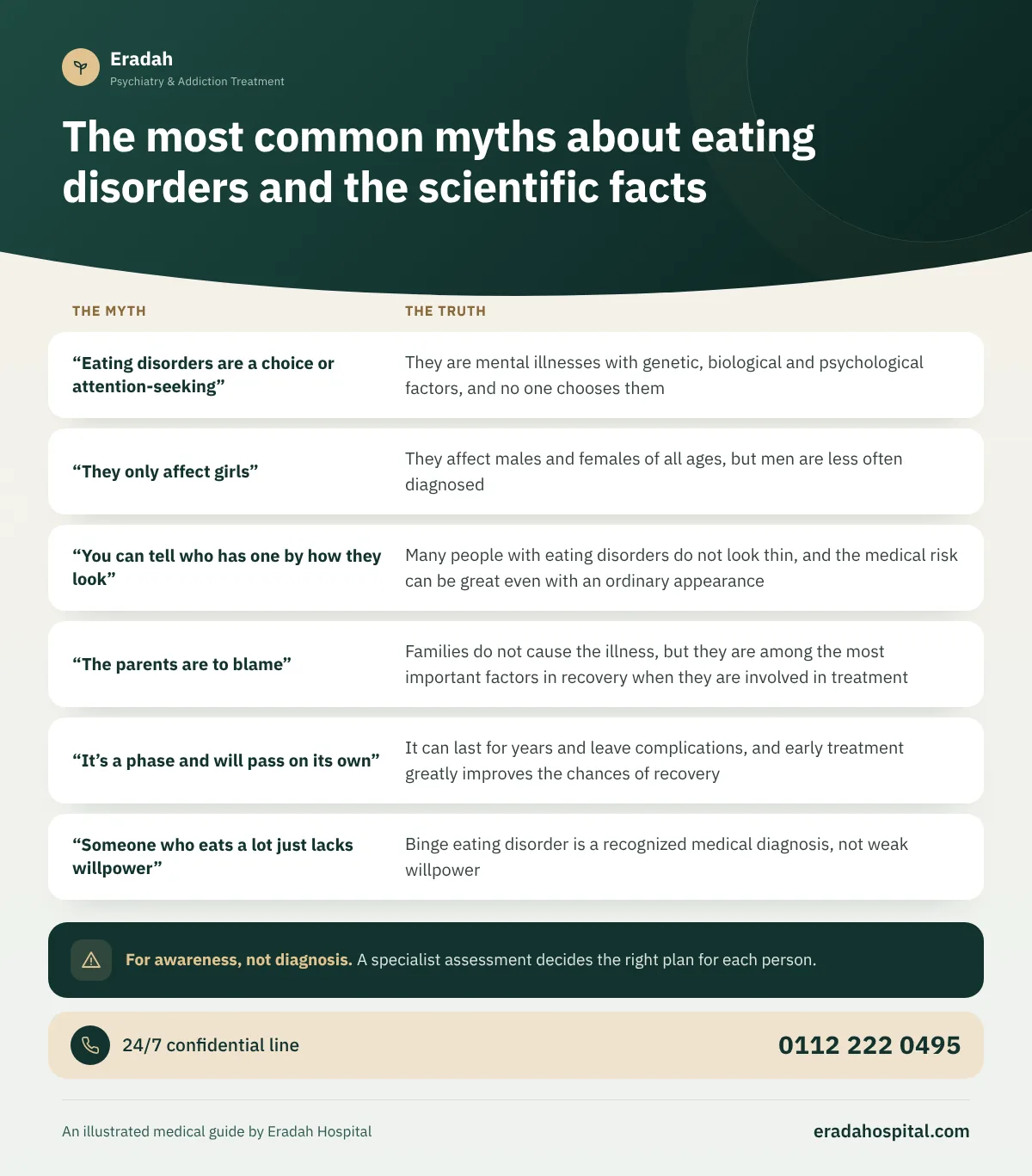
Common myths about eating disorders, and the facts
| The myth | The truth |
|---|---|
| “Eating disorders are a choice or attention-seeking” | They are mental illnesses with genetic, biological and psychological factors, and no one chooses them |
| “They only affect girls” | They affect males and females of all ages, but men are less often diagnosed |
| “You can tell who has one by how they look” | Many people with eating disorders do not look thin, and the medical risk can be great even with an ordinary appearance |
| “The parents are to blame” | Families do not cause the illness, but they are among the most important factors in recovery when they are involved in treatment |
| “It’s a phase and will pass on its own” | It can last for years and leave complications, and early treatment greatly improves the chances of recovery |
| “Someone who eats a lot just lacks willpower” | Binge eating disorder is a recognized medical diagnosis, not weak willpower |
What is the difference between eating disorders, dieting and emotional eating?
| The situation | What sets it apart | How it differs from an eating disorder |
|---|---|---|
| Dieting or caring about health | A temporary or flexible change in eating pattern | It does not dominate thinking, does not bring panic when broken, and does not disrupt life |
| Occasional emotional eating | Eating at times out of stress or boredom | It does not reach repeated episodes with loss of control and severe distress; see the page Food addiction and emotional eating |
| Picky eating in children | Refusing some foods at a stage of development | It does not clearly affect growth, nutrition or daily life |
| Loss of appetite due to depression or physical illness | Reduced appetite as a symptom of another condition | It is usually not accompanied by fear of eating or preoccupation with body shape, and it improves when the cause is treated |
An eating disorder can also occur together with other conditions such as depression, anxiety and obsessive-compulsive disorder (OCD), which is why telling them apart accurately needs a specialist assessment, not an online test.
When do you need to see a psychiatrist?
Do not wait for the condition to become “severe” or for the weight to change noticeably. In eating disorders, early intervention is one of the strongest factors in recovery. Ask for an assessment if you notice the following in yourself or someone you love:
- Food, weight or body shape takes up a large part of thinking every day.
- Intense anxiety or guilt after eating, or avoiding eating in front of others.
- Repeated episodes of eating with a feeling of loss of control, followed by shame.
- Increasing restriction of types or amounts of food that affects health or social life.
- Health changes such as dizziness, exhaustion or disrupted periods.
- Persistent sadness, despair or thoughts of death alongside all of this.
You can start directly with a psychiatrist, or with a family doctor who checks the physical condition and then refers you to a specialist team. The signs are covered in detail on the page Symptoms of eating disorders.
Can you recover from eating disorders?
Yes. The UK’s National Health Service (NHS) confirms that most people with eating disorders can recover with treatment, and medical references state that a large proportion of people with anorexia nervosa treated in outpatient clinics reach full improvement within years. The road can be long and winding, and relapses can happen; they are a known part of recovery, not a failure.
At the same time, eating disorders should not be left to “pass on their own”; they are among the most medically dangerous mental disorders, and anorexia nervosa in particular is linked to the highest death rate among mental disorders, according to NIMH. Most of these deaths can be prevented with timely diagnosis and treatment.
How can a family support someone with an eating disorder?
Families are often the first to notice, and the first to be confused: Do we press? Do we stay quiet? Do we watch? The golden rule: talk about your concern, not about appearance, and about feelings, not about food.
- Choose a calm time away from meals, and express your love and worry in sentences that begin with “I’m worried about you.”
- Avoid any comment on weight or body, even praise, and avoid dividing foods into “good” and “bad” in front of them.
- Do not turn into the “food police”; a battle over every bite increases anxiety and hiding.
- Expect denial or anger at first, and do not give up; come back to the conversation calmly.
- Offer to go with them to the doctor, and seek support and guidance for yourselves too.
With children and teenagers especially, family involvement in treatment is one of the most effective approaches according to current medical guidelines.
Eating disorders guide: everything you need to know
We have gathered everything about eating disorders into 7 pages, each answering one question in detail. Choose what you are looking for:
Symptoms and signs of eating disorders
Psychological, behavioral and physical signs, how they appear in teenagers, men and children, and what families notice, with self-assessment questions that are not a diagnosis.
Causes of eating disorders
Genetics and brain chemistry, perfectionism and anxiety, trauma and bullying over appearance, body image pressures, and the difference between a trigger and a cause.
Harms and complications of eating disorders
Their effect on the heart, electrolytes, bones, hormones, digestive system and brain, and on study, work and family, and why they are among the most serious mental disorders.
Types of eating disorders
Anorexia nervosa, bulimia, binge eating, ARFID and OSFED, and the differences between them under ICD-11 and DSM-5.
Treatment of eating disorders
Cognitive behavioral therapy and family-based therapy, safe nutritional rehabilitation under medical supervision, the role of medication (no doses given), and when hospital admission is needed.
Bulimia nervosa: eating episodes followed by compensation and guilt
Bulimia nervosa: eating episodes with loss of control followed by compensation, guilt and secrecy. Learn its signs, its harms to the teeth, heart and electrolytes, and how it is treated and recovered from.
Anorexia nervosa: what is it, and why is it one of the most serious mental disorders?
Anorexia nervosa: severe restriction of eating, fear of weight gain and a distorted body image. Learn its early signs, its harms to the heart and bones, why it is dangerous, and how it is treated.
Medical danger or suicidal thoughts? Get help now
- Repeated fainting or severe dizziness, or chest pain
- Very slow, fast or irregular heartbeat
- Confusion, severe weakness, or inability to stand and move
- Vomiting blood, or inability to keep down any fluids
- Talk of death, despair or saying goodbye to family
Eating disorders can cause sudden danger to the heart even if the person seems “fine.” Do not wait: call the ambulance on 123 or go to the nearest emergency room, and tell the doctors there is an eating disorder. If there is any talk of death, stay with the person and listen without blame, contact the mental health support line 16328, and keep medications and dangerous objects out of their reach.
Ambulance 123 Mental health support line 16328