What Is Schizoid Personality Disorder?
"He's not upset with anyone, he just doesn't need anyone." This is how a family might describe a son who has spent years alone without complaint: no friends, no wish to marry, and no concern for what people say. When this is a steady pattern since young adulthood, it may point to schizoid personality disorder, a condition that is often misunderstood because of its name.
Schizoid personality disorder is one of the personality disorders in the "odd or eccentric" group (Cluster A), along with paranoid personality disorder and schizotypal personality disorder. The MSD Manual describes it as a long-standing pattern of detachment from, and lack of interest in, social relationships, with a limited range of emotional expression. It estimates average prevalence at about 0.9%, possibly as high as 3.1%, and notes that it may be more common in families with schizophrenia or schizotypal personality disorder.
Traits of Schizoid Personality Disorder
The American diagnostic manual requires at least four of seven signs, beginning by early adulthood:
- No desire for close relationships and no enjoyment of them, even with family members.
- A near-constant preference for solitary activities, such as gadgets and hobbies that need no one else.
- Very little interest in intimacy with a partner.
- Little pleasure in activities in general, even simple sensory experiences.
- No close friends, apart from sometimes a first-degree relative.
- Obvious indifference to praise or criticism.
- Emotional coldness and detachment or flattened expression of feelings.
The MSD Manual notes that a person with this personality type rarely smiles or nods in social situations, has difficulty expressing anger even when provoked, and may seem to have no direction in life. Rarely, when they feel safe, they may admit that relationships cause them pain. Its symptoms are also more stable over time than those of other personality disorders.
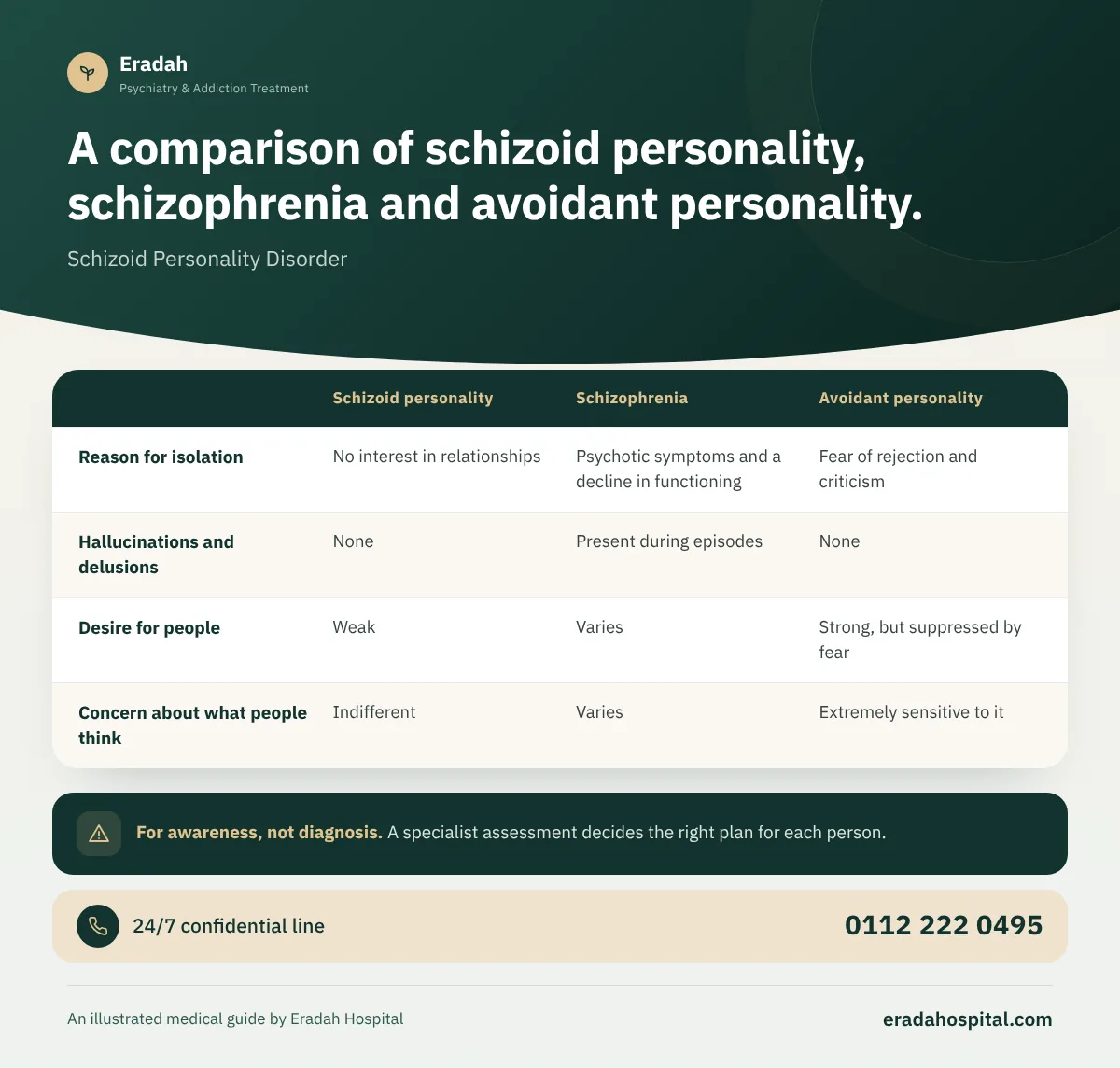
Schizoid Personality vs. Schizophrenia vs. Avoidant Personality
| Schizoid personality | Schizophrenia | Avoidant personality | |
|---|---|---|---|
| Reason for isolation | No interest in relationships | Psychotic symptoms and a decline in functioning | Fear of rejection and criticism |
| Hallucinations and delusions | None | Present during episodes | None |
| Desire for people | Weak | Varies | Strong, but suppressed by fear |
| Concern about what people think | Indifferent | Varies | Extremely sensitive to it |
Doctors also distinguish it from autism, since social difficulties and repetitive behaviors are less pronounced in schizoid personality disorder. It should not be confused with ordinary introversion either: an introvert loves and enjoys their close friends, while a person with schizoid personality finds no pleasure in closeness itself.
Causes of Schizoid Personality Disorder
There is no single cause. The MSD Manual notes that cold, neglectful or emotionally detached parenting in childhood may contribute, by teaching the child that relationships are unrewarding. Genetics may also play a role, as it is more common in the families of people with schizophrenia.
What Problems Are Linked to Schizoid Personality Disorder?
- Depression: the MSD Manual notes that up to half of patients have had at least one major depressive episode.
- Other co-occurring personality disorders, most commonly schizotypal, paranoid, borderline and avoidant.
- No support network in times of crisis or illness.
- Difficulties at work when it requires constant dealing with people.
Treatment of Schizoid Personality Disorder
The MSD Manual acknowledges that there are no controlled studies of psychotherapy or medication for this personality disorder. However, building a therapeutic relationship around impersonal topics that interest the patient, such as hobbies and collections, may open the door to treatment, and cognitive behavioral therapy focused on building social skills can help. The biggest challenge is that the patient may see no reason to change. Medication is prescribed by the doctor to treat accompanying depression or anxiety; never start or stop any medication without a doctor.
Tips for Families and When to Seek Help
Respect their need for space without pressuring them to be social, and share their interests rather than trying to pull them into gatherings. Seek a psychiatric assessment if signs of depression appear, if self-care declines sharply, or if there are strange ideas or hallucinations, because these may mean a different condition that needs urgent treatment. You can contact Eradah Psychiatric Hospital for an assessment, and you will find more guidance in the family support program.
A sudden change, or danger to themselves? Get help now
- Hallucinations, strange ideas or unusual suspicion that were not there before
- Severe neglect of eating, hygiene and self-care
- Deep sadness and withdrawal beyond the usual, with loss of all interest
- Talking about death or life having no meaning
A sudden change from their usual pattern may mean a different condition that needs urgent assessment. Do not leave them alone if they talk about death; ask calmly and listen without pressure or blame. Call an ambulance on 123 or take them to the nearest emergency room, or call the mental health support line on 16328 (24 hours).
Ambulance 123 Mental health support line 16328