What is paranoia?
“Everyone is talking about me,” “My phone is being monitored,” “My wife is putting something in my food.” When a person lives with thoughts like these, the world really does become a frightening place for them. Understanding what they are going through is the first step to helping, without becoming the “enemy” in their eyes yourself.
The UK charity Mind defines paranoia as the feeling that you are being harmed on purpose in some way, even though there is no evidence or very little. It stresses that paranoia can be a symptom of conditions such as schizophrenia, bipolar disorder and postpartum psychosis, that it is not a diagnosis in itself, and that it can also occur in people with no mental illness.
This pattern goes by several names in everyday speech and in books: paranoia, morbid suspicion, and suspiciousness. What they have in common is interpreting neutral situations as hostile, expecting betrayal, and feeling watched or targeted.
What is the difference between healthy caution and paranoia?
Caution is a protective feature; judging other people's intentions is hard even for the most level-headed, as researcher Daniel Freeman points out. But caution becomes paranoia when it loses its connection to the evidence:
| Point of comparison | Healthy caution | Paranoia |
|---|---|---|
| The basis | A clear event or piece of evidence | Far-fetched explanations or very weak evidence |
| With new information | Changes and settles | Becomes more entrenched; contrary evidence may be read as part of the plot |
| Scope | A specific person or situation | Spreads to relatives, neighbors, colleagues and unknown parties |
| Effect on thinking | Does not take over the day | Constant preoccupation, watching and checking |
| Relationships | Usually stable | Conflict, estrangement and growing isolation |
Is paranoia common?
More than people think. According to Freeman's review in The Lancet Psychiatry, paranoia exists to varying degrees in the general population, and the most severe form is persecutory delusions held with strong conviction. In an analysis of data from the British National Survey of Psychiatric Morbidity covering 8,580 people, the prevalence of different kinds of suspicious thoughts ranged from under 2% to about 30%.
The researchers found that these thoughts form a ladder: they start with oversensitivity in relationships, then mistrust, then “ideas of reference” such as feeling that people are talking about you, and finally outright persecutory thoughts, which only a small number of people reach. In other words, between the “normal person” and the “patient” there are many gradations, not a sharp dividing line.
What forms and degrees does paranoia take?
They appear under stress, with lack of sleep or in an unfamiliar place, and settle with rest. They do not necessarily mean illness.
A fixed pattern of mistrust, doubts about others' loyalty and holding grudges, beginning in early adulthood, without clear psychosis.
One fixed belief, such as persecution or a spouse's infidelity, while life seems normal in other respects.
Fixed persecutory beliefs that may be bizarre, often accompanied by hallucinations and disorganized thinking.
Suspicion, fear and a sense of being watched while using stimulants or cannabis, or during withdrawal.
It can be part of dementia, for example accusing family members of stealing things the person has misplaced.
Each of these forms has a different course and treatment, so it is not enough to say “he has paranoia”; we need to know which kind it is. You can read more about delusional disorder and personality disorders on their own pages.
What are the main symptoms of paranoia?
Symptoms revolve around doubting other people's intentions without sufficient reason, feeling watched or talked about, difficulty trusting even close people, and taking innocent jokes as insults, along with “safety” behaviors such as repeated checking and avoiding people. We cover these in detail, with signs for telling the different degrees apart, on the page Paranoia symptoms and signs.
What causes paranoia?
Paranoia rarely has a single cause. These are the causes and factors that recur in the medical literature:
- Psychotic and mood disorders: such as psychosis and schizophrenia, bipolar disorder during severe episodes, and psychotic depression.
- Personality disorders: chiefly paranoid personality disorder, which StatPearls describes as a pervasive pattern of mistrust and suspicion of others.
- Stimulants: Crystal meth (shabu) and cocaine are among the strongest triggers of suspicion and persecutory beliefs, and the effect may persist after stopping.
- Cannabis and synthetic cannabinoids: especially high-potency types and Strox.
- Lack of sleep: in the OASIS trial of 3,755 university students, treating insomnia reduced paranoid thoughts, supporting the view that insomnia is a causal factor and not merely a result.
- Stress, trauma and isolation: Mind notes that childhood difficulties, low self-esteem and isolation are factors linked to suspicious thoughts.
- Physical illness: such as dementia; the Alzheimer's Association notes that a person may become suspicious of those around them and accuse them of theft or infidelity.
Why does paranoia become entrenched over time?
Freeman describes persecutory thoughts as “threat beliefs” that arise on a genetic and environmental foundation and then sustain themselves through psychological processes, chiefly excessive worry, low self-confidence, jumping to conclusions and safety behaviors. These processes work as a vicious circle:
- 1A suspicious thought
“The neighbor looks at me in a strange way.”
- 2Worry and selective attention
The mind picks up everything that supports the thought and ignores what contradicts it.
- 3Safety behavior
Avoiding the neighbor, watching him, closing the windows and constant checking.
- 4No chance for correction
Avoidance prevents the person from discovering that the neighbor is ordinary, so the thought is never put to the test.
- 5Stronger conviction
“I knew it,” so the thought grows stronger and spreads to other people.
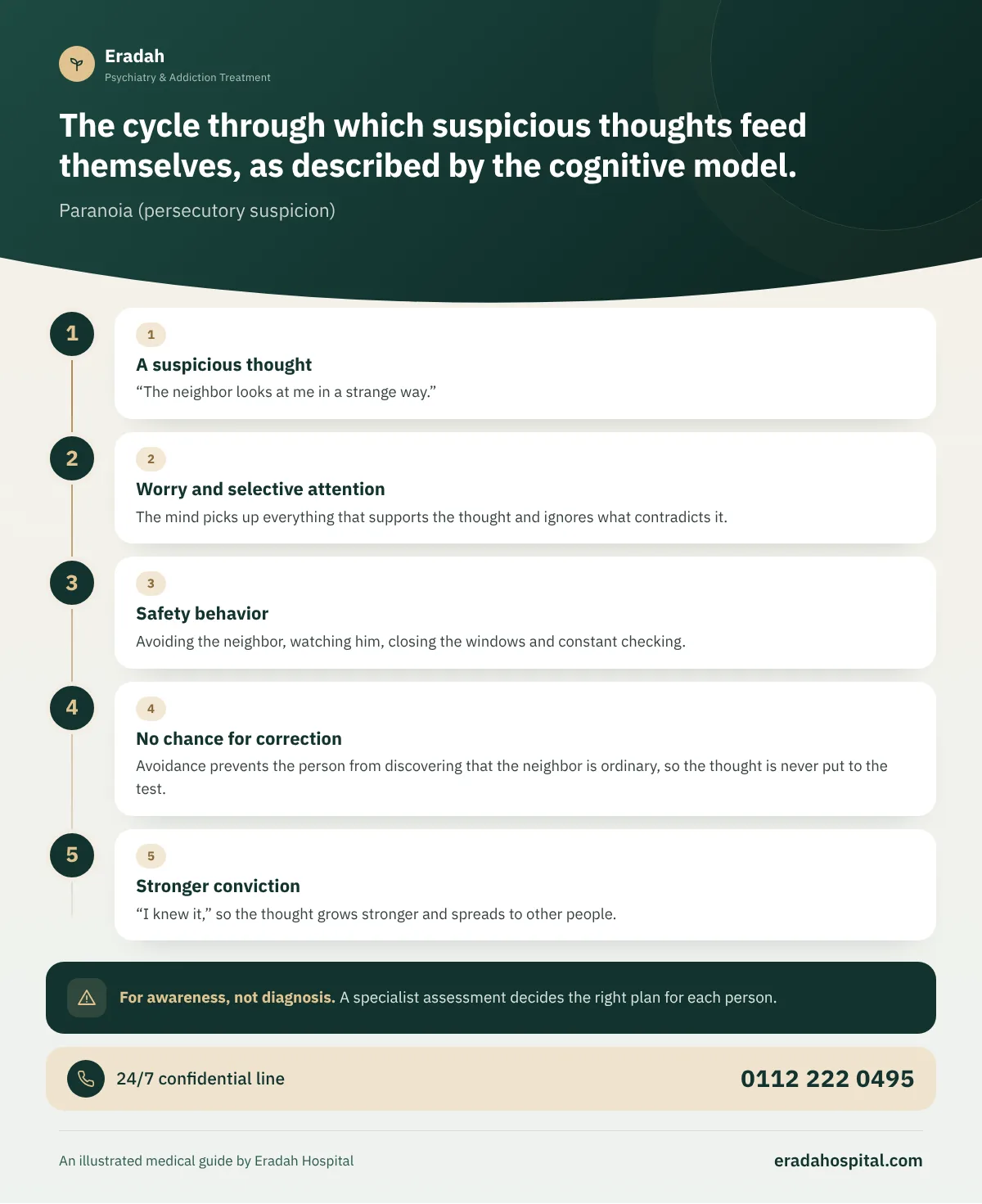
This is why Freeman sees the core of treatment as relearning a sense of safety: reducing the factors that feed the cycle, then gradually entering feared situations to test what actually happens.
What is the difference between paranoia, anxiety and schizophrenia?
Mind notes that paranoid thoughts usually focus on a specific threat or expected harm from other people, whereas anxiety may revolve around many different things such as health, money and the future. A person with generalized anxiety often knows that their fears are exaggerated. Schizophrenia, by contrast, is a broader illness of which paranoia may be one symptom, alongside hallucinations, disorganized thinking and negative symptoms. Paranoia alone does not mean schizophrenia, and schizophrenia does not necessarily involve paranoia.
Can paranoia be treated?
Yes, and treatment depends on the cause. In psychotic conditions, antipsychotics together with cognitive behavioral therapy form the basis of the plan; in paranoid personality disorder, long-term psychotherapy is the mainstay; and when drugs are the cause, stopping them safely is a condition for improvement. Treating insomnia and anxiety may also ease the suspicion itself. We explain these options, along with a practical guide to dealing with a suspicious person, on the page Paranoia treatment.
When does paranoia need urgent assessment?
- It appeared suddenly in someone who was not like this before, especially with hallucinations or confusion.
- It came after using stimulants or cannabis, or after stopping alcohol or sedatives.
- The person has started refusing food or medication for fear of being poisoned.
- The person talks about revenge or “defending himself” against a specific person.
- It appeared for the first time in an older person; it may be a sign of a physical illness or dementia.
Paranoia guide: everything you need to know
We have gathered everything about paranoia into 2 pages, each answering one question in detail. Choose what you are looking for:
Paranoia symptoms and signs
Learn about the symptoms of paranoia: the thoughts, feelings and behaviors, the signs of paranoid personality, and when paranoia is a sign of psychosis or an effect of drugs or dementia.
Paranoia treatment
How is paranoia treated? Cognitive behavioral therapy and the “feeling safe” program, the role of antipsychotics and of treating insomnia and addiction, and a practical guide to dealing with a suspicious person at home.
Is suspicion turning dangerous? Get help now
- Talk of “defending himself” against a specific person, or planning to confront them
- Refusing to eat or drink for fear of being poisoned
- Suspicion and persecutory beliefs that appeared suddenly with hallucinations or confusion, or after using stimulants
- Carrying a weapon or sharp object “for protection”
- Despair, or talk of death or self-harm
Stay calm; do not argue with his belief or threaten him. Give him space without cornering him, and quietly remove dangerous objects if you can, without confrontation. Do not stay alone with him in a closed space if he is angry. Call an ambulance on 123 or take him to the nearest emergency department, or call the mental health support line 16328 (24 hours) for advice, and tell the medical team about any substance he has used.
Ambulance 123 Mental health support line 16328