How does a generalized anxiety treatment plan begin?
The UK’s National Institute for Health and Care Excellence (NICE) guideline CG113 recommends a stepped care approach: the doctor starts with the simplest effective intervention, then moves up to more intensive treatment if that is not enough, depending on the severity of symptoms, their impact, and the patient’s preference.
| Step | What happens |
|---|---|
| 1 | Recognition and assessment of the condition, education about the nature of anxiety, and active monitoring |
| 2 | Low-intensity psychological interventions: guided self-help led by a professional, or psychoeducational groups |
| 3 | Intensive psychological therapy (CBT or applied relaxation) or medication, according to the patient’s choice after the options are explained |
| 4 | Complex or treatment-resistant cases: specialist assessment, combined treatment, and a more comprehensive plan |
Before any of this, the doctor rules out physical causes and substances that can trigger anxiety, and asks about depression and the use of sedatives or alcohol, because these change the plan.
What is cognitive behavioral therapy for anxiety?
CBT is the most studied psychological treatment for generalized anxiety disorder, and the NIMH describes it as the “gold standard.” It is a structured treatment delivered over a set number of weekly sessions, in which the patient learns to:
- Recognize “what if…?” thoughts and catastrophic thinking, and test how realistic they are.
- Modify the beliefs that keep anxiety going, such as “worrying protects me.”
- Gradually reduce reassurance-seeking and avoidance behaviors.
- Practice tolerating uncertainty instead of trying to control everything.
- Set aside a specific “worry time” and postpone worrying outside it, a practical technique many people find helpful.
NICE states that CBT and applied relaxation are usually delivered over about 12 to 15 weekly sessions. The NIMH also mentions acceptance and commitment therapy (ACT) as a useful option, which focuses on accepting thoughts without struggling with them and living by one’s values.
What is applied relaxation, and does it help?
Applied relaxation is a structured technique in which the patient learns to relax their muscles quickly, then applies this in everyday situations at the first signs of tension. It is one of the options recommended in the NICE guidelines for generalized anxiety, and it suits people whose anxiety is mainly felt as physical tension.
It differs from occasional “relaxation exercises” in that it is learned step by step with a specialist until it becomes an automatic skill.
What medications are used to treat generalized anxiety disorder?
The psychiatrist prescribes medication after assessment, choosing it according to the patient’s condition, other illnesses, and current medicines. We list the classes here for awareness only, without any doses:
| Category | Examples | Role and notes |
|---|---|---|
| SSRI antidepressants | Sertraline, escitalopram, paroxetine | Often the first choice; they take weeks to show their effect |
| SNRI antidepressants | Venlafaxine, duloxetine | An alternative or a first choice; they need monitoring of blood pressure and side effects |
| Pregabalin | Pregabalin | An option in some guidelines if the previous classes are not tolerated; it carries a potential for misuse |
| Buspirone | Buspirone | Not a sedative and does not cause dependence, but takes weeks to work |
| Benzodiazepines | Alprazolam, clonazepam, diazepam | Not recommended as a main treatment; only for a very short period in a crisis and at the doctor’s decision |
NICE also advises against prescribing antipsychotics for generalized anxiety in primary care. In the first weeks of antidepressants, a patient may notice temporary side effects such as nausea or increased tension; these call for follow-up with the doctor, not stopping the medicine on your own.
Why are sedatives not a long-term solution for anxiety?
Benzodiazepine sedatives relieve anxiety within a short time, which is why many people ask for them. But in 2020 the US Food and Drug Administration (FDA) added a boxed warning to this entire class because of the risks of misuse, addiction, physical dependence, and withdrawal symptoms, noting that dependence can occur even with prescribed use over days or weeks of continuous use.
They also do not teach the brain a new way of coping with anxiety, so the anxiety returns when their effect wears off, and it may even get worse. This is why NICE recommends against using them to treat generalized anxiety except as a short-term measure in a crisis. Read about Xanax and Rivotril.
How long does treatment for generalized anxiety disorder take?
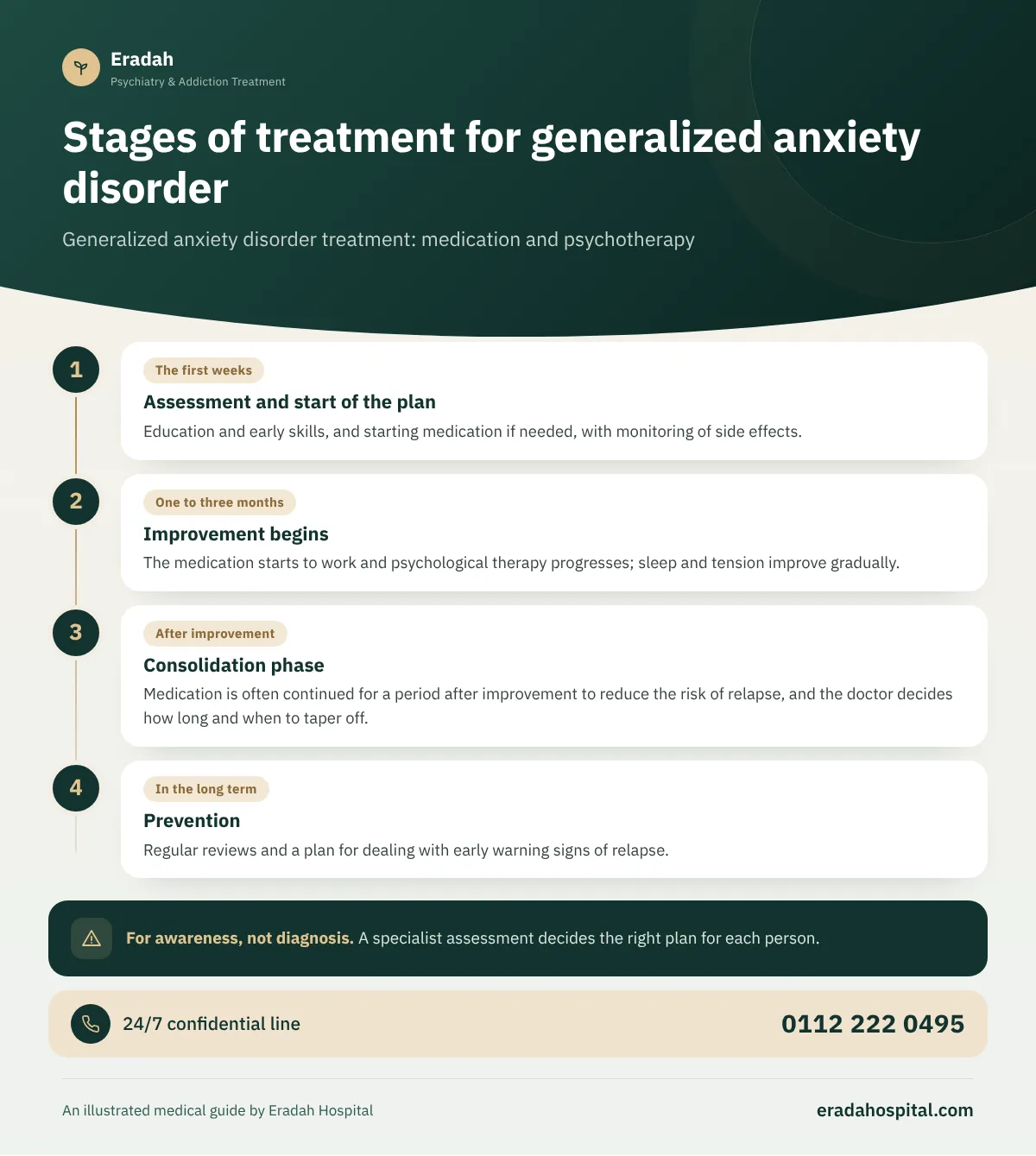
- The first weeksAssessment and start of the plan
Education and early skills, and starting medication if needed, with monitoring of side effects.
- One to three monthsImprovement begins
The medication starts to work and psychological therapy progresses; sleep and tension improve gradually.
- After improvementConsolidation phase
Medication is often continued for a period after improvement to reduce the risk of relapse, and the doctor decides how long and when to taper off.
- In the long termPrevention
Regular reviews and a plan for dealing with early warning signs of relapse.
The duration varies from person to person depending on severity, co-occurring conditions, and how consistently the person follows the treatment.
Does treating generalized anxiety disorder require hospital admission?
Most cases are treated in an outpatient clinic. Inpatient stay may be suggested when there is severe depression or thoughts of self-harm, when dependence on sedatives or alcohol is serious enough to need safe withdrawal under medical supervision, or when outpatient treatment has repeatedly failed.
What role does lifestyle play in treating anxiety?
Walking and regular exercise reduce physical tension and improve sleep.
Fixed times for going to bed and waking up, and less screen time at night.
Gradually reduce coffee and energy drinks, and avoid alcohol.
Skills that help with calming down; they complement treatment and do not replace it.
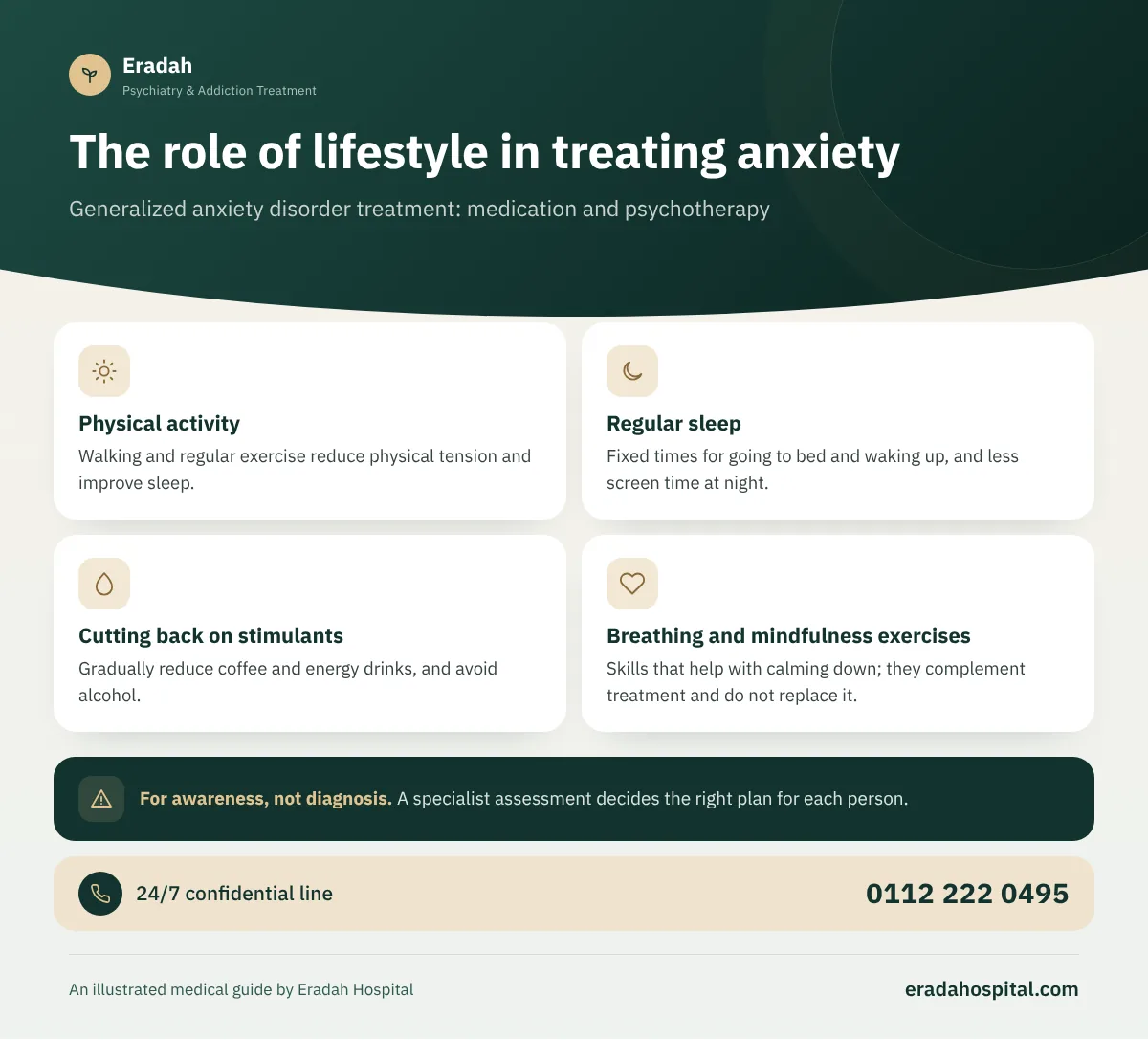
These habits support treatment, but they are not a substitute for it in moderate and severe cases.
How can you prevent anxiety from coming back, and how can the family help?
- Learn your early warning signs: insomnia, irritability, and a return of reassurance-seeking.
- Keep applying the skills you learned in therapy, even on good days.
- Do not stop your medication because you feel better; agree on the timing with your doctor.
- The family should encourage gradual facing of fears instead of giving endless reassurance.
- See the doctor early if symptoms return, rather than turning to a sedative from the pharmacy.
Choosing a hospital for treating generalized anxiety disorder
Most people with generalized anxiety disorder do not need a hospital bed; they need regular treatment in a clinic. So the more useful question when looking for a provider is not “where do I stay?” but “who will teach me to manage anxiety without leaving me dependent on a sedative?” The common risk in this condition is that a patient leaves the first visit with a prescription for a benzodiazepine or pregabalin that brings relief for a few weeks, and then the medicine itself becomes a second problem.
| Criterion | What to look for |
|---|---|
| Psychological therapy | A therapist who delivers CBT or applied relaxation with a clear number of sessions. |
| Medicine | A psychiatrist who explains why a medicine was chosen and for how long, and who avoids sedatives as a long-term solution. |
| Assessment | Screening for depression, sleep disorders, and any dependence on a sedative or alcohol before starting. |
| The role of the family | Guidance for the family on reducing repeated reassurance, which feeds anxiety. |
| Residential treatment | Suggested only for severe depression or a dependence that needs safe withdrawal. |
Eradah handles these cases mostly through the outpatient clinic under the supervision of Dr. Mahmoud El-Sawy, combining CBT sessions with a medication plan that the doctor monitors. If anxiety has turned into dependence on particular pills, see the link between anxiety and addiction. Call us at 01122220495 or message us on WhatsApp at any hour, or book your first appointment; the first consultation is free and its details stay with the doctor, and inpatient stay is available for men if the condition requires it.
Generalized anxiety treatment at Eradah
At Eradah, treatment begins with a comprehensive psychiatric assessment that includes screening for depression and the use of sedatives or other substances, followed by an individual plan that combines CBT with medication follow-up when needed, with the family involved. If there is dependence on sedatives, pregabalin, or alcohol, we treat the anxiety and the dependence together in one plan, in full confidentiality.