What are the physical symptoms of crystal meth use?
Physical symptoms usually appear because of intense stimulation of the body and a lack of sleep and food, and they become more obvious with repeated use:
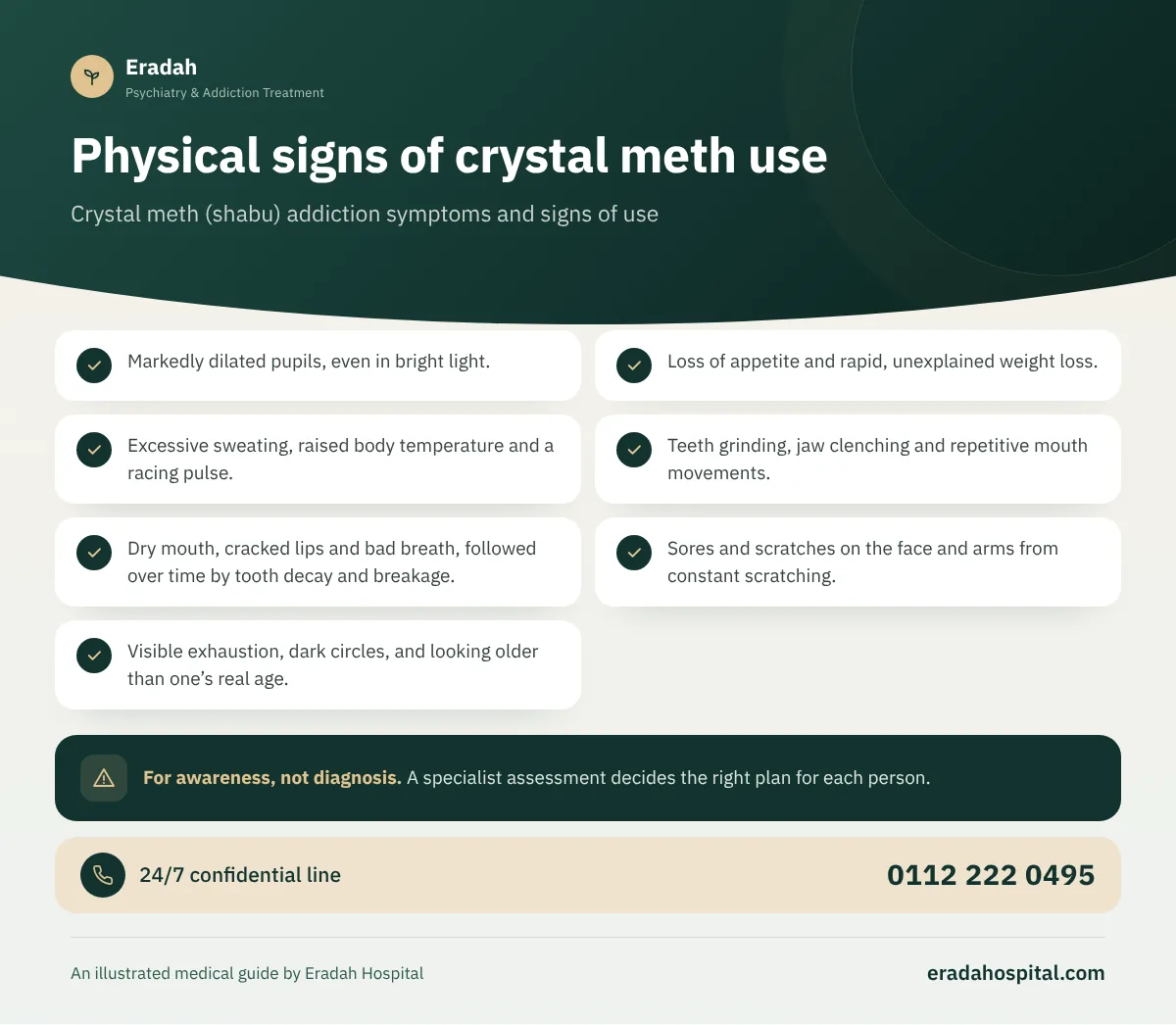
- Markedly dilated pupils, even in bright light.
- Loss of appetite and rapid, unexplained weight loss.
- Excessive sweating, raised body temperature and a racing pulse.
- Teeth grinding, jaw clenching and repetitive mouth movements.
- Dry mouth, cracked lips and bad breath, followed over time by tooth decay and breakage.
- Sores and scratches on the face and arms from constant scratching.
- Visible exhaustion, dark circles, and looking older than one’s real age.
What behavioral signs might the family notice?
Staying awake for a day or more without sleep, then sleeping very long hours and being hard to wake.
Fast, constant talking, nonstop movement, and repeating aimless actions such as taking devices apart or arranging things over and over.
Keeping the bedroom door closed for long periods, hiding the phone, and being repeatedly away from home without explanation.
Pulling away from old friends and joining a new circle the family does not know.
Constantly asking for money, valuables disappearing from the house, or unexplained debts.
Decline in school or work, frequent absences, and neglect of appearance and personal hygiene.
What are the psychological symptoms of crystal meth addiction?
Psychological symptoms set crystal meth apart from many other substances, and they may be the first thing the family notices:
- Suspicion and persecution: believing that someone is watching him, spying on his phone or plotting against him, and repeatedly looking out of the window.
- Hallucinations: hearing voices that are not there, seeing shadows, or feeling insects crawling under the skin.
- Irritability and aggression: outbursts of anger over small things, which can escalate to threats or violence.
- Mood swings: euphoria and excessive confidence while under the effect, then depression and emotional flatness as it wears off.
- Anxiety and panic attacks: constant tension and a feeling of danger for no clear reason.
- Poor concentration and memory: noticeable forgetfulness and difficulty finishing tasks.
What does a person under the influence of crystal meth look like?
| The situation | What you may notice |
|---|---|
| While under the effect | Dilated pupils, rapid speech, overactivity, not sleeping, not eating, sweating, exaggerated confidence or irritability and suspicion. |
| The crash after a binge | Very long sleep, sudden ravenous hunger, severe exhaustion, sadness and emotional flatness, quick irritability. |
| With months of continued use | Marked weight loss, tooth damage, skin sores, constant suspicion, isolation, and decline at work and school. |
This differs from withdrawal symptoms, which last days to weeks after complete cessation and are the subject of the page on crystal meth withdrawal symptoms.
Signs of crystal meth use in teenagers and students
In a teenager, signs of use can blend in with normal adolescent ups and downs, but some signals deserve attention if they occur together:
- A sudden drop in grades or frequent absences from school or university.
- Staying up until morning for several days, then sleeping for many hours during the day.
- Rapid weight loss with refusal to eat at home.
- New friends the family does not know, and refusal to talk about them.
- Repeated requests for money with different excuses, or selling personal belongings.
- Severe irritability or unjustified suspicion toward the family.
What might the family find?
The family may sometimes find unfamiliar items, such as very small bags with crystalline residue, small pieces of glass burnt at the ends, or many lighters with no known smoking habit. Finding such things calls for a calm conversation and a specialist’s advice, not a violent confrontation or an open search that destroys trust.
How is crystal meth addiction diagnosed medically?
Doctors rely on the DSM-5 diagnostic criteria for stimulant use disorder, which revolve around loss of control and continued use despite harm. In summary, the criteria are:
- Using larger amounts or for longer than the person intended.
- A persistent desire to stop, or failed attempts to cut down.
- Spending a lot of time obtaining the substance, using it or recovering from its effects.
- A strong, urgent craving to use.
- Failing to fulfill obligations at work, school or home.
- Continuing despite relationship problems caused by use.
- Giving up important activities or hobbies.
- Using in physically dangerous situations.
- Continuing despite knowing about the physical or psychological harm.
- Tolerance: needing more to get the same effect.
- Symptoms appearing on stopping, or using to avoid them.
Two or three of these within a year indicates a mild disorder, four or five a moderate disorder, and six or more a severe disorder. The international classification ICD-11 uses similar criteria. This list is for awareness only and does not replace a doctor’s assessment.
How do you tell crystal meth use from other substances or conditions?
| Substance or condition | Similarities | What often distinguishes crystal meth |
|---|---|---|
| Captagon and amphetamine | Staying awake, activity and low appetite | A stronger and longer effect, with psychosis and suspicion that appear more clearly and sooner |
| Cocaine | Activity and dilated pupils | Crystal meth lasts far longer, so spells of sleeplessness stretch for days |
| Hashish | Changes in mood and friends | Hashish mostly causes relaxation, hunger and red eyes, not sleeplessness and loss of appetite |
| A manic episode or first-episode psychosis | Overactivity, little sleep and suspicion | Symptoms tied to periods of absence, spending and physical signs; the doctor settles the question through assessment and testing |
Because symptoms can overlap, the doctor relies on the medical history, the examination and a drug test together. A test alone does not diagnose addiction; it only confirms use.
Myths about the signs of crystal meth use
| The myth | The truth |
|---|---|
| A person who uses it always looks thin and neglected | In the early stages he may look completely normal and keep up his job and appearance. |
| If he is active and productive, there is no problem | Overactivity and staying awake for days are among the most telling signs of stimulants themselves. |
| A negative test means no drug use | A test detects only recent use and does not rule out an intermittent pattern of use. |
How do you talk to someone you suspect is using crystal meth?
- Choose the timing: talk when he is calm and has slept and eaten, not while he is under the effect or crashing.
- Start with feelings: “I’m worried about you” works better than “You’re an addict.”
- Be specific: mention the behaviors you have noticed, without exaggeration or an open search.
- Do not argue with the suspicions: if he has persecutory thoughts, do not mock them or confirm them; acknowledge that he is afraid and reassure him.
- Protect yourself: if there is a history of violence, do not talk to him alone, and have the conversation in a safe place.
- Offer a solution: have information ready about a confidential consultation so the path to treatment is clear.
What should you do after noticing the signs?
Do not wait until the person “admits it” or hits rock bottom. The earlier an assessment begins, the less the harm and the better the chances of recovery. The family can start by requesting a consultation for themselves first to learn how to act, and then comes the turn of a suitable treatment plan.